As Venezuela's Maduro falls, Cubans and others in Florida are watching
Published in News & Features
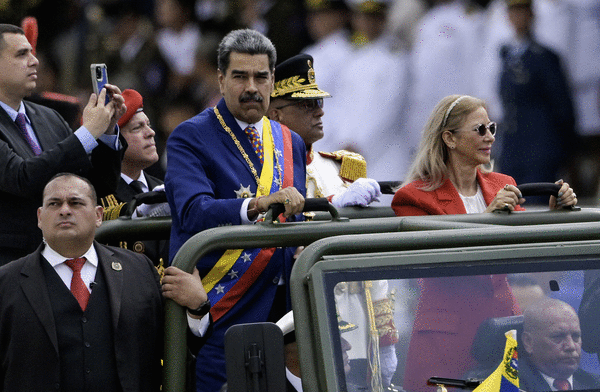
TAMPA, Fla. — The U.S. capture of Nicolás Maduro is being felt far beyond Venezuela.
In Florida, communities with ties to other authoritarian-led nations in Central and South America say the move to arrest Venezuela’s president could reshape immigration and regional stability.
Those like Jaime Arellano, who have firsthand experience with dictators, say they are feeling hopeful.
“In Latin America we have the three-headed viper, which is Venezuela, Cuba and Nicaragua,” said Arellano, 65, a former Nicaraguan political prisoner who was released in 2023 along with 221 others after negotiations between the Daniel Ortega regime and Washington. “Now I believe that one of its heads has been cut off, the main one, which was Maduro’s Venezuela. There is a new hope.”
Arellano, who lives in Hillsborough County, said it was important for the United States to treat the situation in Venezuela as a national security issue. He also said it could impact U.S. immigration policy and anyone seeking asylum from the region.
“Many of the political asylum processes for Venezuelans and Nicaraguans are frozen. Once the problem is resolved, many of us who dream of returning to our country will be able to do so,” Arellano said. “My dream is to return to Nicaragua, to die in Nicaragua, and to live what remains of my life in my country to help rebuild it.”
Florida is home to some of the largest Hispanic populations in the country, according to U.S. Census estimates. About 1.5 million Cubans, roughly 400,000 Venezuelans, more than 440,000 Colombians and around 170,000 Nicaraguans live in the state.
Guadalupe Tuñón, assistant professor of politics and international affairs at the Princeton School of Public and International Affairs, said that for Floridians who were once political prisoners, the capture of Maduro may matter less as a signal of immediate political opening and more as a source of increased pressure on regimes.
“There may be reasons for cautious attention rather than optimism: economic stress can shift regime behavior, but it does not guarantee liberalization,” Tuñón said.
The operation in Venezuela has prompted some Florida Republicans to suggest Cuba could be next.
“If I lived in Havana and I was in the government, I’d be concerned at least a little bit,” U.S. Secretary of State Marco Rubio said.
Wilfredo Cancio, a Cuban journalist and analyst who follows the island’s political and economic crisis from South Florida, said Cuba’s transformation will come under the weight of its own collapsed system.
“The Venezuela factor is a key element in accelerating that transformation,” said Cancio.
U.S. Rep. Carlos Giménez, the former Miami-Dade County mayor, said on X that “what President Trump did in Venezuela was to save American lives! His actions will have direct repercussions in our region, especially in Cuba, where many are finally beginning to see a light at the end of the tunnel!
But Cancio, the Cuban journalist, said he doesn’t see it that way.
“I don’t believe the United States will intervene in Cuba, as some exiles are predicting and hoping for at this crucial moment,” he said. “It would have a tremendously destabilizing effect, at a cost the United States would rather avoid.”
Roberto Pizano, a former Cuban political prisoner living in Tampa, said political shifts across Latin America show growing support for right-wing forces. Pizano, 87, was imprisoned for 18 years under the late Fidel Castro.
“I hope that will happen soon in Cuba, too, but we have to see” said Pizano. “Of course, there is still Mexico, Colombia and Brazil, but Latin American voters are saying enough to left-wing politicians.”
Pizano said a democratic transition in Venezuela and other countries that have long monopolized political power would be welcomed but not easy.
“It is a process because they have to break down the political structure in place and start rebuilding with democracy and laws,” Pizano said.
Colombian Juan Posada, 49, of Tampa, who served as a public information officer under former Colombian President Álvaro Uribe, said that if Venezuela stabilizes and puts in place a democratic government, “the regional impact would be positive,” especially by helping reorganize Venezuelan communities across South America.
Posada said it would ease migration pressure on countries such as Colombia and Perú that have received large numbers of people from this Latin American nation.
Last year, the Department of State added Colombia to a list of nations that have failed to cooperate on U.S. drug control efforts, alongside Venezuela, Nicaragua and México, among others.
Colombian President Gustavo Petro, a former guerilla member who was elected in 2022, has criticized the Trump administration over foreign policy, immigration and attacks on drug boats in the Caribbean.
Posada said Maduro’s departure is already raising concerns among other Latin American presidents, including Petro, Brazil’s Luiz Inácio Lula da Silva and México’s Claudia Sheinbaum.
“This can be seen as a new order,” Posada said. “Countries such as Argentina, Chile and Ecuador are already aligned with democratic values and liberty.”
In Florida, the impact of Maduro’s capture should be viewed with caution when it comes to the immigration issue and local communities from Venezuela, Cuba and Nicaragua, said José Daniel Ferrer, 55, a prominent Cuban dissident in Miami.
“Repressive structures are still in place, controls still exist on those countries. The work toward full democratization must be completed,” Ferrer said. “Only then should people return to their country. I would be among the first to return if the minimum necessary conditions were met.”
Some Venezuelans have begun to discuss what it would be like to go back to their home country — a move encouraged by the Trump administration.
U.S. Department of Homeland Security spokesperson Tricia McLaughlin told Fox News that it’s time for Venezuelans who were under temporary protections in the United States to return home. In 2025, the Trump administration revoked this status for about 600,000 Venezuelans.
“The great news for those who are here from Venezuela on temporary protected status is that now they can go home with hope for their country, a country that they love, that there is going to be peace, prosperity and stability,” McLaughlin said.
Carlos Bohorquez, 42, a Venezuelan immigrant in Tampa, said that for now, returning home is not an option. He said people in Venezuela are being arrested for going out to show support for Maduro’s capture. Temporary protections should remain in place, he said.
“How are you supposed to go back? How are you supposed to send people back to Venezuela under these conditions?” Bohorquez said. “It doesn’t make sense.”
©2026 Tampa Bay Times. Visit tampabay.com. Distributed by Tribune Content Agency, LLC.




Comments