State of the State: Idaho Gov. Brad Little calls for cuts but signals commitment to public ed
Published in News & Features
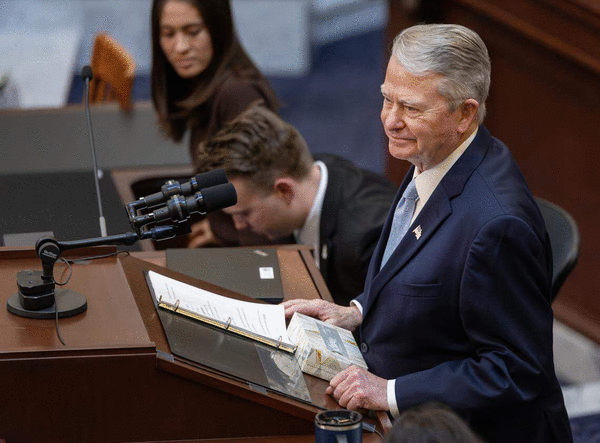
BOISE, Idaho — Gov. Brad Little called for the preservation of state funds for public education and vocational training in his annual State of the State address at the Idaho Capitol, even as he warned of spending cuts in a year of “budget pressures.”
Little’s speech launched the state’s 69th legislative session, and Idaho’s part-time lawmakers are now set to stay in session until at least late March. In his remarks, the two-term Republican governor celebrated the state’s strong economic position and alignment with President Donald Trump’s administration.
“For Idaho, the change from the last administration to having a Republican in the White House now is night and day,” he said in the text of his speech released beforehand. “Under Biden, Idaho was kept in the dark. Now, we have a real partner at the federal level.”
As Idaho lawmakers grapple with how to address a projected budget deficit of over $500 million in fiscal year 2027, Little on Monday proposed an approach to balance the budget — as required by the state’s constitution — that would focus on protecting programs “foundational to Idaho’s long-term prosperity,” he said.
He proposed a $5.6 billion budget for fiscal year 2027, just slightly under the $5.66 billion budget this fiscal year.
He called to leave spending for K-12 education and the Idaho Launch program untouched. Little started Launch, which gives grants to help high school graduates access higher education, in 2022 — but the program has since been highly scrutinized in the Idaho Legislature.
That program “really is the future” of the state, Lori Wolff, the governor’s budget director, told reporters.
To make up the difference, Little proposed extending 3% budget cuts he ordered almost every executive-branch agency to make in the current fiscal year, which he projected would save the state about $120 million.
In the budget proposal, Little called for the Idaho Department of Health and Welfare to maintain a 4% cut to its reimbursement rate for providers taking Medicaid patients — though he emphasized that he would not support the elimination of the state’s Medicaid expansion program, which provides health care coverage to about 90,000 lower-income Idaho residents.
Paula Lewis, 65, and Alison Reddy, 67, came to the Legislature on Monday to advocate for health care. Their red, hooded outfits, a nod to the dystopian book and TV show The Handmaid’s Tale, reflected their concern about women’s health, Lewis told the Statesman. The pair were handing out small sheets of paper emblazoned with the headline “Idaho Women Are At Risk.”
In the afternoon, hundreds of people crowded the Capitol Rotunda, holding signs with slogans like “Medicaid Unites” or “People Before Cuts,” a sign of a fight ahead as lawmakers face down budget decisions.
Little proposed to hold state employee pay flat for fiscal year 2027, which starts July 1, though the state would not increase employees’ health insurance premiums even as its own cost has increased about 15%. And he called to eliminate funding for over 100 state jobs that have been unfilled for six months or more, which he predicted would save the state about $20 million.
These and other proposed cuts would offer a path to a balanced budget without dipping into the state’s “rainy day” funds, and they would allow the state to conform with tax breaks offered in federal tax code. Little assessed that tax conformance would cost the state $155 million in lost revenue — but he has made it a priority regardless.
“The Trump tax cuts will help Idaho compete for jobs and investment, and they will preserve the core principles I have long advocated for in Idaho’s tax system — simple, fair, predictable, and competitive,” he said.
Idaho typically aligns its state tax code closely with the federal one, but doing so this year could cost the state hundreds of millions of dollars of lost revenue at a time when it can’t take the hit, an Idaho think tank warned in November.
The governor’s largest proposed cuts include $275 million to a fund for state and local projects and $100 million in budget-stabilization, water-quality and other funds. The $100 million is interest earnings that normally would have stayed in those funds to support their future spending.
Does that mean the state will have to go through another round of cuts next year?
Hopefully not, Wolff said. “We’re betting on Idaho’s economy.”
_____
©2026 Idaho Statesman. Visit at idahostatesman.com. Distributed by Tribune Content Agency, LLC.






Comments