Supreme Court questions curtailing of birthright citizenship
Published in News & Features
WASHINGTON — A majority of the Supreme Court expressed hostility Wednesday to President Donald Trump’s executive order that seeks to restrict birthright citizenship, even as he became the first sitting president in the modern era to attend oral arguments.
An attorney for the U.S. urged the justices to overturn multiple lower court rulings against the executive order, which would disallow citizenship for children born in the United States to undocumented immigrant parents or those with temporary legal status.
While some of the court’s six-member conservative bloc asked questions that appeared friendly to the administration, most pressed Solicitor General John Sauer to answer for reinterpreting a long-held understanding that those born in the U.S. become citizens.
Chief Justice John G. Roberts Jr. pushed Sauer to explain why the court should allow the traditional exceptions to birthright citizenship, such as children of diplomats, to cover millions of undocumented immigrants.
“I’m not quite sure how you can get to that big group from such tiny and sort of idiosyncratic examples,” Roberts said.
Sauer responded that the authors of the 14th Amendment, which includes the language that all people born in the U.S. and “subject to the jurisdiction thereof” are eligible to be citizens, meant to exclude people born without permanent legal ties to the country.
Sauer argued that the “subject to the jurisdiction” language was meant to exclude “temporary sojourners” and those who could not legally live in the country permanently.
Later in the arguments, Sauer said that the U.S. is now in a “new world” where the entire population is one plane ride away from having U.S. citizen children, and the current U.S. policy encourages an industry of birth tourism.
Roberts responded: “Well, it’s a new world. It’s the same Constitution.”
Sauer argued that for years the U.S. government only granted citizenship to those who established permanent legal residence in the country, including after an 1898 decision by the justices in a case called Wong Kim Ark that granted citizenship to a man born in the U.S. to Chinese parents.
Justice Neil M. Gorsuch questioned that, saying the lead author of a dissent in that case understood the decision to be granting citizenship to anyone born in the country.
Sauer received friendlier questions from some members of the bench. Justice Samuel A. Alito Jr. said the justices could take the language of the 14th Amendment to allow it to address future political problems, such as using an older theft statute to prosecute the theft of a microwave oven.
“There’s a general rule there, and you apply it to future applications. And what we’re dealing with here is something that was basically unknown at the time when the 14th Amendment was adopted, which is illegal immigration. So how do we deal with that situation when we have a general rule?” Alito said.
Justice Sonia Sotomayor pointed out that the administration asked the court to only have the ruling apply going forward, but the government’s reasoning in the case could be used to reach back and strip citizenship from people who were already born in the country and considered citizens.
“This president, or the next president, or a Congress, or someone else, could decide that it shouldn’t be prospective. There would be nothing limiting that,” Sotomayor said.
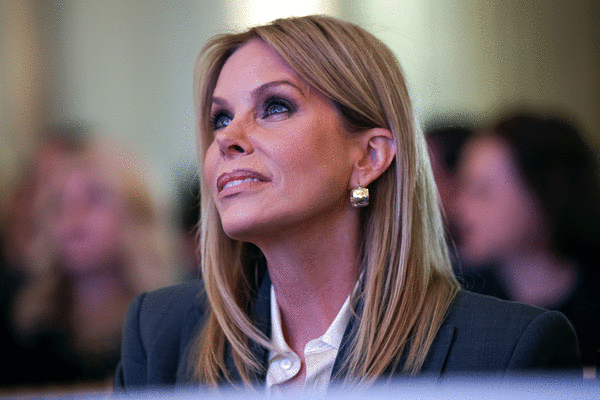
Cecillia Wang, the national legal director of the ACLU who argued on behalf of the states, families and other groups who challenged Trump’s order, argued that the 14th Amendment enshrined birthright citizenship in American law with a “closed set” of exceptions.
Those exceptions were the children of diplomats, Native Americans on reservations and those born in areas subject to an invading army, she said.
Congress could expand the definitions, such as when it passed a law expanding citizenship to Native Americans, “but they can’t go below that floor that the Constitution sets,” Wang said.
However, Wang faced questions from Roberts as well as Alito about whether language in the Wong Kim Ark case that focuses on the parents’ “domicile” in the United States should be considered pivotal in deciding Wong Kim Ark’s citizenship.
Wang argued that the justices could have included the “domicile” language for several reasons, including that Wong Kim Ark’s parents could not legally become naturalized citizens at the time, and the justices should follow underlying rule about birthright citizenship in the opinion.
Justice Brett M. Kavanaugh pointed out that the justices could agree that the Trump administration has the incorrect interpretation of the Wong Kim Ark case and write a “short opinion” to dispense with the Trump effort.
Kavanaugh also pointed out the justices could decide the case based on Congress’ passage of laws in 1940 and 1952 that established birthright citizenship and avoid the constitutional issues of the 14th Amendment.
Trump signed the executive order to change birthright citizenship on his first day of his second term, seeking to exclude children born to undocumented parents and those with temporary legal status. The order was soon challenged by states, expectant parents and civil rights groups, then temporarily blocked by multiple federal judges.
Trump also attended the oral arguments, a first for a sitting president in the modern era. He previously publicly mulled attending the oral arguments over the legality of his worldwide tariff regime under the International Emergency Economic Powers Act.
After the Supreme Court ruled against him in that case, he has taken to publicly criticizing the justices, suggesting they were tools of foreign interests and similar claims.
The justices are likely to issue a decision in the case before the close of the court’s term at the end of June, in a major test of the institution foreshadowed by Trump’s own attendance at the arguments Wednesday. Experts said the case could confine Congress’ power to define who is considered part of the nation.
The case is Barbara v. Trump.
©2026 CQ-Roll Call, Inc., All Rights Reserved. Visit cqrollcall.com. Distributed by Tribune Content Agency, LLC.






Comments