Coach houses now legal in much of Chicago as Mayor Brandon Johnson touts housing efforts
Published in News & Features
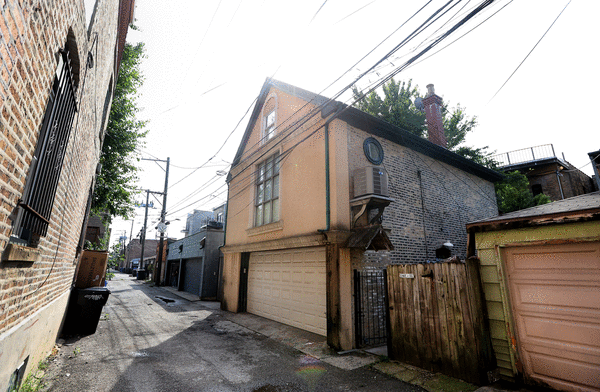
CHICAGO — Many Chicago building owners finally got the green light this week to build coach houses and “granny flats” on their properties, though a split ward-by-ward legalization means lots of Chicagoans will not have the option.
After a bitter City Council fight last year, 34 aldermen opted to allow additional dwelling unit construction in parts of their ward zoned for single-family homes. Another 16 aldermen did not.
The piecemeal approval means homeowners in many parts of the city — particularly the far Northwest Side, Southwest Side and South Side — still cannot legally build the units.
Aldermen opposed to the change argued the added units would mean too much density and take away their say in what construction gets approved. They fiercely fought a plan backed by Mayor Brandon Johnson to legalize the units across the entire city, forcing Johnson to compromise by allowing individual wards to be cut out of the legalization.
But Johnson nonetheless touted the kick-off Wednesday as a critical step to “cut the red tape which inhibits construction” and foster affordability.
“As we work to expand housing availability throughout our city, it’s crucial we don’t limit our ability to establish accessible options which serve an array of unique housing needs,” he said in a statement.
The units, banned by Chicago zoning requirements since 1957, already exist in much of the city: some illegal, some grandfathered in, others built during an ongoing pilot program launched in 2021.
Johnson’s ordinance also permitted them by right in areas across the city zoned for multi-unit residences and some business and commercial districts.
Proponents say the units will allow homeowners and developers to gently add much-needed housing stock without dramatically altering neighborhoods. But many aldermen representing outlying wards filled with single-family homes argued that increasing the population density in their neighborhoods would only make them worse.
Ald. Marty Quinn, who represents the Southwest Side 13th Ward, led the successful effort to give aldermen the power to opt into the ordinance or not. He said in the fall that such units threatened to “erode the fabric of these beautiful neighborhoods.” An influx of new residents would add noise, stretch understaffed police and overcrowd schools, he said.
“Those quality-of-life issues will be accelerated if this is allowed to happen,” Quinn said. “For the mayor to think he knows best about what the needs are on the Southwest Side, it’s not accurate.”
In many areas where the units were legalized, aldermen added caveats. Some decided to limit the number of new units allowed annually per block, while others included owner occupancy requirements or $500 administrative adjustment applications to the city.
Wrigleyville Ald. Bennett Lawson, who backed Johnson’s plan and helped broker the compromise deal while serving as interim Zoning Committee chair, said the new units will create “naturally-occurring affordable housing” that gives homeowners profit.
“Now, Chicagoans have the opportunity to build and be part of the solution, and I look forward to seeing residents across the city take advantage of this bold initiative to address our housing crisis,” he said in a statement.
Johnson also announced this week that over 600 vacant city lots are being put up for sale, part of an ongoing effort to reduce blight in neighborhoods and add more housing.
The lots span 25 wards and are valued at $34 million, his administration said in a statement. Around 500 are being sold at market rates, while 55 are earmarked for affordable housing projects and another 66 for green spaces.
The sale includes 30 parcels in West Englewood and South Chicago being sold as a part of the city’s “Missing Middle” program. The effort to spur housing development sells lots for $1 each in batches to developers who can get up to $150,000 in construction assistance.
Ciere Boatright, Johnson’s Department of Planning and Development commissioner, said the up-for-grabs inventory is the largest since the vacant lot sale program began in 2022.
“These parcels offer unique opportunities for buyers to take ownership of their neighborhoods and contribute to local development goals,” Boatright said in a statement.
Johnson also announced Wednesday that the city would spend around $300 million to assist in the construction of 15 affordable housing developments that together are expected to create 1,223 units.
The construction will be financed in part by $16 million in federal low-income housing tax credits, plus $100 million in private equity tied to the use of the federal money, according to Johnson’s administration.
“Each unit we build empowers families to plant their roots in our city while increasing the ability for long-time residents to stay in their communities,” Johnson said in a statement.
____
©2026 Chicago Tribune. Visit at chicagotribune.com. Distributed by Tribune Content Agency, LLC.





Comments