NYC Mayor Zohran Mamdani vetoing controversial school security buffer zone bill
Published in News & Features
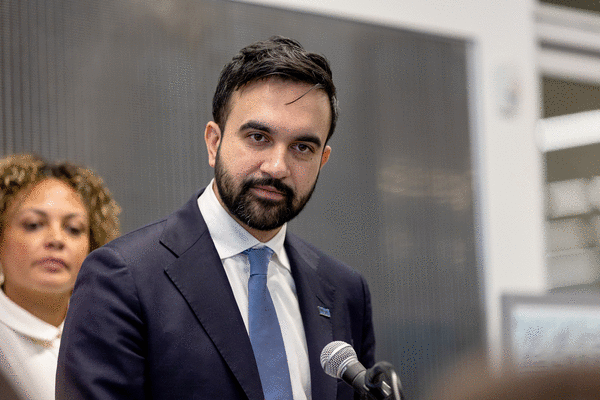
NEW YORK — Mayor Zohran Mamdani said Friday he is vetoing a controversial bill that would have enabled the NYPD to set up “buffer zones” around schools and universities during protests.
Mamdani said he was letting a corresponding bill, which will similarly authorize police to plan for security perimeters around houses of worship, go into law.
In a statement announcing his intent to veto the education-related bill, Mamdani raised concerns about what he sees as the broad scope of the legislation, which could be applied to any building where learning takes place — from schools to museums and teaching hospitals.
“This could impact workers protesting ICE, or college students demanding their school divest from fossil fuels or demonstrating in support of Palestinian rights,” Mamdani said.
“(The bill) is not a narrow public safety measure,” he continued. “It is a piece of legislation that has alarmed much of the labor movement, reproductive rights groups, and immigration advocates, among others, across this City.”
City Council Speaker Julie Menin, D-Manhattan, who sponsored the bill on houses of worship, in a statement said the schools-related legislation should not be seen as “controversial.”
“Ensuring students can enter and exit their schools without fear of harassment or intimidation should not be controversial,” Menin said. “This bill simply requires the NYPD to clearly outline how it will ensure safe access when there are threats of obstruction or physical injury, while fully protecting First Amendment rights.”
The Council can hold another vote in an attempt to override Mamdani’s veto or let it stand. Menin said Friday afternoon that she would be speaking to council colleagues about paths to a potential override.
“Ultimately [it will] be up to my colleagues in terms of the next steps,” she said.
The schools bill, sponsored by Councilman Eric Dinowitz, D-Bronx, passed the legislative body just four votes short of a veto-proof majority, 30-19, last month.
“The legislation requires the NYPD, which is wholly under the power of the Mayor, to plan for addressing interference, intimidation, and harassment,” Dinowitz said in a statement. “The untrue claim that this bill infringes on free speech or is constitutionally unsound is not supported by the text.”
Dinowitz, who’s also the Council’s education committee chair, said the veto amounted to “the Mayor turn(ing) his back on student safety.”
Mamdani’s veto, the first of his mayoralty, comes after multiple unions — including United Auto Workers Region 9, Teamsters 804 and SEIU-CIR — penned a letter with the local chapter of the Democratic Socialists of America urging the mayor to veto the bill, calling it an overreach that could impact labor organizing, the Daily News first reported. Civil liberties groups, such as the New York Civil Liberties Union and Legal Aid Society, also called for Mamdani to block the bill from becoming law on free speech grounds.
“At a time when New Yorkers are taking to the streets in historic numbers to defend our hard-won freedoms and resist the Trump regime — as we must — the City should be looking to support, not stifle, our right to speak out,” NYCLU Executive Director Donna Lieberman said in a statement.
“We’re glad the Mayor takes free speech seriously and honors our city’s long legacy of activism.”
On the buffer zone bill related to houses of worship, Mamdani said he disagreed “with its framing of all protest as a security concern.” The mayor will let the legislation lapse into law, but will not sign it.
That bill, which had been scaled-back since an earlier version would have established a 100-foot security perimeter around synagogues and other religious institutions, passed the Council last month with a veto-proof majority.
“Following a thorough legal review, I do not believe it poses the same risks it once did, and that is why I will allow it to become law,” Mamdani said.
The push for legislative action was sparked by a protest outside Park East Synagogue on the Upper East Side in November. Amid sharp criticism over what some saw as an inadequate NYPD response, Menin vowed to pass a bill requiring the buffer zones.
The protest was opposing a fair held at the synagogue by Nefesh B’Nefesh, a nonprofit organization that helps Jews move to Israel and to the occupied West Bank.
Similar efforts to establish buffer zones to restrict protests near houses of worship are ongoing on the state and federal levels, led by Gov. Kathy Hochul and U.S. Rep Tom Suozzi. Hochul’s measure, included in her budget proposal that is currently being debated in Albany, would also apply to abortion clinics.
“Measures like these importantly safeguard institutions against real and growing threats while maintaining people’s right to protest,” a coalition of Jewish groups, including the UJA-Federation of New York and ADL New York/New Jersey, wrote in a statement.
“Actions speak louder than words. This veto is a profound failure of City Hall to demonstrate to all New Yorkers that our safety is a priority.”
©2026 New York Daily News. Visit at nydailynews.com. Distributed by Tribune Content Agency, LLC.




Comments