Kennedy Space Center gets its hands on biggest Artemis III puzzle piece
Published in News & Features
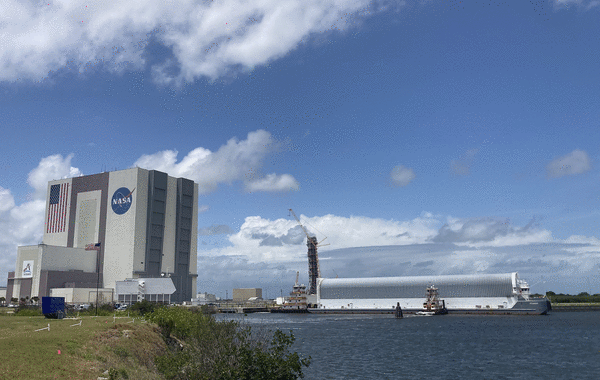
CAPE CANAVERAL, Fla. — A massive piece of NASA’s Artemis project floated into the Space Coast on Monday with the arrival of the biggest portion of the Space Launch System rocket for next year’s Artemis III mission.
The top four-fifths of what will be a 212-foot-tall core stage arrived to KSC’s Turn Basin after making a 900-mile trip laying horizontally on NASA’s Pegasus barge, which picked up the hardware from the Michoud Assembly Building in New Orleans last week. The arriving segments include the liquid hydrogen tank, liquid oxygen tank, intertank and forward skirt.
The bottom engine portion of the core stage arrived to KSC last summer and has been awaiting its sibling pieces that will add to the puzzle for NASA’s next crewed launch of the SLS.
Artemis III won’t be heading toward the moon, though, like the lunar flyby of Artemis II that launched April 1 from KSC. Instead, Artemis III will fly a crew of four to a near-Earth orbit with the goal of docking with one or both of two lunar landers in development by SpaceX and Blue Origin.
NASA Administrator Jared Isaacman, who announced earlier this year a revamp of the Artemis mission plan, said a near-Earth mission first in 2027, buys down risk for the follow-on mission, Artemis IV aiming for early 2028, which aims to return humans to the lunar surface for the first time since Apollo 17 in 1972.
Isaacman pointed out it took 3 1/2 years between the uncrewed launch of Artemis I in 2022 and this month’s Artemis II. NASA’s original plan was for Artemis III to shoot right for the moon landing.
“That is not a good cadence for that rocket that is a very complicated rocket,” he said. “Five prime contractors, I don’t know how many subcontractors on it, decades old design hardware that people aren’t as familiar with. You need muscle memory to do that. So our proposal coming out of it is, let’s get back in the business of launching moon rockets with frequency.”
He warned that the original plan likely would have meant another 3 1/2 years before a moon landing attempt.
Instead, he said keeping Artemis III close to Earth follows the playbook from the Apollo missions. Apollo 8 flew around the moon, but Apollo 9 stayed close before the Apollo 10 lunar flyby and eventual Apollo 11 first moon landing.
“So we’re borrowing from the playbook that worked for us in the 1960s, not jumping right from Artemis II around the moon, waiting 3 1/2 years to land on it, launch again. Rebuild muscle memory in 2027, test the interoperability of the Orion spacecraft and the landers in low-Earth orbit, where, if something goes wrong, you’re not all the way out there, 250,000 miles away. You’re just a couple hours from being in the water. Learn from that and then get incredibly good rebuild core competencies. So we can turn that launch pad, not in years, but months.”
Already, the mobile launcher used on Artemis II, has been rolled back to the Vehicle Assembly Building and is undergoing repairs. But NASA has said damage was not nearly as dire as what was experienced after Artemis I. That’s because of efforts made to harden the mobile launcher to the power created by the 8.8 million pounds of thrust by the SLS rocket on launch.
With the rest of the core stage’s arrival, NASA will soon bring the rest of the pieces needed to stack the rocket topped once again by the Orion spacecraft.
Headed to KSC still are all of the segments for the two solid rocket boosters and by July the four former Space Shuttle Program engines will make their way from Stennis Space Center in Mississippi.
The Orion spacecraft crew and service modules are already at KSC, as is a new heat shield, so they have some work to do getting put together and likely won’t be ready for stacking until next year.
_____
©2026 Orlando Sentinel. Visit orlandosentinel.com. Distributed by Tribune Content Agency, LLC.






Comments