White House to review presidential security after WHCA attack
Published in News & Features
WASHINGTON — The White House is reviewing security protocols for presidential events following Saturday’s shooting at the White House Correspondents’ Association Dinner, as officials weigh whether changes are needed to protect President Donald Trump.
Senior Homeland Security, Secret Service and White House operations officials will meet this week in a session led by chief of staff Susie Wiles, according to press secretary Karoline Leavitt. The review will examine the agency’s protective posture and whether adjustments are warranted after the incident at the Washington Hilton.
“If adjustments need to be made to protect the president, they will be made,” Leavitt said Monday during a press briefing. She added that Trump “continues to have trust in the United States Secret Service” and was “satisfied with the response” to the shooting.
Some top officials have criticized security measures at the annual dinner, which is traditionally attended by thousands of people, including the president, vice president and senior Cabinet leaders. Saturday was Trump’s first appearance at the dinner as president.
U.S. House Speaker Mike Johnson said Monday that leadership at the Secret Service needs to “tighten up.” Security at the event seemed a “little lax,” he told Fox News.
Saturday’s incident marked the latest example of political violence in the U.S., including the Jan. 6, 2021, attack on the U.S. Capitol, the assassination of conservative activist Charlie Kirk and the Pennsylvania governor’s mansion being set ablaze. Trump has been the subject of prior assassination attempts, including at a Pennsylvania rally in 2024, in which his ear was grazed by a bullet.
The latest attack has raised questions about how close a potential attacker could get to the president and exposed vulnerabilities in how the dinner is secured.
The review this week is expected to focus on how the Secret Service can mitigate those risks, including whether additional screening layers or tighter control of surrounding spaces are feasible at large public venues. Officials are also expected to examine the balance between maintaining public accessibility and ensuring security, a tension that has defined presidential protection in civilian settings for decades.
The participants are slated to discuss the processes and procedures that led to the apprehension of the gunman, whom authorities have accused of targeting Trump administration officials, and explore additional options to ensure everything possible is done to secure major presidential events.
Trump had to be rushed from the stage by Secret Service agents amid the incident and the dinner was eventually postponed. The armed assailant ran past a security checkpoint before being apprehended after a brief pursuit that included gunfire. A Secret Service agent was shot but is expected to recover after the round hit his bulletproof vest.
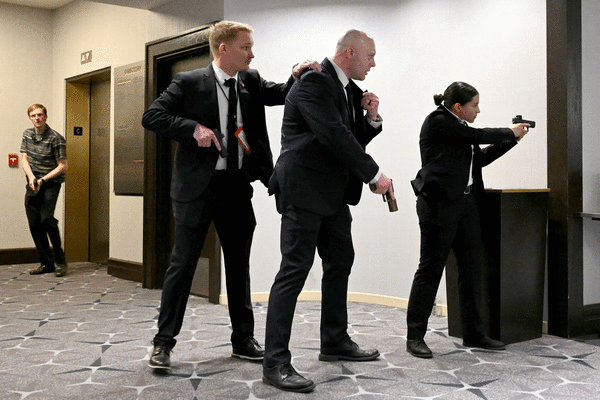
The meeting comes as new details emerge about the Secret Service’s response, including the use of agents embedded throughout the ballroom in covert roles posing as guests and staff, according to a person familiar with the operation. Those personnel, along with pre-positioned teams and a rehearsed evacuation plan, allowed agents to move Trump from the room within seconds of shots being fired.
Agents conducted advance walkthroughs of the site, mapped evacuation routes and staged personnel across the venue, including plainclothes officers positioned to blend into the crowd, the person said.
Trump alluded to that presence during a press conference after the dinner. “We had resources sitting at tables, literally in disguise, sitting maybe at your table,” he said. “We had people all over the room.”
When the shooting began, agents moved the president along a preplanned evacuation route based on the suspect’s position, according to Anthony Guglielmi, the agency’s chief of communications. While the response can appear chaotic, it’s based on detailed advance work, he said.
“They really leave no inch unaccounted for at the presidential level,” said Guglielmi.
Members of the Counter Assault Team, the Secret Service’s heavily armed tactical unit, secured the ballroom after the president was evacuated, taking elevated positions and maintaining sight lines across the room. As agents move a protectee through a crowd, they form what is known as a body bunker, a mobile shield designed to absorb a threat.
The operation also highlighted the limits the Secret Service faces in civilian venues. The Washington Hilton, with more than 1,100 rooms and expansive public space, remained open to guests during the event. Security was concentrated around the ballroom, where a single magnetometer checkpoint controlled entry, while the rest of the hotel continued normal operations.
Investigators believe the suspected gunman had been staying at the hotel for days before the attack, moving through the building without restriction, according to a person familiar with the matter.
That constraint is a recurring challenge for the Secret Service. When the president appears in public settings, agents cannot fully control the surrounding environment. Hotels cannot be completely screened, and adjacent rooms cannot be vetted. The same limitations apply overseas, where buildings overlooking motorcade routes cannot be secured in the same way as government facilities.
The Washington Hilton has long posed such challenges. The hotel was the site of the 1981 shooting of Ronald Reagan, after which security procedures were overhauled and a secure presidential entrance was added. Even so, its scale and public access complicate efforts to fully lock down the property.
_____
(With assistance from Caitlin Reilly, Catherine Lucey and Courtney Subramanian.)
_____
©2026 Bloomberg L.P. Visit bloomberg.com. Distributed by Tribune Content Agency, LLC.




Comments