In South Florida, opposition leader Juan Pablo Guanipa calls for pressure on Caracas regime
Published in News & Features
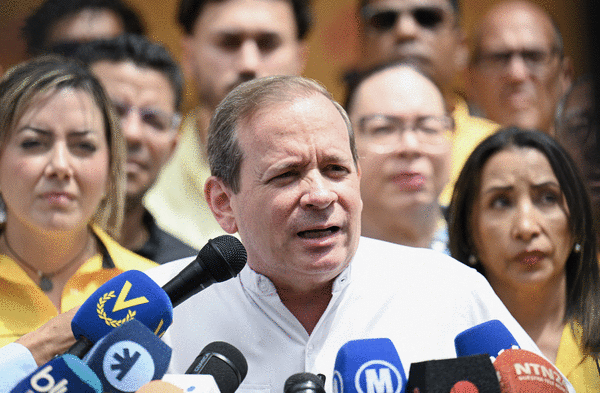
MIAMI — Venezuelan opposition leader Juan Pablo Guanipa delivered a forceful call to action Friday before members of South Florida’s exiled community, urging them to intensify pressure on Caracas while warning that the country’s political crisis remains far from resolved.
Speaking at an event held at the Aloft Hotel in Doral, a hub for Venezuelan diaspora activism, Guanipa painted a bleak picture of conditions inside Venezuela and sharply criticized the country’s current leadership, accusing those in power of clinging to control despite widespread rejection.
“Those who govern today have no intention of recognizing the country’s reality,” Guanipa said. “They don’t care — they only care about power.”
The opposition figure — a close ally of opposition leader and Nobel Peace Prize laureate María Corina Machado — reserved some of his harshest criticism for interim leader Delcy Rodríguez, accusing her of attempting to rewrite her political past.
“Delcy Rodríguez wants to make us believe she was born on January 4, 2026 — that she’s just crawling, that she doesn’t know who Chávez or Maduro were,” Guanipa said. “That she has nothing to do with any of it… and now she dresses in blue and asks for forgiveness.”
He dismissed that narrative as detached from reality. “Obviously, we know that is not the truth of what Venezuela is living,” he added.
His remarks come at a pivotal moment in Venezuela’s ongoing political transition following the January capture of Nicolás Maduro by U.S. forces, a development that has reshaped the country’s power structure but left deep uncertainty about its future direction.
Following Maduro’s capture, Venezuela has entered a volatile and highly managed political transition, one shaped as much by Washington as by internal dynamics. Rodríguez’s rise to interim leadership has signaled continuity in key areas of state control, even as her government adopts a more pragmatic tone toward the United States.
The shift has opened the door to renewed diplomatic engagement, financial easing and a gradual reintegration into global markets — particularly in the oil sector — but has also raised questions about whether meaningful democratic reforms are being sidelined in favor of stability and economic normalization.
Guanipa warned attendees not to assume that recent changes mean the crisis has been resolved.
“No one should believe that everything was fixed on January 3,” he said, emphasizing that Venezuela continues to face severe economic and social challenges.
He described a country marked by deep poverty, collapsing wages and what he called “hunger-level incomes,” conditions that have fueled desperation across the population.
“In Venezuela today there is an extremely harsh, complex situation — marked by poverty, by the destruction of wages, by incomes that don’t cover even the basics,” Guanipa said. “People feel absolutely desperate.”
That desperation, he argued, must be understood — and leveraged into political momentum.
“It’s up to us to interpret that despair,” he said. “To use empathy so that all actors understand the urgency — and so that change can happen as soon as possible.”
At the same time, Guanipa sought to reassure the audience that opposition leaders remain active inside the country despite risks and repression.
He said a “large number” of political leaders are traveling across Venezuela, mobilizing citizens and encouraging a peaceful push for democratic change.
“We are helping the country rise — peacefully, democratically — but to rise and demand the political change that Venezuela needs,” he said.
The message resonated strongly in Doral, home to one of the largest Venezuelan communities outside the country, many of whom have played an increasingly active role in shaping U.S. policy toward Caracas.
Guanipa urged exiles to go beyond expressions of solidarity and become more directly involved in advocacy.
“Venezuelans abroad are in countries whose governments have enormous influence over what happens in Venezuela,” he said, calling on attendees to lobby policymakers, organize public events and use media platforms to keep attention on the crisis.
The event underscored the diaspora’s continued political engagement at a time when Washington’s approach to Venezuela is evolving, with renewed diplomatic contacts and selective easing of sanctions.
Still, Guanipa cautioned that the regime is actively trying to reshape its image to gain international legitimacy — a strategy he said must be confronted head-on.
“It’s our responsibility to dismantle those lies,” he said.
Despite the challenges, Guanipa struck an optimistic tone, saying he remains convinced Venezuela can emerge from decades of authoritarian rule — but only if pressure, both inside and outside the country, is sustained.
“This is an existential struggle,” he said. “And everyone has a role to play.”
©2026 Miami Herald. Visit miamiherald.com. Distributed by Tribune Content Agency, LLC.



Comments