Jailed leader's protege attempts left-wing comeback in Peru
Published in News & Features
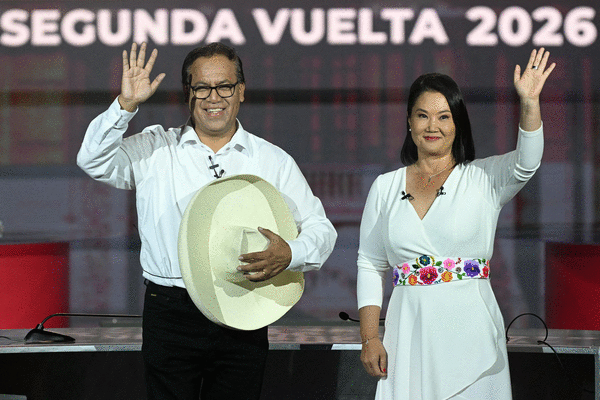
Roberto Sánchez campaigns wearing a traditional farmer’s hat from one of Peru’s poorest provinces, promising to slash the entrenched inequities in the copper-rich nation.
But the leftist candidate is nothing like the Andean farmers who have propelled him into what’s set to be a tight presidential runoff against right-winger Keiko Fujimori on June 7.
Sánchez, a psychologist-turned-politician, has been in Congress for five years, living in a well-off district of Lima. Still, his lack of rural credentials doesn’t matter to those voters — as long as he vows to continue to pursue promises of former President Pedro Castillo.
Elected in 2021 with overwhelming support from rural communities, Castillo has been in jail since attempting to dissolve Congress in a power grab almost four years ago. His supporters largely believe he was mistreated by Lima’s business and political elite, leaving him no other choice but to carry out the self-coup. His ouster triggered massive protests that left dozens dead. Three presidents have succeeded him since.
So in many ways, Sunday’s ballot is a rematch of the chaotic political cycle that began five years ago, when Castillo won against three-time presidential runner-up Fujimori. This time, it’s his protege who will face off against the establishment politician in a referendum on wealth and poverty.
“We don’t want to be further ruined by those rich people, when there are so many poor,” said subsistence farmer César Olivera Quispe, 58, from Castillo’s hometown of Chota. Olivera Quispe, too, wears the iconic hat that Castillo and now Sánchez have put on the world stage.
Sánchez was the sole minister who survived all of Castillo’s 16-month administration, in which more than 70 ministers rotated through five Cabinets. From jail, Castillo anointed his loyal minister’s campaign and gave him his broad-rimmed hat. Sánchez has barely taken it off since.
Meanwhile, Fujimori, 51, is one of Peru’s most known politicians. The polarizing legacy of her father, former President Alberto Fujimori who was convicted for corruption and human rights abuses, has turned many voters against her in past campaigns. Her role in Peru’s political turmoil as a major power broker in an unpopular Congress hasn’t helped her image either.
Still, supporters and investors see her as a source of stability and a safeguard of Peru’s successful economic model, rooted in the market-friendly constitution enacted under her father in the 1990s. That charter opened to private investment key sectors like mining, now Peru’s top magnet for foreign capital.
The model, blamed by the left for failing to distribute wealth fairly, is what Sánchez wants to rethink. Picking up where Castillo left off, his plan to rewrite Fujimori’s constitution has fueled as much support in Peru’s poorer rural areas as fear among investors.
“Of course I’m a danger,” Sánchez, 57, told Fujimori during a presidential debate. “I’m a danger to the concentration of wealth in a few hands because I will democratize it.”
An angry vote
Castillo’s hometown of Chota, one of the poorest provinces in Cajamarca, is now a Sánchez stronghold. The candidate campaigned there, and even challenged Fujimori to debate there, though it never happened.
And the Castillo effect still holds. His brother became the nation's second most-voted senator in April's general election and his sister-in-law also obtained a congressional seat.
The vote for Sánchez “is fundamentally a protest vote, a lesson the people want to teach the right,” said Castillo’s former prime minister Mirtha Vásquez, who will likely be a senator elect soon.
That’s the case for Olivera Quispe, who grew up with Castillo in Chota. While Olivera Quispe dropped out of school to farm potatoes and corn full-time, Castillo was one of the few classmates who kept studying.
“The powerful people who run this country never accepted that a man from the countryside could govern,” said Olivera Quispe. He lives in Puña, a Chota hamlet of adobe homes and nameless dirt streets, where only roosters break the chatter of women carrying crops on horseback.
Agriculture and mining are the main economic drivers of Cajamarca, and many gravitate toward policies like those of Sánchez. His initial proposals to tax mining windfall profits and phase out open pits have won him overwhelming support in mining regions where a sentiment prevails that the sector’s huge profits and record tax revenues have done little to improve life in nearby communities.
“Neocolonial Peru is over,” Sánchez said in an interview with Bloomberg last April.
Peru is the world’s third-largest copper producer and South America’s top gold exporter. Mining represents over 60% of the country’s exports and has helped fuel economic growth at rates that outpace its regional peers. Still, over 2 million more Peruvians are living in poverty today than a decade ago.
“It makes no sense that with so much wealth we are still so poor,” said Víctor Cusquisibán, director of energy and mines in Cajamarca.
As the presidential runoff approaches, Sánchez has softened his message, pledging to respect mining contracts and taxes, and cut red tape. But his leftist stance still worries a sector eager to tap Peru’s vast copper deposits to meet the world’s needs for the green energy transition.
In the race for copper, Cajamarca could win big — or miss out.
Rich copper stash
About 2,500 meters above sea level in northern Chota, Jorge Benavides had to turn his head from side to side to trace every open road that has helped reveal what lies beneath the mountain before him: the world’s second-largest undeveloped copper resource.
“Look at the opportunity there is” for multiple generations, said Benavides, country manager of First Quantum Minerals, the company that has been operating this exploration project called La Granja since 2023 after acquiring a majority stake from Rio Tinto.
FQM estimates that the open pit could start construction by the end of 2029 and begin production about four years later, with a potential of around 350,000 annual tons of copper. La Granja is also one of the seven projects that, if developed, could together bring in over $16 billion in investment into Cajamarca, according to government estimates.
“We need that investment,” said Cusquisibán, from the regional government. But any dream-like figure will fall on deaf ears if state inefficiency and entrenched corruption are not reversed to address people’s most basic needs, from water to doctors and schools, he said.
Mining executives say Peru also needs greater political stability and faster permitting processes to unlock new projects.
Social conflicts remain another hurdle. The region is home to one of Peru’s most emblematic mining disputes: Conga, a multi-billion gold project that has been stalled for more than a decade by socio-environmental opposition.
The industry argues that frustration over the lack of tangible benefits stems from government failure, not mining itself.
The anti-mining sentiment “can easily intensify when candidates like Sánchez emerge,” said Paola Herrera, economist at the Peruvian Institute of Economics.
FQM will move forward with La Granja’s environmental assessment this year regardless of the election’s outcome, Benavides said, preferring not to openly back any candidate. “Our vision is long-term.”
After the company’s disastrous experience in Panama, where a major $10-billion copper project was shuttered following environmental protests, FQM is engaging early with communities affected by La Granja. The $5 million the mine allocates each year into a community social fund used to improve roads, support coffee projects and fund scholarships is also helping keep support for the project steady, even as most voters lean toward Sánchez.
Take the family of 50-year-old homemaker Luz Villanueva. She and three of her siblings have worked on and off in La Granja. Her husband, Reinerio Cubas, has spent more than a decade doing various maintenance jobs at the mining camp, earning about twice what he usually makes harvesting avocados, he said. One of their daughters also got one scholarship to study for a higher degree in administration.
“The project has helped us a lot,” Cubas said. A strong supporter of Castillo, he doesn’t see a Sánchez win as a risk for La Granja. He thinks any attempt of radical reform would be quashed by the newly elected Congress, set to lean more to the right. Fujimori’s Popular Force party is actually the one holding the largest minority, giving investors and business leaders some relief no matter who wins on Sunday.
“We feel comfortable with how this new Congress has been elected that will guarantee some kind of peace,” said Leandro García, CEO of Buenaventura, one of Peru’s biggest publicly traded mining companies, in the latest earnings call.
Back in Puña, the chance of Fujimori ending up controlling both the executive and legislative rattles Castillo’s hometown, where she is seen as alien to poor, rural Peru and unable to look after its needs.
“She would only keep benefiting her own people and big companies,” said Olivera Quispe.
The father of the former president, 85-year-old farmer Ireño Castillo, blames “the power of money.”
--------
—With assistance from James Attwood.
©2026 Bloomberg L.P. Visit bloomberg.com. Distributed by Tribune Content Agency, LLC.




Comments