People who live near George Floyd Square are angry they have to pay for street overhaul
Published in News & Features
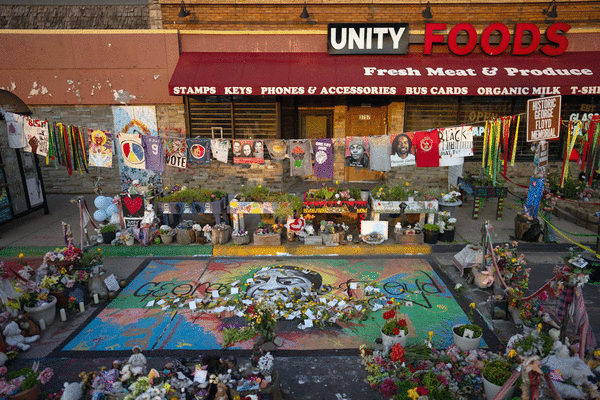
MINNEAPOLIS - People who own property near George Floyd Square are upset that the city notified them they are picking up part of the tab for an overhaul of streets and infrastructure in a part of Minneapolis drastically altered by what happened there in 2020.
City leaders have debated for the past six years how to manage, renovate and reconstruct the area around 38th Street and Chicago Avenue after George Floyd was killed there by Minneapolis police. In December, the outgoing City Council finally agreed on a plan after years of discord.
Property owners in the area say they were surprised to learn about five weeks ago that they would be expected to pay over $636,000 in special assessments for a $15 million overhaul of streets and infrastructure set to begin next week. Some of them told a City Council committee they cannot bear the cost, given the hardships many endured in the riots and unrest that followed Floyd’s murder.
“We are exhausted — emotionally, mentally, physically — and now you’re asking [us] to be financially exhausted,” said Bridgette Stewart, spokesperson for Agape Movement, a violence prevention nonprofit based near the intersection, said the area has been hit hard. “We’re living inside ‘The Wire’ and ‘New Jack City.’ ... Stop playing with us. Stop holding us hostage. We deserve more.”
At the meeting, committee members vowed to look for a way to avoid making the neighbors cover the cost. They voted unanimously to move the special assessments forward to the full council next week without a recommendation on the assessments.
The city plans to reconstruct Chicago Avenue between 37th and 39th Streets, and 38th Street between Park and 10th Avenues, while preserving the area’s memorial site and gathering space at a former gas station. The streets date back to the late 1950s and early 60s and need to be replaced, according to Adam Hayow, principal professional engineer for the city.
People from the neighborhood said they were taken by surprise by the special assessment notices. What happened at the intersection took a toll in many ways, some said — from police initially staying away from the area to snow not being plowed and a bus stop being moved blocks away the year after Floyd’s death prompted a global racial reckoning.
The first phase of construction is scheduled to begin Monday, and the second phase, focused on the intersection, next year.
It’s city policy to assess adjacent property owners for a portion of the cost of reconstruction projects, based on how much square footage they own. Property owners can pay in a lump sum or spread payments out over 20 years, with interest, beginning in 2028.
Mikaela Ziegler, a board member for Central Area Neighborhood and Development Organization (CANDO), a neighborhood organization and nonprofit serving the Central neighborhood, said the council needs to help.
“What is supposed to be a new dawn for the square will instead leave businesses and residents indebted by as much as $60,000 each,” Ziegler told the committee.
Lane Brown, co-executive director of CANDO, said 33 property owners and residents were there to formally object to the assessments, saying the neighborhood has experienced state violence and is vulnerable to displacement.
Michael Olson suggested the city cover the cost of their assessments with money from the police budget. “They have plenty of money,” he said.
PJ Hill said he supports rebuilding the streets, but will have to give a building back to his financing partner, Bill Graves, because of the financial burden that would come with the assessments after having lived through public safety challenges, rising costs, vacancies and declining economic activity.
Graves said he was approached by the Powderhorn Park Neighborhood Association more than three years ago to buy a building that had lost all but one tenant after Floyd. He committed to buying the building and returning it to community ownership, but said Hill won’t be able to buy it with the special assessment and “excessive tax” on the building.
CANDO co-executive director Mickella Rolfes said last week the group connected with 28 stakeholders and property owners, and only three were aware of the special assessments coming. This year, CANDO provided emergency funding to four businesses in George Floyd Square, Rolfes said, and coordinated $100,000 in food assistance and helped residents raise $700,000 in rent relief.
“Now we’re being asked to fund our own gentrification and displacement,” Rolfes said. “How many times will this community be forced to pay for the harms of the city?”
Council Member Soren Stevenson, who represents the area, said he never agreed with reconstructing streets as some sort of reparation.
“After a man was murdered by the city, I just don’t think the right response is to rebuild a street,” Stevenson said. “I think the right response is police accountability and investment in the community.”
But now it’s too late, with construction set to begin, and the bill is “salt in the wound.” Still, he’s optimistic the council can work with the Public Works department to find a solution by the council meeting Thursday.
A city spokesperson said city officials recognize the significance of 38th and Chicago, understand this is not a typical street reconstruction and are working with council members to find funding that “honors its significance” and the impact on nearby property owners.
Council Member Aurin Chowdhury said the city has to find a solution, even though it’s limited by state restrictions.
“We all deserve a break,” she said. “Boy, do the people of Minneapolis need a break.”
©2026 The Minnesota Star Tribune. Visit at startribune.com. Distributed by Tribune Content Agency, LLC.






Comments