How Florida Gov. Ron DeSantis signed away $1 billion for state-run immigrant detention centers
Published in News & Features
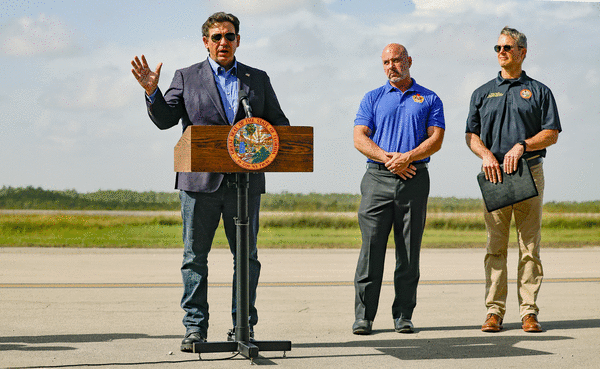
MIAMI — Florida Gov. Ron DeSantis won’t say how much he’s spent to carry out his vision for state-run immigration detention centers, but his office has signed at least 55 contracts worth $1 billion over the past year for the effort, a Miami Herald analysis found.
The vast majority of those contracts were for building and maintaining the soon-to-be-shuttered Everglades tent city the state dubbed Alligator Alcatraz. The rest were for a jail-turned-detention facility in Baker County, which DeSantis’ office calls Deportation Depot.
DeSantis administration officials have always known the price tag for the projects would be enormous, telling the Federal Emergency Management Agency in September that it would cost more than $1.7 billion to operate the two facilities over a two-year period. FEMA agreed to reimburse the state a maximum of $608 million across both facilities.
But the full extent to which the state continued to sign expensive contracts without competitive bidding processes — even as it became clear much of the costs would not be reimbursed by the federal government — has not been previously reported.
The Herald traced about five dozen private vendor contracts worth $991 million directly to the maintenance and operation of the two state-run detention facilities, most of which the state hasn’t yet paid out. More than $824 million was intended for Alligator Alcatraz.
Now, Floridians face a hefty bill for DeSantis’ efforts to spearhead Donald Trump’s mass deportation plan, and are left questioning whether that billion dollars — enough to give every public school teacher in the state about a $6,000 bonus — could have been better allocated elsewhere.
The contracts just for Alligator Alcatraz are about the same as what the governor spent from his emergency fund on Hurricane Nicole in 2022, Hurricane Idalia in 2023 and Hurricane Debby in 2024 combined, according to a March report.
State leaders are “going to spin it as a success, of course, but it’s all spin. Nobody can say that taxpayer money was well spent,” said Jeff Brandes, a former Republican state lawmaker who now leads the non-partisan think tank Florida Policy Institute.
Following a tour of the Everglades facility, Democratic Congressman Maxwell Frost called Alligator Alcatraz a project to “funnel our taxpayer money to corporations,” describing DeSantis’ immigration expenses as an “almost criminal use” of tax dollars while Floridians ”struggle to afford housing, health care, and insurance.”
When asked about the cost of Alligator Alcatraz last week, DeSantis said he “didn’t think” $1 billion was accurate, but didn’t provide an alternate number.
He said the costs equal at least the $608 million the state expects from the federal government and “there were some other things” the state had to pay for, noting the high sanitation costs to shuttle human waste out of the protected Everglades.
“We take that out every day,” he said.
The portable toilet company Doodie Calls has penned the largest contracts for the state’s detention efforts: more than $219 million across the two new state-run immigration detention facilities. The company declined to comment.
Payments from a shrinking emergency fund
State spending records show the state has paid out at least $335 million on those 55 Alligator Alcatraz and Deportation Depot contracts. That money is coming from a governor-managed emergency fund created by the state Legislature after the COVID pandemic.
His office has also paid an additional $90 million from the fund on other immigration enforcement expenses the Herald couldn’t directly tie to existing contracts for Alligator Alcatraz and Deportation Depot. That extra spending includes things like legal fees the state has paid to fight lawsuits over the facilities, flight repairs and state employee meals in Tallahassee.
In recent weeks, as it became clear the state and federal government were intending to close the facility and as the emergency fund balance dwindled, some Alligator Alcatraz vendors told the New York Times they received delayed or missed payments on their agreed-upon contracts.
One vendor contacted by the Miami Herald confirmed they’re still waiting for payment for services they’ve already provided.
The private dispatch company getResQ911 signed a $430,000 contract with Florida in November to fund six dispatchers at an Alligator Alcatraz dispatch center, according to contract documents. The company has been paid about $67,000, records show.
The company’s founder, Diane Carroll, said her company already completed the services outlined in the contract, but has been waiting for the rest of the money her company is owed.
As of mid-March, the governor’s emergency fund had at least $220 million in outstanding invoices for immigration enforcement expenses, according to state records.
The DeSantis administration has signed at least 55 immigration detention contracts over the past year
When asked by the Herald about whether the state was struggling to pay its high bills for the facilities, DeSantis said he had “bigger fish to fry than cutting checks to vendors.” The governor’s office directed questions about these contracts to its Division of Emergency Management, which did not respond to the Herald’s inquiries.
Since 2022, the state has poured $4.8 billion into DeSantis’ emergency fund. A report prepared by the Florida House shows that by March of this year, DeSantis had spent all but about $256 million of the fund’s total revenue — with $255 million in outstanding invoices, mostly for immigration enforcement expenses. State lawmakers approved an extra $250 million for that fund Friday.
Politically connected contractors on the receiving end
Florida has received just $58 million from the $608 million in federal reimbursement DeSantis is expecting.
It’s not immediately clear how much of the $991 million the state will ultimately pay. One of the smaller vendors for the site, who spoke with the Herald on the condition of anonymity due to ongoing work with the state, said their services only amounted to about a third of their originally contracted amount and they already received that payment.
Florida Division of Emergency Management Director Kevin Guthrie has referred to the state’s contracts as “not-to-exceed amounts,” not fixed costs. But at least one vendor, Public Safety Solutions, received $6,000 more than its original contracted amount, records show. The company did not respond to a request for comment.
The state estimated as recently as October that the cost of operating Alligator Alcatraz for 365 days would amount to $1.07 billion, according to documents the state sent to FEMA.
If Florida does pay out the full $1 billion it has committed to spend in the dozens of contracts for the facilities, several of DeSantis’ political allies will be on the receiving end.
The state signed away $210 million to three companies affiliated with the Miami-based CDR Companies, whose executives, Carlos Duart and Tina Vidal-Duart, are DeSantis allies and donors to his failed presidential bid.
Duart is a DeSantis appointee to Florida International University’s Board of Trustees and Vidal-Duart is a previous board member of the Hope Florida Foundation, the embattled charity created in support of Casey DeSantis’ anti-welfare initiative.
“As an approved and vetted service provider for the state, CDR Health has been on-call to support Floridians in times of crisis,” Vidal-Duart said in a statement about the company’s contracts. “This situation is no different.”
Most of the funds directed to CDR were for medical facilities and “site prep” at Alligator Alcatraz, according to contracts. Another $99 million was to a new joint venture CDR formed with the private prison company GEO Group late last year to provide staffing for Deportation Depot.
Other contracts for the sites include $112 million to IRG Global Management, $83 million to Garner Environmental Services and $79 million to GardaWorld, a company that donated $5,000 to a political committee backing DeSantis’ presidential run. GardaWorld directed questions back to the Division of Emergency Management. IRG and Garner did not respond to questions about their contracts.
The Jacksonville-based Critical Response Strategies signed a $70 million contract for management staffing, more than half of which was intended to cover overtime pay, according to state payment records. The company’s CEO Will Adkins declined to comment when reached by phone.
None of these dozens of contracts were negotiated through a competitive bidding process to ensure the state was getting the best deal, after DeSantis waived more than two dozen state laws and regulations to erect the facilities.
High costs
DeSantis has argued that the state-run detention centers were necessary to carry out Trump’s mass deportation plans.
“I’m doing it out of necessity. I’m not doing it because I just think we should just do it for a press release,” he said Friday. “We had nowhere else to put these folks. [The Department of Homeland Security] did not have any place to put them. Now they’ve had [a] place to put them and that’s been very, very positive.”
But some experts say the cost of DeSantis’ detention project is much higher than the federally operated immigration detention facilities, and largely on Florida taxpayers’ dime.
Claire Trickler-McNulty, a former ICE official in the Biden administration, said, “there are plenty of other facilities that already existed that could have provided bed space for ICE at a lower cost.”
Before the Everglades detention center opened in July, ICE had agreements with Florida county jails and was expanding detention capacity. In April last year, it announced that it had reinstated its agreement with the Glades County Jail in Moore Haven to add 500 beds for immigration detention.
According to Brandes, the vision of creating a brand-new, state-run immigration detention facility in the Everglades was an expensive and failed marketing tactic.
“The whole point of putting it at this location was the alligators. It was optics, it was for cable TV,” he told the Herald. “There was no other rational reason to put it at this location.”
_____
—Miami Herald staff writer Syra Ortiz Blanes and Herald/Times Tallahassee Bureau correspondent Garrett Shanley contributed to this report.
©2026 Miami Herald. Visit at miamiherald.com. Distributed by Tribune Content Agency, LLC.






Comments