Deadly flooding in Grand Canyon leaves 15 missing. Extreme weather fueled deluge
Published in News & Features
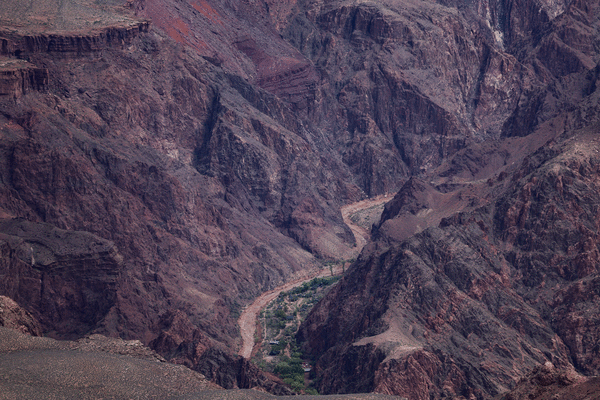
Epic flooding in the Grand Canyon that left at least two dead and more than a dozen missing was fueled in part by extreme weather, including the Southwest’s long-term drought, unusually hot ocean temperatures and air from El Niño, forecasters said.
Flash flooding is common in northern Arizona, but experts say the amount of rain in the Grand Canyon this weekend was unusually high. Floodwater ripped through the popular recreational area, and officials were still searching for people who remained unaccounted for.
Chad Merrill, senior meteorologist and a long-range forecaster with AccuWeather, said the El Niño climate pattern has caused unusually warm sea-surface temperatures in the eastern equatorial Pacific, increasing the moisture in the atmosphere that strengthened the Southwest monsoon.
The unusually warm waters between Southern California and Hawaii that have contributed to a higher dew point and brought on the muggy conditions in Los Angeles, are also delivering additional boosts in moisture and energy to those monsoon storms, he said.
The Grand Canyon’s typography also exacerbated the storm.
“At 7,000 feet on the South Rim (of the national park), we basically have a tremendous amount of uplift that causes convective storms, also known as hot air storms, (which produce) a massive amount of rainfall,” said Randy Cerveny, a meteorologist with Arizona State University.
“We get these convective thunderstorms many times during the course of the summer, but not of this kind of intensity,” he added.
Merrill said a persistent drought, which has prompted water restrictions at the Grand Canyon, allowed the heavy rainfall to run off quickly rather than get absorbed by the ground. Additionally, the heat dome in the region has been moving away eastward, allowing for the moisture to build up in the atmosphere.
“We’re seeing these water temperatures that are very close to record highs for this time of the year,” he said, “and anytime you get some sort of a jet stream flow out of the southwest that comes into the Grand Canyon, that will continue the heavy intensity of the rain.”
El Niño is not the primary mechanism in this flash flooding event, but it’s definitely a strong secondary factor, Cerveny added.
The last time there was a significant flash flooding event in Bright Angel Canyon was in December 1966. About 14 inches of rainfall caused devastating floodwaters that destroyed the North Kaibab Trail, the Transcanyon Waterline before its construction was complete, and much of Phantom Ranch, which sits at the bottom of the Grand Canyon, according to the Grand Canyon Historical Society.
“What we have is these storms that are kind of like popcorn,” Cerveny said. “They pop up in different parts of the state, and they can produce a massive amount of rain in a very short period of time.”
On Monday, the National Park Service said search and recovery efforts were well underway in Bright Angel Canyon, which runs from the North Rim of the Grand Canyon into the Colorado River.
Preliminary assessments indicate approximately 40% of the Transcanyon Waterline, a 12 1/2-mile water pipeline that provides potable water and fire suppression for all facilities on the South Rim of the canyon as well as some inner canyon facilities in the Cross Canyon Corridor, was damaged or destroyed, officials said in a statement on Facebook.
Continued rain in the week-ahead forecast could affect the timing and pace of operations, the National Park Service said.
Officials are concerned about the rainfall in the burn scar area of the Dragon Bravo fire that burned nearly 150,000 acres on the Kaibab Plateau within the national park, including more than 71,000 acres of Grand River Conservation Authority-managed land.
“Vegetation helps to hold water in,” Cerveny said. “When you remove the vegetation, the water can run and run down into the lowest areas of the canyons much more quickly.”
A flash flood watch for northern Arizona remained in effect through midnight Monday. Meteorologists with the National Weather Service said showers and thunderstorms were expected to continue into the evening with deep monsoonal moisture.
_____
©2026 Los Angeles Times. Visit at latimes.com. Distributed by Tribune Content Agency, LLC.






Comments