Aftershocks rock Panama following largest quake in decades
Published in News & Features
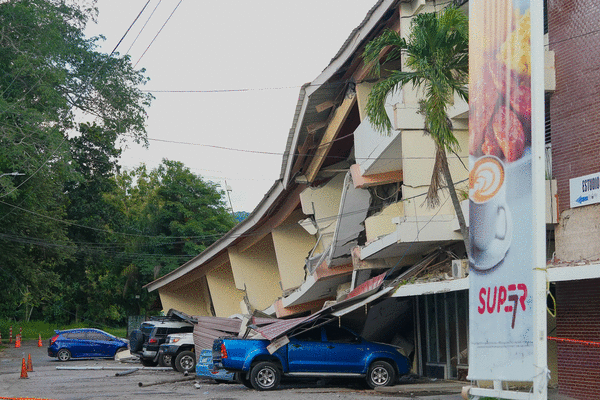
Panama was hit by its strongest earthquake in more than seven decades on Friday, followed by powerful aftershocks, as President José Raúl Mulino said no deaths had been reported immediately after the quake.
The 7.7-magnitude quake struck Herrera Province, more than 120 miles (193 kilometers) southwest of the Panama Canal, according to the U.S. Geological Survey. Economic losses in the region are likely to exceed $1 billion, according to an early USGS estimate.
The earthquake was the strongest to hit that part of Panama since at least 1951, according to the U.S. National Earthquake Information Center. It struck at a depth of 12.6 kilometers, the USGS said.
A magnitude-6.6 aftershock hit west of the initial quake late Friday afternoon, according to preliminary USGS readings. Another eight aftershocks have been recorded at magnitude 4.8 strength or higher.
The first earthquake was caused by a rupture along a major plate boundary on the Ring of Fire, the seismically active zone that encircles the Pacific Ocean. The mechanism resembled a strike-slip event, in which tectonic plates grind past each other horizontally, according to Jonathan Tytell, a geophysicist at the U.S. National Earthquake Information Center.
“It was a very messy event, and shallow, which is not good,” Tytell said. “The energy is right there at the surface and it doesn’t really have time or distance to dissipate.”
The USGS initially registered an 8.0 magnitude before revising it. Panama’s geological institute reported the quake as a 7.2-magnitude.
Immediately following the quake, the Pacific Tsunami Warning Center said waves of one to three meters (3.3 to 9.8 feet) above tide level were possible along parts of Panama’s coast. As of 2:42 p.m. local time, all warnings had been lifted.
The Panama Canal said operations were continuing normally, with emergency protocols activated and technical teams inspecting facilities for possible damage.
The quake was felt as far away as several Colombian cities, including Medellín, according to local media. In Panama, people evacuated buildings, businesses, schools and homes across several regions, local newspaper La Prensa said. Panama’s Tocumen International Airport was closed follwoing the quake but was later reopened.
Mulino said the government was mobilizing personnel, resources and aid for people affected by the quake, and ordered ministries and public agencies to respond immediately and take preventive measures. Emergency officials were expected to hold a news conference to provide an update on the impact.
When touring the affected area Friday, Mulino told reporters that efforts were being made to relocate families away from impacted dwellings. Analysis was also being done about moving patients out of damaged hospitals.
Panama’s Finance Minister Felipe Chapman said he contacted the World Bank, the International Monetary Fund and other banks “to obtain the necessary resources to face this crisis.”
Corporación Andina de Fomento, known as CAF, one of the contacted institutions, said it was donating $250,000 to Panama for earthquake relief. Mulino thanked CAF for the “promt help.”
People stood barefoot or shirtless in the streets as aftershocks continued, said Cibeles De Freitas, a communications representative for the local unit of First Quantum Minerals Ltd.
“There’s a lot of fear because we’re not used to earthquakes in Panama,” she said. “We’re OK, just very scared.”
First Quantum Minerals said on social media that the infrastructure at Cobre Panama, its partially idled copper mine, located about 140 kilometers north of the epicenter, remained stable and safe following earthquake.
Panama City’s Metro said lines 1 and 2 were temporarily shut down because of the earthquake.
Panama’s firefighters said there were no reports of deaths or injuries in the immediate aftermath of the quake. AES Panama, a unit of AES Corp., the country’s top electricity supplier, said through a spokesperson that its hydroelectric, gas-fired and renewable power plants were operational.
Activities at the Trans-Panama oil pipeline were continuing normally after the quake, according to a statement from its operator.
Friday’s quake was the latest to hit Latin America in recent months.
Venezuela was struck by twin earthquakes in late June that killed nearly 6,500 people and caused widespread destruction along its northern coast. In Colombia, an Aug. 10 quake killed more than 330 and prompted an economic emergency as damage was estimated at roughly $10 billion.
Venezuela’s acting President Delcy Rodríguez offered assistance to Panama, as did Colombian President Abelardo de la Espriella.
“Panama is not alone,” De la Espriella said in a post on X, adding that Colombia was ready to provide whatever assistance was needed.
U.S. Secretary of State Marco Rubio said in a social media post he was monitoring the situation, adding that “the State Department is rapidly mobilizing resources and personnel to assist.”
____
—With assistance from James Attwood, Valentine Hilaire, Jose Orozco, Brian K. Sullivan, Michael McDonald, Lucia Kassai and Sarah Gray.
©2026 Bloomberg L.P. Visit bloomberg.com. Distributed by Tribune Content Agency, LLC.






Comments