Maryland's campaign trail still leads through churches
Published in Religious News
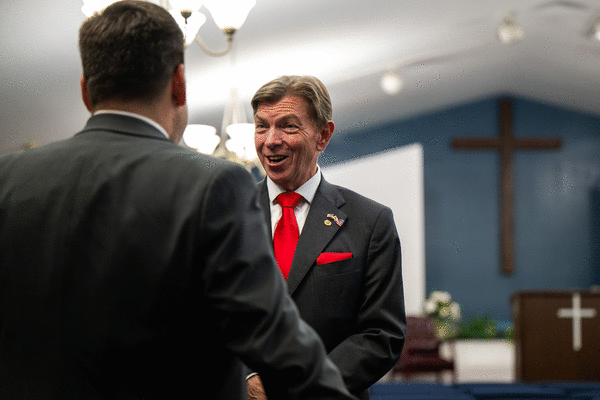
BALTIMORE — Despite declining religious affiliation, Maryland’s campaign trail increasingly runs through church sanctuaries, fellowship halls and post-service meet-and-greets, where candidates see an opportunity to connect with voters in a setting that remains influential.
Reflecting the enduring political influence of faith communities, candidates from both parties have made appearances at churches across Maryland this election cycle.
Federal tax law bars tax-exempt religious organizations from endorsing candidates. Still, political analysts say churches remain attractive venues because they bring together both undecided voters and highly engaged voters, particularly older Marylanders who consistently participate in elections.
In that spirit, Gov. Wes Moore visited Shepherd’s House International Christian Church in Upper Marlboro on Sunday, speaking with the congregation.
“There are going to be a lot of Black people who vote for Wes Moore, but there are some Black people who are not sold on Wes Moore. Maybe they don’t think he’s the most sincere or authentic person, and maybe seeing him in this setting helps them pull that lever,” said Niambi Carter, a professor at the University of Maryland School of Public Policy.
Church attendance has declined in most religious groups. A 2024 Gallup study found only 21% of Americans say they attend religious services every week, while 31% say they never attend. The number of American adults who say religion is important to their daily life has also dropped to a record low — from 66% in 2015 to 49% in 2025, according to a Gallup study that same year.
Although there isn’t polling on church attendance in Maryland, the number of Marylanders who identify with some form of religion has steadily increased in the past two decades — from 17% in 2007 to 23% in 2014 to 32% in 2024, according to the Pew Research Center. However, median church attendance in the country has risen, according to 2026 data from the Hartford Institute for Religion Research.
Still, candidates see opportunity in appearances at houses of worship.
A senior Maryland Democratic official, who requested anonymity to discuss campaign strategy candidly, said Moore’s church appearances provide him with valuable face time before groups of engaged voters.
Moore’s Sunday remarks focused largely on faith, though he also made passing references to the political climate.
“I believe in the King of kings, and I believe in the Lord of lords. He does not live here, nor in Washington, nor anywhere else,” Moore said, as the congregation cheered him on.
Republican gubernatorial candidate John Myrick has also made church visits part of his campaign outreach, though his message tends to focus more directly on policy issues.
Myrick attended a service at Woodlawn Baptist Church in Bowie on Sunday. Although he did not deliver a formal speech, he spoke with churchgoers afterward about his plans to address rising energy costs if elected governor.
“It’s pandering to a specific group, and our message is pretty clear as to what we plan on doing for Marylanders, and the respect that we will afford every Marylander,” Myrick told The Baltimore Sun ahead of the service. “Marylanders of all faiths pretty much want the same things when it comes to their government, and that really doesn’t require an overly religious undertone to that.”
Maryland candidates using religion to appeal to voters is a longstanding tradition. Former Gov. Larry Hogan went to churches whenever he campaigned, including during his 2024 Senate bid when he spoke to voters at Iglesia Hispana Emmanuel Church in Annapolis. Former Gov. Martin O’Malley employed the same strategy, most notably during his 2003 mayoral campaign when he attended a service at Bethel African Methodist Episcopal Church, Baltimore City’s largest and oldest Black church.
Not every candidate views church outreach as a central part of campaign strategy. Some argue that legal restrictions on church involvement in politics — the Johnson Amendment — can limit the usefulness of such appearances.
President Donald Trump’s administration attempted to reverse this law, but a federal judge blocked its efforts. Maryland lawmakers, during the 2026 legislative session, tried to codify the Johnson Amendment into Maryland law, but their efforts didn’t move past committee hearings.
Joe Crawford, Charles County Republican Party chair and pastor at Woodlawn Baptist, said candidates “tend to pass up on” coming to his church because they don’t see the value of participating in events that aren’t overtly political, given that federal law prohibits churches from endorsing or opposing political campaigns. Crawford added that candidates also seek larger congregations, of which his church isn’t one.
_____
©2026 The Baltimore Sun. Visit at baltimoresun.com. Distributed by Tribune Content Agency, LLC.



Comments