David M. Drucker: The GOP is kidding itself about the economy
Published in Op Eds
No amount of narrative-setting can convince American voters that the economy is better or worse than their own experience dictates. That’s what I’ve been telling the Republicans who’ve asked me, earnestly, if the media’s reporting on affordability is responsible for voters’ gloomy assessment of their finances.
That’s not to say that the news media (guilty as charged) doesn’t get caught up in narrative-setting from time to time. It’s our job to report on the state of the economy, domestically and globally. We rely on statistics, percentages, figures and graphs, and the performance of stock and bond markets, to fulfill that function. If the macro indicators appear to be singing from the same hymnal, well then, voilà, a cohesive media narrative on current economic conditions.
But of course, the economy is about more than numbers. It’s about how American voters feel about it and experience it. Do they feel anxious or secure? Like they’re getting ahead or treading water? Financially stretched or making ends meet?
As the 2024 elections approached, with first President Joe Biden running for a second term and then Vice President Kamala Harris succeeding him atop the Democratic ticket, the American economy was strong and growing. Inflation, the acute source of voters’ economic anxiety, was cooling. That’s what the numbers told us, and the numbers were largely correct (although we learned this year that the jobs market was weaker than presumed). And so, the breadth of the media’s reporting on the health of the economy reflected as much.
But voters felt differently.
Their personal economic experience did not feel “strong and growing.” They felt anxious, not secure; like they were treading water, not getting ahead; financially stretched, not making ends meet. This is the No. 1 reason why President Donald Trump was returned to the White House despite any misgivings voters may have had about his first term and the way it ended.
So much for the power of media narratives. Ironically, Trump and many of his Republican supporters don’t appear to have internalized the lesson.
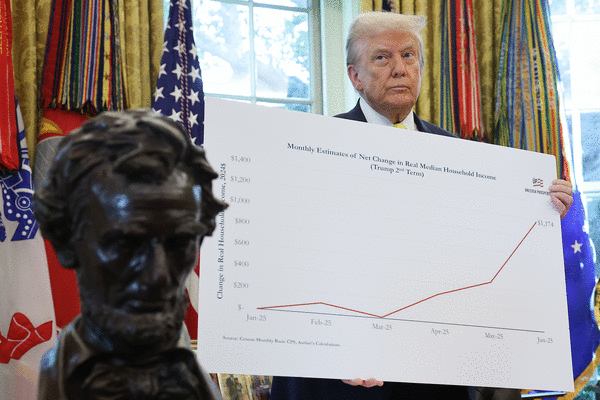
In early December, Trump hosted a campaign-style rally in Pennsylvania to promote his stewardship of the economy, where he said, regarding voters’ expressed, specific concerns about affordability: “Our prices are coming down … It’s a hoax.” The president pointed to a chart with a bunch of macro indicators intended to prove the cost of living is affordable. “They use the word affordability and that’s their only word,” Trump added, referring to Democrats and the media. “Our prices are coming down, tremendously, from the highest prices in the history of our country — and look at that chart.”
Trump has been saying some version of this repeatedly for the past few months, or at least since Democrats won big victories in last year’s key off-year elections in New Jersey, Virginia and a few other states by making affordability the centerpiece of their campaigns. The president and other Republicans claimed vindication after government data showed inflation in November rose just 2.7%, less than the 3.1% forecasted. They did so again after the federal Bureau of Economic Analysis issued a report showing third-quarter GDP growth of 4.3%, the fastest pace of economic expansion in two years.
The political implication, both in Trump pointing to his charts and Republicans highlighting obviously welcome news of a possibly brightening economy, is that, armed with this new, positive information, voters would start to feel better about the economy.
But that’s not how this works. Voters haven’t soured on the economy or their perception of Trump’s role in managing it because Democrats and the media told them there was an affordability crisis. Voters concluded they were having a hard time affording the cost of living because they were, and they are.
The media has simply reported this; the Democrats have simply capitalized on it. The data bears this out.
Regarding those robust economic growth numbers from the third quarter and the lower rate of inflation from November: If GDP growth was translating into improving Americans’ ability to afford the cost of living, we would not have seen CBS/YouGov polling in October that showed the economy and affordability were voters’ top priorities and that they believed Trump was insufficiently focused on lowering prices. We would not have seen CBS/YouGov polling in December that showed 63% of Americans rated the national economy either “fairly bad” or “very bad,” with 56% saying it’s “getting worse.” Also from this survey: 76% said their income isn’t keeping up with inflation.
The 2026 midterm elections are less than 10 months away.
Given voters’ historic habit of punishing the party in residence in the White House, there may be little Trump, and his party, can do to preserve their thin majority in the House of Representatives. But the surest way to put their majority in the US Senate at risk is to keep telling Americans that the only thing wrong with the economy is that the Democrats and the media are driving a false narrative. The American economy, broadly speaking, is resilient. Voters’ patience with politicians who try to convince them that their problems aren’t real is not.
____
This column reflects the personal views of the author and does not necessarily reflect the opinion of the editorial board or Bloomberg LP and its owners.
David M. Drucker is a columnist covering politics and policy. He is also a senior writer for The Dispatch and the author of "In Trump's Shadow: The Battle for 2024 and the Future of the GOP."
©2026 Bloomberg L.P. Visit bloomberg.com/opinion. Distributed by Tribune Content Agency, LLC.

















































Comments