Editorial: Punitive tax increases won't solve budget shortfalls
Published in Op Eds
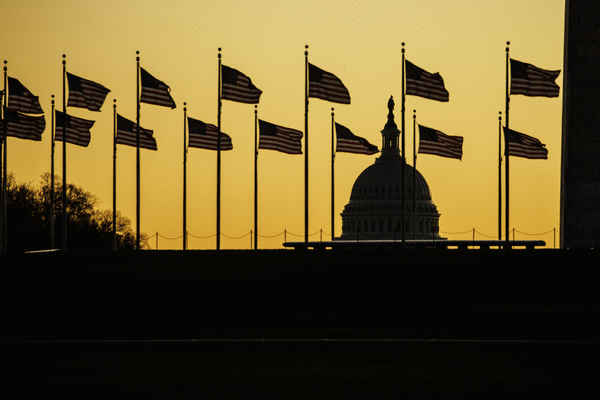
Tax day is a few weeks away, yet politicians across the country are still scheming to concoct new ways to separate people from more of their own money.
Whether it’s a proposed “wealth” assessment on billionaires in California, a new income tax in Washington state, higher city income taxes to cover “free” stuff in New York City or proposed tax reforms in Congress intended to soak high earners, Democrats and progressives can never acquire enough of other people’s money to spend.
Notably absent from these proposals, however, is any talk about the spending side of the equation. “The problem is not that the government collects too little,” Veronique de Rugy of George Mason University’s Mercatus Center argued last week. “It’s that the government spends too much.”
Indeed, as the national debt speeds past $39 trillion, even massive tax hikes won’t solve the problem without a long-term commitment to a leaner federal government that lives within it means. The move to enact various “tax-the-rich” proposals is “gaining traction, in part, because politicians are running out of painless ways to fund the governmental growth they are unwilling to constrain with spending cuts,” Adam Michel, director of tax policy studies for the Cato Institute, wrote for Forbes this month. “Unfortunately, they won’t work.”
The numbers tell the story. Even a decade of revenue from a proposed federal wealth tax pushed by socialist Sen. Bernie Sanders ”would barely fund a single year of the deficit,” Michel notes.
Both Michel and de Rugy cite the research of economist Jack Salmon, who concluded that 98 percent of the nation’s “structural deficit can be attributed to spending policy decisions.” Progressive allegations that tax cuts — signed by Ronald Reagan, George W. Bush or Donald Trump, take your pick — have “starved” Washington ignore the fact that federal tax revenues as a percentage of gross domestic product have been remarkably consistent for nearly eight decades regardless of rates.
Spending is another story. Michel reports that government outlays represented about 20 percent of the economy in 1950. That has risen to more than one-third.
During testimony before a Senate finance subcommittee last week, Maya MacGuineas of the Committee for a Responsible Federal Budget said that 61 percent of the national debt was the result of policies other than tax cuts. “Meanwhile, federal revenues will be higher than their historical average,” she testified, “but fail to keep up” with spending growth.
Any rational fiscal fix must include compromises and reforms from both politicians on both sides of the aisle. But ignoring the role of increased spending is a dangerous recipe for exacerbating the problem that has led us down an unsustainable path in the first place.
©2026 Las Vegas Review-Journal. Visit reviewjournal.com.. Distributed by Tribune Content Agency, LLC.


















































Comments