Andreas Kluth: The Iran war made the North Korea problem worse
Published in Op Eds
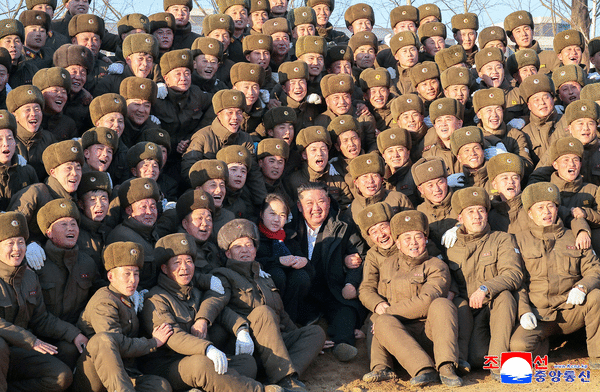
Forget about the $25 billion. That’s the estimate the Pentagon has tentatively picked for the direct cost of the Iran conflict, a sum that analysts consider laughably lowballed. The true expense of this U.S.-Israeli war of choice is much higher. It must include not just the global economic and humanitarian fallout, but the strategic opportunity costs of other and more urgent problems not dealt with, and perhaps now made impossible to deal with. One example: North Korea.
For decades, during which American presidents have sloppily lumped its dictatorship with other bogeys in the Middle East as part of woolly “axes of evil” and such, North Korea has arguably been the greatest threat to the United States and its treaty allies South Korea and Japan.
And each time the U.S. threw its military might against those other targets — Iraq, Afghanistan and now Iran — Pyongyang, under successive generations of the Kim dynasty, became more convinced that the only way to forestall an American attack would be to have its own nukes; and not just a few, but enough to overwhelm America’s missile defenses.
I still remember watching television in December 2002, when my news channel had this split screen: The main panel showed the American preparations for the invasion of Iraq, while the inset ran live footage of nuclear inspectors from the International Atomic Energy Agency being expelled from North Korea. Pyongyang quit the Non-Proliferation Treaty the following month and tested its first nuclear weapon five years later.
Today, after another twenty years of failed American attempts to “denuclearize” the Korean peninsula, Kim Jong Un has an arsenal that is impressive in the most diabolical way. He has an estimated 50 atomic warheads and enough enriched uranium to build 50 more. North Korea also produces enough fissile material to keep adding about 20 warheads a year indefinitely. It appears to aim at minimum for parity with nuclear powers such as France or Britain, which each have over 200.
Kim’s weapons range from relatively “small” tactical nukes (equivalent to the Hiroshima blast, say) that he could use in battle against South Korea to huge thermonuclear bombs that could take out entire American cities. North Korea has also developed, or is testing, about 20 delivery systems, which include intercontinental ballistic missiles that can reach the U.S. and submarines that can float undetected and launch their hellfire even after a preemptive American attack on North Korea’s ground-based launch silos.
Knowing that North Korea is militarily too weak to put up much of a conventional fight against the U.S. and South Korea, Kim has clearly concluded that this “survivable” atomic arsenal is what it’ll take to deter his enemies, allowing him to throw his weight around in the region in other ways. He has also changed North Korea’s doctrine to allow for the first (meaning offensive) use of nukes if things go badly for him.
By contrast, Iran had no nukes when the U.S. attacked it, either last June or this February. Nor was Tehran actively seeking to build any, according to U.S. intelligence assessments.
These contrasting outcomes yet again affirm Kim’s assumptions. North Korea, he determined long ago, will not be a Ukraine (which in the 1990s gave up its nuclear weapons in return for security guarantees from the U.S., UK and Russia). Nor will it be an Iraq or Libya, which once had dictators who gave up their nuclear programs and later paid with their lives. Nor will his regime be an Iran. What the Strait of Hormuz is to Tehran, nukes are to Pyongyang.
Kim is “probably happy” as he watches events unfold in the Middle East, Joel Wit told me. He’s a veteran of the State Department who helped negotiate one of the nuclear deals between the U.S. and North Korea that later fell apart, a saga he chronicles in a recent book.
For a start, the Pentagon had to move troops and munitions from South Korea and other parts of Asia to the Iranian theater. That ammo included valuable missile-defense interceptors such as the THAAD systems that are now about half-depleted. Even if the Iran war ends this year and America regroups, the U.S. is unlikely to devote as many resources to defending its East Asian allies as its official strategy documents promised only a few months ago.
Washington is now also distracted more generally, with the Iran war pushing aside other diplomatic and political objectives, as may become evident when President Donald Trump meets his Chinese counterpart, Xi Jinping, in Beijing this week.
Like Kim, both Xi and Russian President Vladimir Putin see the Iran quagmire as confirmation that the U.S. is in decline as a superpower and hegemon, leaving a power vacuum into which Russia, China and even North Korea can expand. Kim, Xi and Putin have their own problems and eye one another warily. For now, though, they’ve decided that they can be stronger by sticking together against the U.S.
Since his failed summitry with Trump in 2018 and 2019, Kim has ended his country’s isolation and cultivated an emerging triple entente with Russia and China. He signed a mutual-defense pact with Russia in 2024 and has sent North Korean soldiers to fight against the Ukrainians (picking up experience in modern drone warfare as a by-product). Moscow has reciprocated with commerce and technological knowhow for all that whizz-bang weaponry, including the ICBMs.
China has also boosted its trade with North Korea. And both China and Russia, as veto-wielding members of the United Nations Security Council, have started shielding North Korea from UN sanctions enforcement. In the past, they had cooperated with the U.S. in striving to denuclearize the Korean peninsula. Now they accept Pyongyang as belonging to the atomic club.
Xi communicated this quasi-alliance visually by hosting both Putin and Kim at a big military parade in Beijing last September. Jung Pak, who dealt with East Asia in the State Department during the Biden administration, thinks that Kim has “transformed himself from a global pariah into a global power player.”
All three leaders also cannot have failed to notice the lethally efficient and almost casual way in which the U.S. has been “decapitating” foreign regimes, first by kidnapping Venezuela’s dictator and then by killing Iran’s Supreme Leader and many commanders.
Kim has been obsessed with such scenarios for years, Wit told me. The Russians have long had “dead-hand” systems in place that could launch retaliatory strikes against the U.S. even after Moscow’s leadership is taken out. Kim has done something similar, delegating the authority to launch nukes far and wide, depending on the scenario.
The ill-advised American war against Iran thus appears to have made the problem of North Korea worse. A dictator who already felt stronger than he was in Trump’s first term now wields more diplomatic clout and military power, even as he has reason to be even more paranoid about the potentially lethal unpredictability of his counterpart in the White House. Kim Jong Un is more dangerous than he has ever been. And the United States appears unable to do anything about it.
____
This column reflects the personal views of the author and does not necessarily reflect the opinion of the editorial board or Bloomberg LP and its owners.
Andreas Kluth is a Bloomberg Opinion columnist covering U.S. diplomacy, national security and geopolitics. Previously, he was editor-in-chief of Handelsblatt Global and a writer for the Economist.
©2026 Bloomberg L.P. Visit bloomberg.com/opinion. Distributed by Tribune Content Agency, LLC.




















































Comments