Ex-Rep. David Rivera is convicted on all counts in case tied to Venezuela
Published in Political News
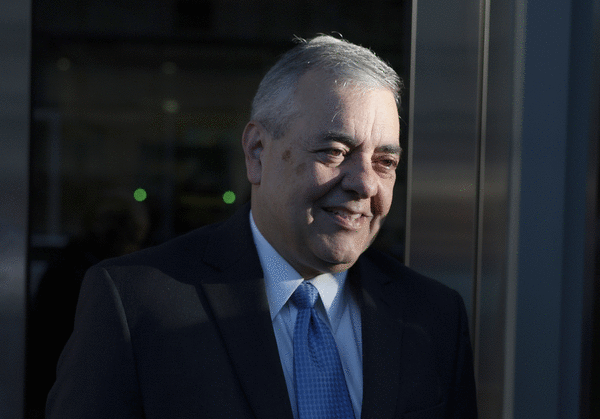
MIAMI — A Miami federal jury on Friday convicted former Florida Congressman David Rivera and consultant Esther Nuhfer on charges of failing to register as foreign agents when they lobbied major U.S. politicians in a scheme to “normalize” relations with Venezuelan President Nicolás Maduro after Rivera had signed a $50 million contract with the American arm of Venezuela’s national oil company.
The 12-person jury found Rivera and Nuhfer guilty of breaking a foreign-agent registration law when they secretly worked on Venezuela’s behalf while they lobbied their friend, Florida Sen. Marco Rubio, and other U.S. officials in 2017 and 2018.
Rivera, 60, and Nuhfer, 51, now face several years in prison for their convictions on conspiracy, foreign-agent and related money-laundering charges. The jury reached the verdicts after a five-week trial with 14 witnesses, including Rubio, and thousands of records, such as text messages, emails and financial documents. The jury began deliberations Thursday morning.
Both defendants also face a potential forfeiture judgment of $20 million, representing the proceeds that they received from Rivera’s consulting contract with the U.S. subsidiary of Venezuela’s national oil company, PDV USA.
During closing arguments this week, prosecutors said Rivera and Nuhfer deliberately avoided registering as foreign agents for Venezuela with the U.S. government as they “preyed” on politicians such as Rubio because they wanted to keep the public in the dark about their consulting relationship with the socialist Maduro regime, prosecutor Roger Cruz told the jury.
“His public image was as an anti-communist, but he was working for the Maduro regime the whole time, and he knew it,” Cruz told jurors Tuesday. “Marco Rubio was one of the many pawns used by these two defendants.”
Cruz said Rivera and Nuhfer cared only about making millions off the Venezuelan government, while Cruz cited one of Rivera’s text messages in which he described Venezuelans who fled to the Miami area as “savages.”
Lawyers for Rivera and Nuhfer, who did not testify at their trial, attacked the government’s case, asserting that Rivera’s highly lucrative consulting contract was with a U.S. corporation even though it is a Venezuelan oil subsidiary; therefore, they did not have to register as foreign agents in the United States.
Perhaps more significant, the lawyers argued, Rivera and Nuhfer tried to promote the refinery business of the subsidiary, PDV USA, which operates as Houston-based Citgo, and reestablish business relations between Venezuela and the U.S. oil giant Exxon, whose assets were seized by Maduro’s predecessor. Their representation of a Venezuelan business did not require them to file papers under the Foreign Agents Registration Act, a transparency law dating back to 1938, the lawyers claimed.
Moreover, the lawyers said, they interacted with Rubio, now the Trump administration’s secretary of state, and Texas Congressman Pete Sessions for one purpose: removing Maduro from power and replacing him with an opposition candidate in democratic elections in Venezuela. They sought to weaken Maduro, who faced economic sanctions along with other senior officials and Venezuela’s national oil company, PDVSA, the parent company of the U.S. subsidiary.
‘Trying to blind you’
“They have spent this entire trial trying to blind you with the light of that $50 million contract,” Rivera’s lead attorney, Ed Shohat, told the jurors. “This case from the very beginning has been nothing but shifting sands and changing positions.
“There is not one word in the indictment about manipulating Sessions or Rubio. All that David Rivera cared about during the entire time frame of this case, without exception, was removing Nicolás Maduro. The only thing that he did was try to get that SOB out of Venezuela.”
Shohat also said his client’s description of Venezuelans as “savages” in a text was political commentary, not a racist slur.
Nuhfer’s lead defense lawyer, David O. Markus, made similar arguments, but she played a supporting role in the alleged conspiracy led by Rivera. For starters, Rivera’s company, Interamerican Consulting, signed the $50 million contract with PDV USA in March 2017. Nuhfer was not a party to that agreement.
Soon after, Rivera cut side deals with Nuhfer and two others, Miami businessman Hugo Perera, a convicted drug trafficker who cooperated with the government, and wealthy Venezuelan TV network owner Raul Gorrin, who had access to Maduro and his then-foreign minister, Delcy Rodriguez.
Prosecutors say Maduro and Rodriguez authorized a series of payments totaling $20 million under terms of the PDV USA contract before having a falling out with Rivera’s group by the end of 2017. Of that sum, Rivera paid about $4 million to Nuhfer, mainly for introducing him to Perera, who lived on exclusive Fisher Island. Rivera gave about $5 million to Perera for introducing him to Gorrin, who also had a home on the island. And Rivera gave about $4 million to Gorrin for his access to Maduro and Rodriguez and gaining their approval for the contract.
“Esther Nuhfer is innocent,” Markus told the jurors Wednesday, as about 30 of her supporters sat in the courtroom. “The question is, why did they charge her in the first place?”
Markus pointed out that when Perera, who was not charged, testified for the government at trial, he said he believed what he was doing with Rivera was legal.
“That’s exactly what Esther believed,” Markus said. “Never in a million years did she think she had to file” a registration form as a foreign agent for Venezuela.
“They gave the benefit of the doubt to Hugo Perera,” Markus said. “Why do you think they gave him the benefit of the doubt? Because he was willing to point the finger at David Rivera.”
Markus also said Nuhfer did not lobby Rubio, Sessions or any other U.S. official, as prosecutors Cruz, Harold Schimkat and David Ryan allege in the indictment.
During the five-week trial, Rubio, Sessions and influential GOP lobbyist Brian Ballard testified. None said he knew about Rivera’s consulting contract with the Venezuelan subsidiary, PDV USA, until the company sued Rivera over allegations of doing little work in May 2020.
Sessions testified as a defense witness Monday that Rivera enlisted him in 2017 to persuade Maduro to step down and hold democratic elections in Venezuela.
But the Republican lawmaker acknowledged he did not know at the time that Rivera’s consulting company had signed the $50 million contract that March with the U.S. subsidiary, which prosecutors say was controlled by Maduro’s government.
“I did not ask, nor did they say anything,” Sessions, who was first elected to Congress in 1996, testified.
Sessions testified he agreed to meet on April 2, 2017, in New York City with Rivera, Rodriguez (the Venezuelan foreign minister), and others.
At their meeting, he said Rodriguez resisted the idea of regime change in Venezuela but urged him to consider bringing Exxon, the Dallas-based oil behemoth in his congressional district, back to the negotiating table with Venezuela. Exxon and Venezuela had a major legal battle after Maduro’s predecessor, the late President Hugo Chávez, confiscated the company’s assets in the South American country.
Sessions testimony
Sessions testified that he also met separately that day with Rivera, Nuhfer, Venezuelan political opposition leader Julio Borges and Orlando business consultant Bertica Cabrera Morris, a friend of his wife Karen, at the Manhattan apartment belonging to Gorrín, the wealthy Venezuelan businessman.
The gatherings set the groundwork for Sessions to act as an “intermediary” between the U.S. government and Maduro’s socialist regime during the first Trump administration.
But Sessions testified that Exxon’s lawyers refused to negotiate directly with senior Venezuelan officials to resolve their legal dispute, which was going through arbitration in the International Court of Justice. Meanwhile, little progress was being made in the parallel effort to promote democratic elections in Venezuela, whose top officials, including Maduro, and Venezuela’a national oil company, PDVSA, were slapped with U.S. economic sanctions in July 2017.
As a result, Maduro and Rodriguez stopped paying Rivera’s company, Interamerican Consulting, through the American subsidiary.
Despite the setbacks, Rivera and Nuhfer continued to communicate with Sessions and arranged for the congressman to travel to Caracas to meet with Maduro and his wife, Cilia Flores, at a military compound near the presidential palace on April 2, 2018. Sessions testified that Congress, the State Department and Trump administration were fully aware of his meeting with Venezuela’s president.
Rivera, Perera and others — excluding Nuhfer — flew to Caracas in Gorrín’s private jet from South Florida. Sessions made the trip on a commercial flight.
Sessions said he and Maduro — with Rivera acting as an interpreter — discussed holding democratic elections, freeing political prisoners and allowing the president and his family to move to a “safe haven” after he left power. He said Maduro expressed interest in the plan.
The following day, Sessions testified that he met with Venezuelan opposition leader Henry Ramos Allup and with U.S. Embassy officials at Gorrín’s palatial estate in Caracas. (The No. 2 embassy official, Brian Naranjo, testified at Rivera’s trial that he saw Sessions’ visit as a “back-channel” mission that would come to nothing, and he described Allup and Gorrín as “corrupt.”)
After the trip, Maduro and Sessions exchanged letters. On April 13, 2018, Sessions wrote that he shared “issues of mutual concern between the United States and Venezuela” with incoming Secretary of State Mike Pompeo and planned to discuss them with President Donald Trump and national security adviser John Bolton.
But, ultimately, Maduro did not agree to any of the U.S. demands in exchange for his exit.
Rubio meetings in D.C.
The previous year, Rivera and others met twice with Rubio in Washington, court records show.
In the first meeting, Rivera and Rubio met at the senator’s residence in Washington on July 9, 2017. They discussed how Gorrín could broker Maduro’s exit. Rivera and Rubio were longtime allies, having been roommates when they served in the Florida Legislature. Rubio was the speaker of the Florida House from 2006 to 2008.
A few days later, on July 12, 2017, Rubio met with Rivera, Nuhfer, Gorrín and others at the Marriott Hotel off Connecticut Avenue in Washington rather than Rubio’s office because he didn’t trust Gorrín.
Rubio testified during Rivera’s trial that he thought the meeting was going to be about Gorrín’s role to obtain a letter from Maduro indicating his willingness to hold democratic elections in Venezuela. But Gorrín spent the meeting talking about how life was bad in Venezuela.
Rubio — like Sessions — testified during the trial that he had no idea Rivera had secured the highly profitable agreement with PDV USA when he met with him.
In late 2018, Gorrín was charged with foreign corruption and money laundering in federal court in South Florida. He was also charged in another foreign-corruption case in the same court in late 2024. Gorrín, in Caracas, is considered a fugitive wanted by U.S. authorities.
Also in late 2024, Rivera was charged again with secretly working as an unregistered foreign agent in the United States — this time in Washington, for trying to lobby a Trump administration official between 2019 and 2020 on behalf of Gorrín. Authorities say Gorrín paid Rivera $5.5 million while trying to get himself removed from a federal government sanctions list. The case is pending for trial.
In early January, U.S. military forces seized Maduro and his wife from a compound in Caracas and brought them to the United States to face drug-trafficking charges in New York.
Maduro was replaced by Rodriguez, the former foreign minister who had become vice president.
_____
©2026 Miami Herald. Visit miamiherald.com. Distributed by Tribune Content Agency, LLC.


Comments