Robert White wins Democratic primary for DC delegate
Published in Political News
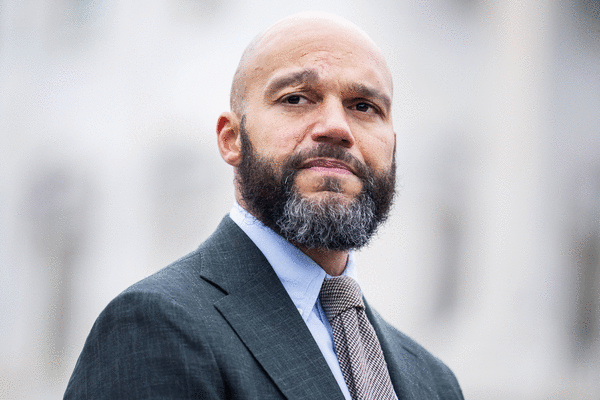
WASHINGTON — Robert White is poised to become the District of Columbia’s next nonvoting delegate to Congress, replacing retiring Del. Eleanor Holmes Norton and bringing a fresh voice to the role for the first time in 36 years.
A current at-large D.C. councilmember, White emerged as the victor in Tuesday’s Democratic primary in the District, all but guaranteeing a general election win this fall in the deep-blue stronghold.
White was leading the Democratic field with 63% of the vote when The Associated Press called the race shortly after midnight. Fellow councilmember Brooke Pinto trailed with around 22% in the primary, which also included former Justice Department official Kinney Zalesne, former Norton staffer Trent Holbrook and former Nuclear Regulatory Commission Chairman Greg Jaczko. White will next face lawyer Denise Rosado, who was unopposed for the Republican nomination.
White had endorsements from Massachusetts Sen. Elizabeth Warren and the campaign arms of the Congressional Progressive Caucus and the Congressional Black Caucus. Pinto supporters included Sens. Angela Alsobrooks of neighboring Maryland and Richard Blumenthal of Connecticut.
White’s likely victory in November would mark a new era for D.C. on the Hill. Over the past half-century, only two people have held the nonvoting seat in Congress representing the District’s now roughly 700,000 residents — Democrats Walter Fauntroy and Norton.
Norton, who announced in January she wouldn’t run for reelection, has held the seat since 1991. Once known as D.C.’s “warrior on the Hill,” she’s faced criticism that her grip on the job was slipping at a crucial moment as local issues seep into national politics and President Donald Trump threatens further interventions in D.C. affairs.
Trump deployed more than 2,500 National Guard troops in the District last year against the wishes of local leaders, and congressional Republicans have sought to tighten federal control. Rep. Andy Ogles, R-Tenn., and Sen. Mike Lee, R-Utah, say they want to repeal home rule altogether.
Last week, Trump was asked in the Oval Office about the D.C. mayoral race and what he would do if Janeese Lewis George, a democratic socialist and current member of the D.C. Council, won.
“Maybe we’ll take back Washington, run it on the federal basis,” Trump told reporters.
As of publication time, the AP had yet to call the Democratic primary for mayor, with Lewis George leading former D.C. Councilmember Kenyan McDuffie as votes continued to be counted. The race would be decided by ranked choice voting – being introduced for the first time this year – if no one takes a majority of the vote.
Threats to take over the District have also gained traction in Congress. Last fall, a number of Democrats joined House Republicans in advancing bills that aimed to roll back local criminal justice laws, frustrating local advocates who described it as an attack on D.C.’s already limited autonomy. And in February, both chambers voted to block changes to D.C’s tax code, despite pleas from local officials.
White, also a former Norton staffer, told CQ Roll Call in January that his prior experience on Capitol Hill would help him navigate those kinds of situations — something that he felt had room for improvement.
“In the entire Congress, there’s only one person whose top interest is the District of Columbia, and that’s the D.C. delegate. So people won’t understand why it’s important or why it matters across the country, unless the delegate explains it to them and makes them understand,” White said at the time.
The delegate is one of six members of the House with limited powers, joining Puerto Rico’s resident commissioner and delegates from American Samoa, the Northern Mariana Islands, Guam and the U.S. Virgin Islands. While they can sit on committees and perform other duties, they can’t vote on final passage of legislation on the floor.
Norton spent much of her tenure fighting for D.C. statehood, but advocates fear they’ve lost ground in that fight and now worry about preserving home rule, the system of limited self-governance first established for the District by federal law in 1973.
Under that law, Congress has the right to review and block local legislation passed by the D.C. Council, but it has done so only sparingly until recently.
“What I have said to members, including fellow Democrats, when they have voted to overturn D.C. laws is that you would never find that acceptable if Congress tried to overturn a law passed by elected officials in your state,” White said in January. “These are folks who want to score political points, and that is dangerous, because people live here – and their lives are impacted by the things that Congress does.”
©2026 CQ-Roll Call, Inc., All Rights Reserved. Visit cqrollcall.com. Distributed by Tribune Content Agency, LLC.
















































Comments