Mike Vorel: New Trail Blazers owner Tom Dundon could be cautionary tale for Seahawks
Published in Basketball
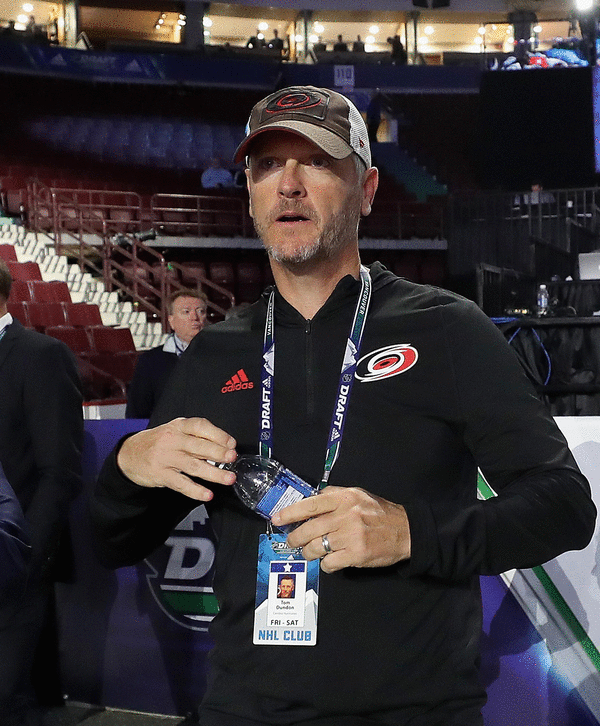
SEATTLE — This could be a cautionary tale.
Specifically, for the Super Bowl champion Seahawks.
Last month, the NBA board of governors approved a sale of the Portland Trail Blazers to a group led by Texas billionaire Tom Dundon. In the weeks since, Portland made its first playoff appearance since 2021, upsetting the Phoenix Suns in a play-in stunner. Powered by first-time All-Star Deni Avdija and former lottery picks Shaedon Sharpe, Scoot Henderson and Donovan Clingan, the Blazers — who fell to the favored San Antonio Spurs in five games — could contend for seasons to come.
It should smell downright rosy in Rip City.
But Dundon’s first impression has been frugal to a fault.
And Paul Allen’s estate — which will soon sell the Seahawks — handed him the reins.
The grievances, best classified by Sports Illustrated’s Chris Mannix, amount to “insane level cheapery, like, insane stinginess.” In his first month after buying the Blazers, the 54-year-old Dundon ruffled feathers for the following:
— Courting and interviewing possible replacements for interim coach Tiago Splitter … while Splitter was still leading the Blazers into the playoffs for the first time in five years.
— Setting a $1.5 million contract cap for his new coach, according to reports, which ESPN analyst Doris Burke called “not in the vicinity of even the low average.” By comparison, former Denver Nuggets coach Mike Malone — who would have been an intriguing Blazers target — opted instead to earn more than $8.3 million annually at the University of North Carolina.
— Declining to travel Portland’s two-way players (whose contracts allow them to bounce between the NBA and the developmental G League) to San Antonio for Games 1 and 2, an unprecedented act of penny-pinching. Dundon also declined to send a scout to the Minnesota-Denver series, the winner of which Portland would have played in the second round.
— Eliminating late hotel checkouts for staffers, which caused concern that the team masseuse might not have a suitable space to treat players before a recent play-in game.
— Refusing to provide T-shirts for fans at home playoff games, a widely accepted practice throughout the league.
Of course, Dundon did lead an investor group that paid $4.25 billion to buy the Blazers. It may sound like an oxymoron to write “cheap” and “billions” in the same sentence.
But take away the T-shirts, and people will talk.
“You can’t call someone cheap that just spent [$4.25 billion]. Except when you do all things cheaply, you’re going to be called cheap,” Golden State Warriors forward Draymond Green said on his podcast this week. “Because there’s just a standard in the NBA of how people will be treated, how players will be treated.”
There’s also a reason I wrote this could be a cautionary tale.
Because, like it or not, Dundon’s way might work.
Consider the NHL’s Carolina Hurricanes, who endured a nine-year playoff drought before Dundon bought the team in 2018. They’ve made the playoffs in all eight seasons since.
“I’m not following the NHL every night, but he knows what he’s doing,” NBA Commissioner Adam Silver recently said on the “Pardon My Take” podcast. “His mindset is, and I’m just getting to know him, but I don’t think it has as much to do with the cost of the T-shirts or wherever he’s saving money. It’s a mindset on how to run a business.”
Still, given Dundon’s aggressively frugal approach and the pleas for governmental aid in renovating the Moda Center, there’s concern about the Blazers’ long-term prospects in Portland. Relocation, for a franchise that has resided in the Pacific Northwest since 1970, is not an inconceivable outcome.
But the point is not to sound alarms. It’s to highlight how much ownership matters. It matters in player acquisition and development, in coaching and scouting and analytics, in facilities and fan engagement, in recovery and nutrition, in culture, in every corner the wrong owner could catastrophically cut. In perception and production.
(This will also be a relevant message for the Sonics, whose fans were betrayed by previous ownership, if/when the NBA approves their return.)
The impact of ownership is evident in the NFL, where Daniel Snyder’s dysfunctional Washington team mustered two playoff wins and zero NFC championship game appearances in his scandal stricken 24-year term. Where Dallas Cowboys owner Jerry Jones, who conducts ego-feeding postgame news conferences, hasn’t reached a conference championship game in more than three decades.
Where the Seahawks tallied just four playoff appearances in 21 seasons before being bought by Paul Allen in 1997 … and 17 playoff appearances, 11 division titles, four conference championships and two Super Bowls in 29 seasons since.
That’s a mind-boggling before and after.
But it’s not a mystery. It’s a testament to the influence of Paul and Jody Allen, among many others. In the last five years, Jody Allen signed off on the Russell Wilson trade, which brought future franchise cornerstones Devon Witherspoon and Charles Cross to Seattle. She made the agonizing — and necessary — decision to fire Pete Carroll after a remarkable 14-year run. She empowered general manager John Schneider, the reigning NFL executive of the year, and oversaw the hire of Mike Macdonald. She made a series of decisions that helped deliver a second Super Bowl.
Now, she has one more massive decision to make for this franchise.
I’m not naive; that decision may be dictated strictly by dollar signs. But I hope the Seahawks’ next owner(s), whoever they are, refuse to cut corners even after the first check clears.
Because “insane level cheapery” won’t win a Super Bowl.
©2026 The Seattle Times. Visit seattletimes.com. Distributed by Tribune Content Agency, LLC.




Comments