Are FIFA's exclusive Seattle World Cup jerseys worth the steep price?
Published in Soccer
SEATTLE — After what felt like eons of waiting, the World Cup officially arrived in Seattle on Monday.
The waiting period, which lasted anywhere from days to years depending on who you ask, was ripe with news from questions of who would play in the tournament to if FIFA would be able to sell their tickets, which were priced higher than ever before.
But when the day arrived, more than 66,000 people packed into Lumen Field, ahem, Seattle Stadium, for the first World Cup match in the city’s history. From the streets of Pioneer Square to the stands of the stadium, fans brought joy and excitement.
Despite the many fan frustrations, people in Seattle seem to have bought into FIFA’s Men’s World Cup — or at least, some parts of it. This year’s tournament features several new elements, from more teams to variable pricing. Some have been more well received than others.
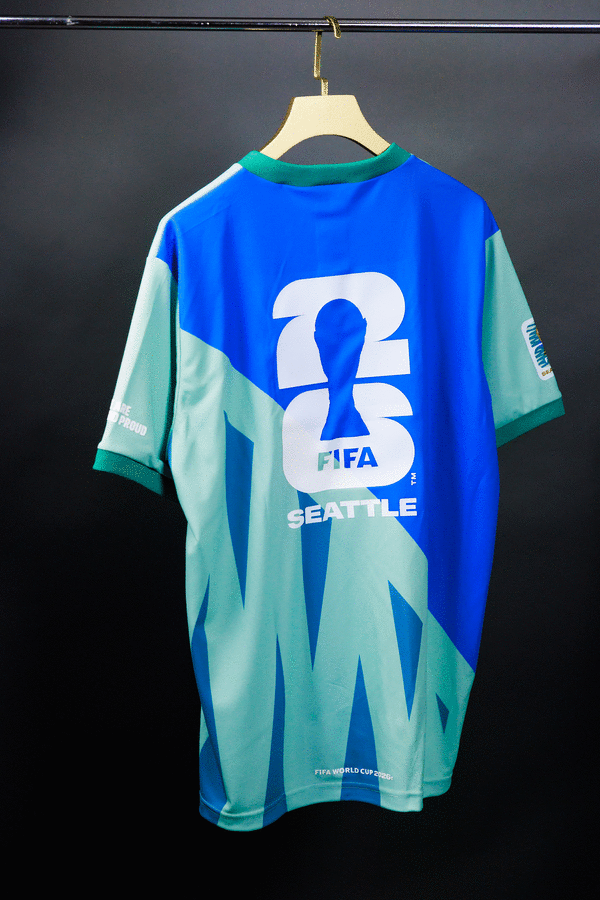
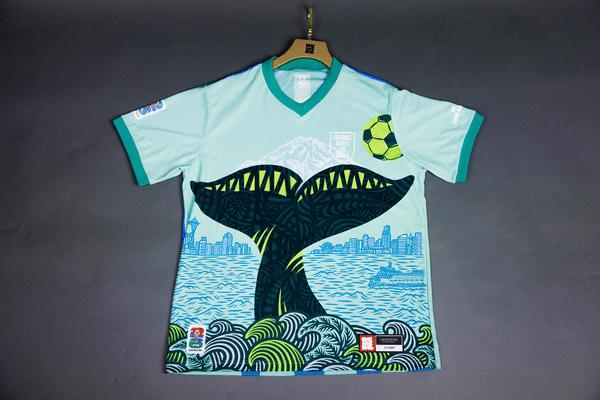
In early May, FIFA released a limited edition jersey collection, featuring 16 jerseys for each of the host cities. The jerseys — marketed as a one-of-a kind collectible — were each priced at $375 with 999 available. More than a month after the first four were released, none of the jerseys have sold out.
The jersey seemed to surprise some fans, who took to social media to express sticker shock and the feeling FIFA was disconnected from what fans wanted. Also caught by surprise was the local artist whose poster design is plastered on Seattle’s jersey.
‘This is not merchandise’
The Seattle jersey was among the first four released in FIFA’s limited edition host city collection on May 7.
Fans immediately took to social media, criticizing the item both for the price and the direct adaptation of the host city poster’s colorful design which features a whale tail and Mount Rainier.
Fans also criticized FIFA’s claim that the expensive jersey wasn’t intended to be worn.
“Not all jerseys are made to be worn,” the description of the product webpage read. “Some are created to last beyond the moment they represent. This is not merchandise. This is a collectible.”
Still, the jersey was made available in six sizes, from XS to XXL. The website touted additional features, including an NFC authentication chip and “luxury boxed packaging” that came with a certificate of authentication, hanger and “exclusive collector’s book.”
About two weeks after the jersey’s release, all six sizes remained available. On June 15, a few days after the start of the tournament, Seattle’s jersey was sold out only in XL and XXL. It’s unclear how the 999 jerseys produced were split among the sizes, and FIFA did not respond to a Seattle Times inquiry about how many jerseys had been sold last month. Of the other 15 cities’ jerseys, none have sold out.
FIFA also did not respond to a question about whether AI was used in the marketing materials for the jerseys which fans had suggested online when the promotional photos were released.
The jerseys were created in collaboration with a UAE-based company called Goat Skins that specializes in limited-edition clothing and produces a maximum of 999 pieces per collection. Other projects include a limited-edition DC Comics jersey collection.
Daniel Georr, the company’s founder, said he knows the company made a product that isn’t for everyone, and that’s OK.
“If FIFA produced only these jerseys, it would have been unfair for fans,” Georr said. “Fans have the choice. These are only 900 pieces and millions are going to buy merchandise.”
Fans can buy jerseys for their country of choice from FIFA starting at $100 which have the classic look that fans are accustomed to. But the limited edition jerseys all feature bright designs, adapted from each of the FIFA-selection host city posters.
“This is not fashion,” Georr said of the city jerseys. “This is something you’re supposed to hold in your hand and enjoy looking at. You enjoy looking at it, and trust me, if you wear it several times you might discover things that you didn’t see the first time.”
The project had a quick turnaround, with Georr getting the green light from FIFA in the fall. Goat Skins and FIFA had agreed to a collection honoring the host cities, and the decision was made to use the posters that had been designed by local artists. Georr said the poster designers were intentionally left untouched.
“The Seattle artist is from Seattle,” Georr said. “We will never understand Seattle better than him. We will never feel Seattle better than him. So we took this culture that he integrated in his poster, and we made this artifact.”
Local artist left out
Shogo Ota, the Camano Island-based artist who designed Seattle’s official World Cup host city poster, said FIFA did not notify him before the release of the $375 jerseys featuring his artwork.
The SeattleFWC26, a Washington-based organizing committee, separate from FIFA, named the Japanese artist the winner for the Seattle Host City Poster contest back in April 2025. Ota signed a contract with FIFA shortly afterward, granting the association full licensing rights to his design.
“Inspired by Shogo Ota’s powerful visual narrative, the design team approached the jersey not simply as merchandise, but as a cultural canvas rooted in Seattle’s identity,” FIFA said in a May email to The Seattle Times.
Ota shared the widespread public opinion that the jersey was “very pricey,” but, similar to Georr, said while it wasn’t for the general public “some big fan is gonna appreciate that.” According to Georr, Goat Skins was not in contact with any of the poster artists during the design process. Had there been more time, Georr said, he would have liked to collaborate with them directly.
“If they asked me to design it and don’t just want to translate the poster to the jersey, can you do something cool — yes, of course, I will do something,” Ota said.
Ota said his deal with FIFA was limited to designing the official host city poster and reasoned that while the association is responsible for large-scale merchandising, he is more focused on creating local projects with SeattleFWC26.
SeattleFWC26 paid Ota a $2,500 finalists fee once he was selected as one of the four finalists for the poster competition, according to Hana Tadesse, spokesperson for the Seattle committee. She said that the committee was only involved in hosting the contest and is not a party in the licensing contract with FIFA.
“FIFA has committed to provide the Seattle Host Committee a percentage of the revenue that it generated from sales of the Host City Poster. SeattleFWC26 has not yet received any of these payments and FIFA has not yet indicated the amount of these payments,” Tadesse wrote in an email. “SeattleFWC26 has committed to pay Shogo a percentage of any poster payment proceeds it receives from FIFA when SeattleFWC26 receives any such payments.”
FIFA did not respond to a request for comment regarding compensation to Ota or SeattleFWC26 at the time of publication.
Ota continues to work with SeattleFWC26 on various projects for an agreed-upon fee, altering parts of the host city poster while still maintaining the style and spirit of the original design.
For instance, Ota produced a separate limited-edition poster for the committee’s SEA&WIN interactive mobile game app, showcasing a blue heron detailed in the same tribal-inspired style. He also created the 130-foot banner draped down the Nordstrom on Pine and 6th St, featuring a pair of cleats hanging off an orca tail.
Additionally, in partnership with the Port of Seattle, he painted two pillars at Pier 69, adding a kraken to accompany the orca.
SeattleFWC26 has worked with other local artists, leading up to the tournament, including a mural done by Leo Shallat and a sculpture produced by Gerard Tsutakawa outside of Lumen Field, titled “Vital Spirit.”
Ota emphasized throughout his time working with the SeattleFWC26, he views the committee differently from FIFA.
“I understand they cannot do both things,” Ota said. “Seattle has to focus on community and people, and then FIFA has focused on selling tickets and those big merch (items).”
____
©2026 The Seattle Times. Visit seattletimes.com. Distributed by Tribune Content Agency, LLC.






Comments