South Florida Democrats may be knocked out of Congress by DeSantis' new map
Published in News & Features
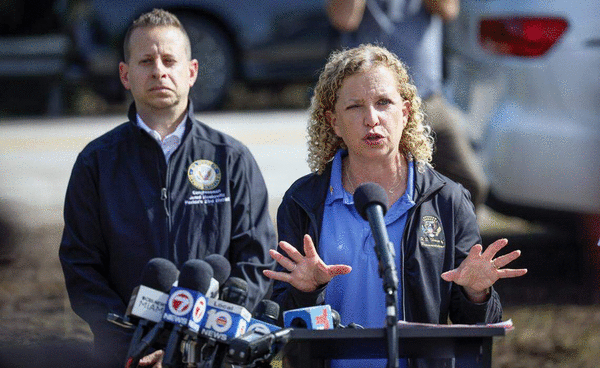
MIAMI — The Broward and Palm Beach County congressional districts represented by Democratic mainstays Debbie Wasserman Schultz and Lois Frankel will favor Republican candidates instead when voters head to the polls this November under new voting maps proposed Monday by Gov. Ron DeSantis’ office.
The maps, which must be approved by the Legislature, would eliminate four of Florida’s eight Democratic-friendly congressional districts in a state with 28 U.S. House members. The Orlando-area district held by Democrat Darren Soto and Tampa-area district held by Rep. Kathy Castor would also favor Republicans, according to the proposal.
The map would also make the district currently held by Rep. Mario Díaz-Balart district more competitive for Democrats in November.
“The process they went through to try to make those seats more Republican, I wouldn’t want to be Mario Díaz-Balart right now. I’m sure he woke up to a district he wasn’t expecting,” Democratic political consultant Steve Schale said.
Díaz-Balart did not respond to a request for comment.
The Florida Legislature is set to begin a special session tomorrow to discuss and vote on the maps. Democrats say the maps are a partisan power grab, but they have little power to stop them in a Legislature with a Republican supermajority.
“DeSantis’ maps absolutely cuts the people’s representation. It is a partisan gerrymander,” House Democratic leader Fentrice Driskell told reporters Monday. “We’ve heard rumors for months that they intended to take aim at Debbie Wasserman Schultz and Jared Moskowitz.”
South Florida, where there are now five Democrats elected to the House of Representatives, would only feature three left-leaning districts. The new districts would likely pit Democratic incumbents against each other in the August primaries, or force some of them to run in Republican-friendly districts. Much of Rep. Jared Moskowitz’s current district, for example, is drawn into Congressional District 25 — currently represented by Wasserman Schultz — in DeSantis’ proposed map.
“This clear effort to steal more seats for Republicans shows [DeSantis’] total contempt for Florida voters, who voted two-to-one in favor of a ban on partisan gerrymandering in our Constitution,” Wasserman Schultz wrote in a statement Monday.
Moskowitz did not respond to a request for comment. Frankel said, “The district number is not relevant,” but wanted to look closer before commenting further.
DeSantis’ has defended the maps as a response to Florida’s population growth and a state Supreme court ruling on how lawmakers consider race when drawing voting maps. He had previously pointed to an expected Supreme Court ruling on the federal Voting Rights Act as justification as well, but that ruling hasn’t come down.
Cramming a majority of Florida’s 4 million Democrats into just four districts could put some Republican-held seats at greater risk in November. After a string of Democratic special-election wins across the country, Democrats have been bullish about flipping seats in Florida. The major Democratic super political action committee House Majority PAC made initial advertising buys worth $20 million in Florida last week — their first ad buy in the state since 2020.
Those ads were already going to target voters in the districts held by Republicans María Elvira Salazar and Carlos Giménez. Under the proposed new maps, both incumbents have about the same number of 2024 Donald Trump voters as their current districts do, according to a Miami Herald analysis of data compiled by Dave’s Redistricting.
But at least one South Florida district held by a Republican could become more competitive for Democrats in November under the proposed voting map. Almost 70% of voters cast a ballot for Trump in 2024 in the Miami-area District 26 represented by Díaz-Balart. Just 58.6% of the voters drawn into the proposed new District 26 voted for Trump, the data show.
Democrats writ large are decrying any redistricting effort, but if the maps do pass as they are, it could put all of Miami in the center of Democratic efforts to flip districts in Florida.
“If Miami Hispanic [voters] revert back to something closer to the mean over the last 10 or 15 years, I think all three of those are going to be in play,” Schale said. He added that Gimenez’s seat is likely the biggest reach for Democrats of the three. “But in a cycle like this, I don’t know what’s a reach and what’s not.”
©2026 Miami Herald. Visit at miamiherald.com. Distributed by Tribune Content Agency, LLC.






Comments