Trump signs order to tighten Cuba sanctions, targeting foreign banks, companies
Published in News & Features
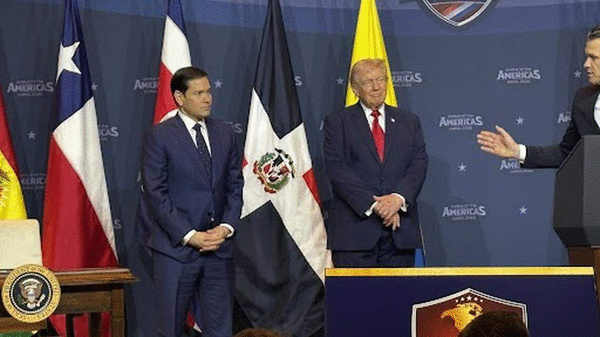
President Donald Trump signed an executive order on Friday that significantly hardens sanctions on the Cuban government, authorizing sanctions on foreign companies and banks that do business with Cuba.
Cuba is under a comprehensive U.S. trade and financial embargo, but so far the prohibitions have mostly affected U.S. companies and people under U.S. jurisdiction. But for the first time, the new executive order threatens sanctions on foreign companies and banks from other countries found to be helping the Cuban government, a type of sanctions labeled “secondary.”
The broad executive order uses a new legal authority, the International Emergency Economic Powers Act, to expand the embargo on Cuba. It authorizes blocking the U.S. assets of “any foreign person” that operates in key Cuban economic sectors such as energy, defense, mining and financial services. It gives the secretaries of the Treasury and the State Department the authority to add other sectors of the Cuban economy.
For the first time, foreign banks worldwide that conduct or facilitate transactions for the Cuban government and other individuals and entities sanctioned under Friday’s executive order risk losing access to U.S. dollars. The order authorizes the Secretary of the Treasury to restrict or block their bank accounts in the United States.
The decades-old U.S. embargo already prohibits U.S. banks from processing transactions involving Cuba, with very few exceptions, but the new measure will further complicate the Cuban government’s efforts to find foreign banks willing to work with it.
The new sanctions, first reported by Reuters, come after a recent round of negotiations in Havana in which senior State Department officials told their Cuban counterparts that the island has a small window of time to act on key U.S. demands, including the release of political prisoners and implementing significant economic and political reforms.
“This is a clear escalation,” said Brian Fonseca, Vice Provost for Defense and National Security Research and Director of the Jack D. Gordon Institute for Public Policy at Florida International University.
“Washington is doubling down on economic pressure by raising legal and financial risk for anyone helping sustain the Cuban regime’s economy,” he added. “Secondary sanctions are the centerpiece here. They’re designed to reach beyond Cuba and force global banks and companies to stop enabling the regime’s economic survival.”
Experts have stressed how broad the language in the executive order is. For example, Treasury can also block property in the United States belonging to foreign entities or persons found to “have materially assisted, sponsored, or provided financial, material, or technological support for, or goods or services to or in support of, the Government of Cuba.”
The executive order also blocks assets owned or controlled by the Cuban government, its agencies, companies and officials. Those are already blocked under previous sanctions, but the new order also targets former government officials, as well as companies and people who may act as a front for the Cuban government. It freezes the U.S. properties of “entities or persons who have acted or purported to act for or on behalf of, directly or indirectly, the Government of Cuba.”
The new restrictions do not affect trade and financial transactions authorized by embargo exceptions or government authorizations, called licenses, according to the executive order.
The order also includes an expansive clause allowing the U.S. government to sanction the adult relatives of designated individuals. And it requires no prior notice given to anyone in the United States affected by it.
Friday’s announcement was a long time in the making, after Trump issued a national security memorandum last year calling for strengthening sanctions on the Cuban government and its military, which controls some of the most important economic sectors on the island. In January, Trump signed another executive order threatening tariffs on countries providing oil to Cuba, calling the island’s government “an unusual and extraordinary threat.”
John Kavulich, the president of the U.S.-Trade and Economic Council, said Friday's executive order has the potential to be “almost immeasurably impactful upon Cuba,” especially regarding banking. But he cautioned that Cuba’s foreign allies might test it, given the administration lack of detailed implementation of previous executive orders related to Cuba.
But even the threat might dissuade foreign companies and banks from pursuing business opportunities on the island, experts say, especially at a time Cuban officials have been touring abroad seeking funding that would allow the government to resist U.S. pressure.
Talks between the two countries have stalled, after Havana rebuffed key U.S. demands while announcing some economic measures that fall short of Washington’s expectations.
On Friday, the Cuban government organized its usual May 1 Workers Day parade, this time with a message that the country can resist U.S. aggression. Despite the shortages of fuel, images of social media show lines of buses used to transport students and state workers to the event, whose participation is usually mandatory.
Raúl Castro, still the most powerful figure in Cuba who is soon to turn 95, joined the parade early morning Friday at a point closer to the “Anti-Imperialist Tribune,” the stage near the U.S. Embassy, where officials gave speeches questioning how Cuba could be considered a threat to U.S. national security.
A bullish Miguel Díaz-Canel, the country’s handpicked president who has vowed to die for the revolution, published a picture of the rally with the caption: “United as one, standing shoulder to shoulder, we demand PEACE and reiterate our readiness for unconditional dialogue. Fear has no place here.”
_____
©2026 Miami Herald. Visit miamiherald.com. Distributed by Tribune Content Agency, LLC.




Comments