'They just want to get it done:' More Florida women turn to mail-order pills for abortions
Published in News & Features
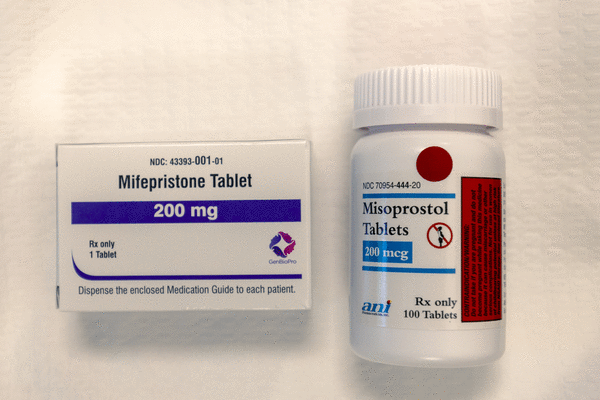
FORT LAUDERDALE, Fla. — When Florida’s six-week abortion ban went into effect two years ago, advocates expected a sharp rise in women traveling for abortion care to states with less restrictive laws. While many did travel, the surprising increase occurred in Florida women using medication from out-of-state telehealth providers to end their pregnancies.
Newly released counts now show that in 2025, one in four abortions in Florida (28%) were women using medication from providers in states with laws that shield those who prescribe them, according to Florida data and Guttmacher Institute’s Abortion Provision Study. The Florida telehealth numbers mirror a national shift in the way people in states with bans access abortion care.
“I think the message is getting out that reproductive health is accessible regardless of what state someone lives in,” said Leo Raisner, executive director of Mayday Health, a nonprofit that educates on reproductive health options. Mayday held several events in Florida in the last two years to educate women on the availability of abortion medication and also sponsored digital advertisements about abortion medications on social media.
But that could change. Quickly.
A lawsuit brought by Louisiana aims to ban doctors nationwide from remotely prescribing the abortion pill mifepristone via telehealth and mailing it across state lines. On Friday, a three-judge panel of a federal appeals court in New Orleans ruled in that case that the abortion pill can be distributed only in person and at clinics, overruling regulations set by the federal Food and Drug Administration. The ruling, which may be the most pivotal change in abortion policy since the 2022 Supreme Court ruling that overturned Roe v. Wade, is likely to be appealed to the U.S. Supreme Court.
The medications known as mifepristone and misoprostol are approved by the U.S. Food and Drug Administration for use in the first 10 weeks of pregnancy. The pills have become the most common method for abortion in the U.S., according to the CDC’s Abortion Surveillance System.
Florida law prohibits abortion by telehealth by in-state providers. But 15 states, including New York, Illinois and Maryland, have passed shield laws that protect clinics and physicians who provide the procedure across state lines. Appointments are conducted by telehealth, and abortion medication is mailed to the patient. The number of medication abortions in Florida and the U.S. likely are even higher when including pills mailed from international websites and other online platforms.
“For some people, travel is hard to access, and medications via telehealth are faster and cheaper,” said Robyn Schickler, chief medical officer of Planned Parenthood of Florida. “They just want to get it done.”
Nationally, the proportion of abortions from mail-order medication has been increasing since the Supreme Court overruled Roe v. Wade in June 2022, and states began imposing bans. It went from 5% in the first half of 2022 to 27% by the first half of 2025, according to the Guttmacher Institute, a research organization providing reproductive health data.
“Part of the story here is the way in which the telehealth provision has offered another mode of access for women to abortion care,” said Isaac Maddow Zimet, a data scientist with the Guttmacher Institute. “The drop in abortions would have been steeper if not for the fact that people can access care through telehealth services.”
Although Florida doctors cannot prescribe abortion pills without an in-person visit, officials have not been able to enforce the law on out-of-state physicians protected from liability.
In-person abortions see a massive decline
In Florida, the majority of abortions still occur in person; however, the number has significantly declined in the last two years.
In-person abortions in Florida decreased from 84,052 in 2023, the last full year before the six-week ban went into effect, to 48,149 abortions in 2025 — a nearly 43% drop, data compiled by Florida’s Agency for Health Care Administration shows. The majority of abortions in Florida in 2025 took place in the first trimester, with only 319 occurring in the second trimester, mostly because of a fatal fetal abnormality, the data shows.
For women like 22-year-old Nellyann Martinez, a Tampa Bay preschool teacher, the state’s restrictions have real-life implications.
Martinez found out at 10 weeks of her pregnancy that her daughter wasn’t developing as expected. At 14 weeks, Martinez learned the baby had a rare, severe congenital brain malformation.
“If they had told me earlier, they could have done a D&C,” she said. (A dilation and curettage is a common surgical prodecure that removes tissue from the uterus.)
Because of the state’s abortion ban, Martinez said she will carry the baby to term and give birth at a Tampa hospital. Most infants with the baby’s condition do not survive beyond the first week. The families of her students are raising money to help cover the medical expenses ahead.
“She’s growing and kicking,” Martinez said. “It’s going to be difficult.”
Fewer women travel for abortion care
Some women in Martinez’s position, further along than six weeks, have traveled outside of Florida in the last two years to get abortion care in states with less restrictive laws. New York and Virginia became common destinations for Floridians. Overall, the number of Florida residents who traveled out of state for abortion care almost tripled between 2023 and 2024, from 2,800 to 8,200, and preliminary counts suggest that the number of Floridians traveling out of state also increased in 2025, according to the Guttmacher Institute.
Yet, the increase in travel hasn’t been as significant as expected when Florida’s six-week ban went into effect on May 1, 2024 — mostly because telehealth across state lines has played an increasingly critical role, Guttmacher found. Travelers still represent only about half the number who received medication abortions via telehealth, according to Guttmacher data.
Michelle Quesada, interim executive director of Planned Parenthood of Florida, said since the six-week ban went into effect, its patient navigators in Florida have connected more than 6,000 patients to resources in other states. “There’s still a very large number of patients who are traveling to other states to get that inpatient care,” she said.
Prior to the changes in abortion laws, Florida had drawn women from other states and countries.
Now, travel to Florida for abortion care has plummeted. Over 9,000 people traveled to Florida for abortion care in 2023; the number dropped to 2,200 just two years later in 2025, Guttmacher found.
Have Florida abortion clinics closed?
Abortion advocates nationwide feared clinics would close in droves as states imposed abortion bans. It hasn’t happened.
As of late 2025, there were approximately 753 brick-and-mortar clinics providing abortion services in the United States, representing a 7% decline from 2020, according to the Guttmacher Institute. Florida went from 57 brick-and-mortar clinics in 2021 to 49 in 2025, representing a 14% decline, according to data from Florida’s Agency for Health Care Administration.
However, since Florida’s six-week ban went into effect, the state reported only three fewer clinics as of year-end 2025.
“Clinics try hard to stay open, often under financial strain,” said Maddow Zimet with Guttmacher. “I think Florida’s numbers speak to efforts of facilities to maintain access to care.”
Inside Florida clinics, women continuously arrive further along than six weeks, shocked when they are turned away.
“Some of our patients are totally blindsided and don’t know there is a six-week ban in Florida,” said Schickler of Planned Parenthood of Florida, which operates 16 women’s health clinics in the state. “Most often, the initial reaction is a lot of crying.”
Over the last two years, Schickler said Planned Parenthood is working harder on education. “In our health centers, we are letting patients know, even if they’re not there for a pregnancy test, we are letting them know that there is a six-week ban in effect,” she said.
Fear of breaking the law has intensified
The reverberations of Florida’s six-week ban have been felt in doctors’ offices and emergency departments across the state.
Florida women who have experienced pregnancy complications told the Sun Sentinel they are being turned away from emergency departments — until their conditions worsen, even when profusely bleeding.
Schickler of Planned Parenthood sees some of those women in her clinics.
“We get people who have been to the ER and are actively miscarrying, either were still bleeding or the pregnancy had passed but didn’t come out, and they just sort of get sent home,” she said.
“We also get a fair amount of referrals from providers who are still feeling nervous about even doing some miscarriage care,” she said.
Florida abortion records illustrate the hesitancy of physicians to participate in abortion care.
A report by the Agency for Healthcare Administration shows that all abortions in 2025 occurred in clinics or hospitals. Physicians no longer do abortion procedures in their offices.
“I have colleagues in practices that were totally good doing abortions, and then this ban happened, and just basically to be on the safe side, they just won’t do anything,” Schickler said. “And I would add to that, I think the abortion ban has really expanded the amount of people it touches. We’re hearing from fertility doctors who, when something goes wrong in the fertility treatment plan, they need help with miscarriage management.”
Schickler said that although Planned Parenthood of Florida still operates 16 clinics, daily care has become more stressful for workers
“I feel it when I am in the clinics,” she said. “Everyone is bringing so much stress to their visit with them … they are much more anxious than in the past. So from a providing care standpoint, it feels very different.”
©2026 South Florida Sun Sentinel. Visit sun-sentinel.com. Distributed by Tribune Content Agency, LLC.






Comments