North Atlantic right whales see 'positive news' this calving season
Published in News & Features
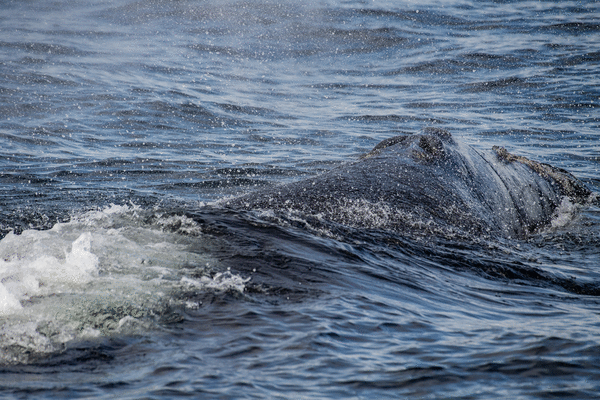
BOSTON — It has been a good year for the North Atlantic right whale, according to scientists at the New England Aquarium.
The calving season, from mid-November until mid-April in the Southeast, generated “positive news” for the critically endangered species, as it produced 23 mother-calf pairs, the fourth-highest count ever.
So far this spring, at least 18 mother-calf pairs have been seen in Massachusetts waters. The most recent sighting came on Wednesday when a mom and her child were seen in Gloucester Harbor.
About 380 individual right whales remain in the world.
Scientists at the Aquarium’s Anderson Cabot Center for Ocean Life tracked the season closely, and they said they are “pleased” to see shorter intervals between calving for most whale moms.
Amy Warren, the center’s scientific program officer, says that scientists had been seeing “nearly 10 years between calves for some females,” in contrast to every three to four years when a healthy right whale can give birth.
But this season proved different.
“Many of this year’s moms have had shorter intervals,” Warren said in a statement, “18 of them previously gave birth within the last six years – giving us hope that they may be healthier and can help grow the population faster.”
Research teams from the Anderson Cabot Center have documented more than one-third of the 23 pairs seen in the Southeast earlier this year in Cape Cod Bay this past month. By the end of the calving season, most of the right whales had begun migrating from Florida, Georgia and the Carolinas.
Scientists say there are three first-time mothers this season, with two of them just 10 years old, the age at which they expect females to begin calving. The mom group also includes two elder right whales who are at least 40 years old and have given birth to at least nine calves, one shy of the current record.
“It is hopeful to see 23 new calves born this year,” Warren said, “but their survival into adulthood is still a long journey ahead in an ocean with many dangers and obstacles.”
In January, when right whales typically remain in the Southeast, at least 23 individuals were spotted south of Nantucket. The sightings prompted the National Oceanic and Atmospheric Administration to implement a voluntary speed zone, limiting mariners to 10 knots to protect the species.
Vessel strikes are one of the leading causes of injuries and deaths for right whales. Scientists say vessels must slow down to the recommended speed.
©2026 MediaNews Group, Inc. Visit at bostonherald.com. Distributed by Tribune Content Agency, LLC.






Comments