'I intend to stay on it forever.' Along with rapid weight loss, patients see other benefits and risks of GLP-1 drugs
Published in Health & Fitness


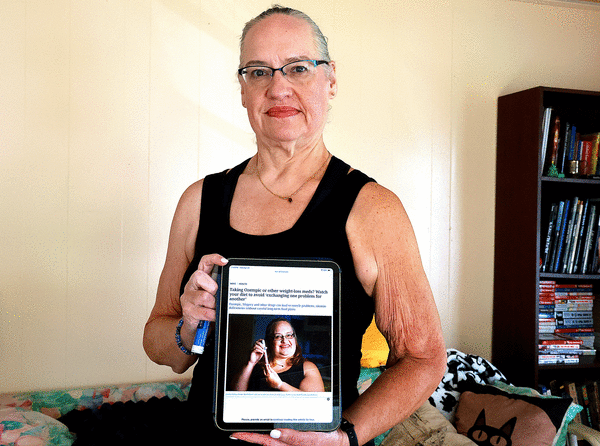



FORT LAUDERDALE, Fla. — Two years ago, Jennifer Kirtley looked down at the scale and saw 328 pounds. Today, she’s looking in the mirror at a size 6.
After a transformative 180-pound weight loss from weekly Wegovy shots, Kirtley says she is happy with her overall weight and health.
“My blood pressure is down. My A1C is down. I have no desire to drink alcohol and my food cravings have gone away,” Kirtley said.
But there have been some surprises for the Lake Worth Beach woman.
After overcoming the initial nausea, Kirkley said she has experienced unexpected benefits linked to the class of weight-loss and diabetes drugs known as GLP-1s, sold under the brand names Ozempic, Wegovy, Mounjaro and Zepbound. One of those advantages is the anti-inflammatory effects. Kirtley says the inflammation in her once arthritic knee is mostly gone. And, because she has combined weight loss with exercise, she said she feels stronger.
The less favorable effects, she said, include hair thinning and excess skin.
Comfortable with her current weight, Kirtley is about to switch to the Wegovy pill, which was recently rolled out in pharmacies. “I intend to stay on it forever,” she said.
Medications that suppress appetite and increase feelings of fullness are allowing people to better manage diabetes and obesity. However, as prescriptions for weight-loss drugs soar, additional benefits and risks of GLP-1 drugs are emerging. New research reveals a potential link between GLP-1 drugs and improvements in myriad health conditions, including sleep apnea, joint pain, liver disease, heart disease, asthma, and even addiction.
♦ ♦ ♦
South Florida clinicians say they see firsthand some of the surprising benefits of these drugs.
Heart disease
Large clinical trials revealed a striking finding: GLP-1 drugs reduce the risk of heart attacks, strokes and cardiovascular death.
A 2023 study of more than 17,000 patients published in the New England Journal of Medicine found that semaglutide reduced the risk of major cardiovascular events — including heart attack, stroke and cardiovascular death — by about 20% in overweight or obese adults who already have cardiovascular disease but not diabetes.
Dr. Leonard J. Pianko, founder and medical director of the Aventura Cardiovascular Center, lost nearly 90 pounds while taking GLP-1 medications. A CAT scan before Pianko started Mounjaro showed a greater-than-normal amount of plaque. “That’s why I started on it,” the cardiologist said. Three years later, a significant amount of that plaque is gone.
“That shows there can be some regression of heart disease,” he said. “Certainly, most people on GLP-1s at least have stabilization of plaque; it doesn’t get worse.”
Liver disease
South Florida obesity doctors say they are seeing improvement in nonalcoholic fatty liver disease in patients on semaglutide.
Research backs up the finding.
After clinical trials, the U.S. Food and Drug Administration has approved Wegovy (semaglutide) injection to treat metabolic-associated steatohepatitis in adults with excessive scar tissue in the liver. MASH is a severe form of metabolic liver disease — the progressive stage of fatty liver disease. The FDA said about 6% of U.S. adults, about 14.9 million people, have MASH, and its prevalence is expanding.
Fertility
South Florida fertility specialist Dr. Armando Hernandez-Rey says medications such as Ozempic and Wegovy can indirectly improve fertility. Weight loss, he explains, can enhance ovulation and the symptoms of polycystic ovary syndrome, a common hormone imbalance. Hernandez-Rey explains that 30% to 35% of the population with PCOS seek fertility treatment.
Researchers are studying the association after women with PCOS who have struggled for years with low fertility or infertility are posting on social media about their surprise “Ozempic babies.”
Limited data exists about exactly how GLP-1 medications affect fertility, pregnancy and breastfeeding. But as the popularity of these medications grows, so too does the research. As many as a dozen studies involving GLP-1 use are underway for women with PCOS and obesity.
Hernandez-Rey said it is strongly recommended to stop GLP-1 medications at least one to two months before attempting pregnancy to avoid potential risks to a fetus. However, many Ozempic babies were born after their mothers conceived while on the medication.
“I haven’t seen any negative effects on babies as a result,” he said. “The idea is to discontinue them once you learn you are pregnant.”
A few observational studies also suggest that GLP-1s may increase fertility in men, particularly those with obesity. Experts believe that weight loss increases testosterone levels, reduces inflammation, and improves sperm quality, but large-scale studies are needed to confirm a link with GLP-1s.
Cancers
While preclinical data have raised concerns about GLP1 use and thyroid cancer, a 2025 study by University of Florida researchers found the medications are associated with a 17% lower risk of developing 14 obesity-associated cancers, including endometrial, meningioma and ovarian cancers.
“The mechanism of each cancer is a bit different, but the bottom line is that, in the big picture, it comes down to decreasing the inflammatory effect,” said Dr. Sonya Daryanani, internist and obesity specialist with Nova Southeastern University. “You are decreasing the chronic inflammation, and that can really help in reducing tumors.”
In addition, Dr. Jacob Tangir, with The Center for Gynecologic Oncology in Miramar, said while studies are in early stages, the data on GLP-1 and endometrial cancer are encouraging.
“We can’t prove that the drug itself affects the development of cancer cells. That is more complicated to prove,” he said. “But what is likely is that by decreasing obesity, a risk factor, people get less endometrial cancer.”
Tangir said the GLP-1s also are curbing a pre-cancer condition in the uterine lining called complex atypical hyperplasia.
“GLPs together with progesterone reverse this pre-cancer condition in a higher proportion of people than if they were treated with progesterone alone,” Tangir said. “And that’s a big thing for younger patients who are overweight because it will help them preserve the uterus so they can conceive.”
Alzheimer’s and dementia
The research is not conclusive on the use of GLP-1 and Alzheimer’s, but some preliminary data is encouraging.
Two global clinical trials studying semaglutide and Alzheimer’s failed to show a significant reduction in cognitive decline compared to placebo. The drug did improve unspecified markers of the disease.
However, research continues on the potential for GLP-1s to become part of a new class of Alzheimer’s treatments, potentially complementing other approaches that target amyloid and tau proteins.
Addiction/mental health
A study of more than 2 million people with diabetes taking the popular weight-loss drugs found the medications were associated with reduced risks of seizures and addiction to substances such as alcohol, cannabis, stimulants and opioids.
“The substance abuse is where these GLP ones might have the most promising benefits,” said Dr. Gil Lichtshein, a Boca Raton psychiatrist.
Other effects may be mood improvement, tied more to results. Kirtley, who has lost 181 pounds, says her outlook on life has improved. “I am sleeping better. I am happier. I am more comfortable in my body and how I move through the world,” she said.
Dr. Manisha Chand, an obesity medicine specialist at the Cleveland Clinic Weston, said her patients on the medications are happier, too.
However, some doctors also say they are hearing about mood flattening from people on the medication. The Washington Post reported that several studies are underway to better understand why some people lose motivation for activities and experience apathy while on GLP-1s.
♦ ♦ ♦
Along with unexpected benefits, medical specialists in South Florida also see patients grappling with the drawbacks of GLP-1 use.
Hair loss
Hair loss with weight-loss medications is a real phenomenon, but it is more indirectly related to other factors than to the medications themselves, said Dr. Jeffrey Fromowitz, a Boca Raton dermatologist.
Fromowitz said rapid weight loss pushes follicles into the shedding phase. In clinical trials, hair loss was directly proportional to the rate and total amount of weight loss in people on the drugs.
Muscle loss and bone weakening
Numerous studies have documented that rapid weight loss from Ozempic and other medications can cause significant muscle loss, especially in people who don’t increase their protein intake.
Chand at the Cleveland Clinic Weston said another side effect can be a reduction in bone density and an increased fracture risk.
“When you have accelerated weight loss, you do tend to lose a little bit of lean muscle mass as well, and that includes some bone mass. You’re not going to lose 100% fat,” Chand said.
She said combining GLP-1 therapy with strength training and ensuring adequate nutrient intake can help protect bone health.
“A lot of physicians who treat obesity will tell you to go low and go slow when prescribing the weight-loss drugs,” she said. “It’s not about who gets to the highest dose fastest. It’s not about getting to your goal weight in three months. It’s about steadily getting the weight off and being able to keep it off.”
Droopy skin
South Florida plastic surgeons say they are seeing patients who lost weight on Ozempic and then feel their faces have aged five years overnight. Dr. George Kamal explains that as people lose weight, they also lose the underlying fat that helps plump and fill out the face, giving them a sunken look, and experience a decline in collagen and elastin.
“I am seeing it quite a bit,” said Kamal, a South Florida plastic surgeon who employs a combination of treatments to help — from fillers to facelifts and necklifts.
In addition, with weight loss often comes excess skin, another condition Kamal increasingly encounters as semiglutides become more prevalent.
“In the past two years, I have seen an increased prevalence of excess skin all over the body,” he said. “I am removing it from the abdomen, thighs, arms and buttocks.”
Vision problems
The American Optometric Association says that when on weight-loss drugs, temporary vision changes, such as blurred vision, are common as blood sugar stabilizes. Another side effect can be dry, irritated eyes because of dehydration.
However, some more serious risks are non-arteritic anterior ischemic optic neuropathy, a form of permanent “eye stroke,” and diabetic retinopathy, a worsening of existing diabetic eye disease.
Daryanani at Nova Southeastern University said she advocates slow and steady weight loss and monitoring by an ophthalmologist to avoid this risk.
Dental concerns
Lesser known effects of weight-loss drugs — such as chronic dry mouth, nausea and vomiting — can cause enamel erosion, tooth decay, increased sensitivity and gum issues.
Some Florida dentists say their patients on weight-loss medications report these concerns. The American Dental Association advises when on GLP1s to pay close attention to increasing hydration and stepping up oral hygiene.
Gallbladder disease
Shelly Roth of Hollywood is thrilled that she lost nearly 80 pounds on Ozempic. While she was aware of the diarrhea, vomiting and nausea that some people get when adjusting to the medications, she did not expect the painful gallbladder issues that cropped up.
GLP-1 medications work in part by slowing digestion, helping people feel full longer, and reducing overall calorie intake. However, as part of that, the gallbladder empties less frequently and more slowly.
“When patients lose weight quickly, the bile thickens,” according to Oklahoma surgeon Dr. William Hinojosa. “Thicker bile can lead to gallbladder sludge, which can then turn into gallstones. When you combine thicker bile with a gallbladder that’s not emptying well, you start seeing more gallbladder attacks.”
A meta-analysis of 76 randomized clinical trials found that the risk of gallbladder problems increases when weight-loss medications are used at higher doses and for longer durations.
Roth plans to have her gallbladder removed.
©2026 South Florida Sun Sentinel. Visit at sun-sentinel.com. Distributed by Tribune Content Agency, LLC.









Comments