Auto review: 2026 Dodge Charger Scat Pack: Two fewer cylinders, but same bad attitude
Published in Automotive News
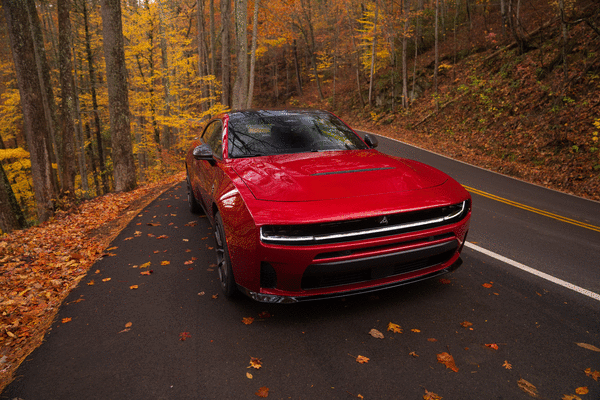



The Dodge Charger has always been an argument on wheels, preferably shouting, occasionally sideways, and often accompanied by tire smoke and poor judgment. Since 2006, when the nameplate was reintroduced after a two-decade hiatus, Dodge’s side of the argument has been simple: V-8 beats everything, and if you disagree, you’re probably French. Dodge detonated that orthodoxy with the 2025 Charger Daytona EV, which was like going to a steakhouse famous for dry-aged ribeye and ordering the vegan special. For Charger customers raised on the advertising mantra “That thing got a Hemi?” it was an automotive heresy bordering on sacrilege.
Now comes the 2026 Dodge Charger R/T and Scat Pack, powered not by electrons, but by Stellantis’ “Hurricane” twin-turbocharged inline-six branded, with admirable frat-house honesty, as the Sixpack. The name is apt. This Charger is clearly aimed at gym-obsessed bros with six-packs, or those who lack them but heroically consume them by the dozen. There is nothing wrong with that; it is, in fact, the backbone of the American economy. Still, this won’t pacify Hemi intransigents, even if the new inline-six is objectively the better engine, one that’s more efficient, more flexible, and every bit as alive, loud, and powerful as the V-8s it replaces. It is annoyingly good, which is possibly the most infuriating outcome imaginable for traditionalists.
The Sixpack is offered in R/T trim with 420 horsepower or, more importantly, in Scat Pack form with 550 horsepower, though for now, only the latter is available. Power is routed through a ZF-designed eight-speed automatic transmission. All-wheel drive is standard, as are Brembo brakes and an aluminum multi-link suspension, which sounds suspiciously like something borrowed from a car that corners.
And while this might look like Dodge scrambling to undo an unpopular electric debut, it isn’t. The EV Charger was always meant to arrive first. Dodge didn’t change direction; it just let the outrage run its course.
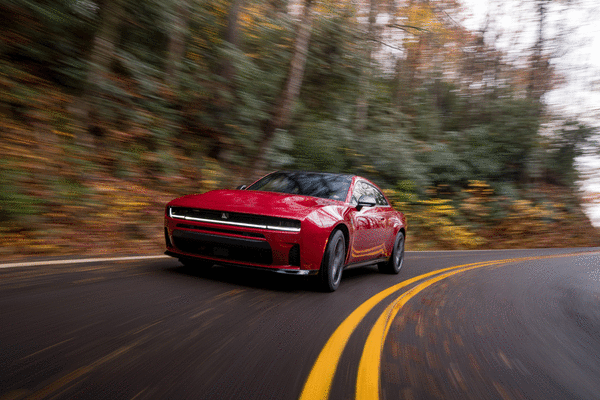
From behind the wheel, the Charger Scat Pack delivers the unsettling realization that Dodge may have been right all along. The twin turbos spool quickly, torque arrives with authority, and the Charger lunges forward with the enthusiasm of an espresso-fueled Labrador chasing a tennis ball. It doesn’t feel like a consolation prize. It feels like escalation. The standard all-wheel-drive system gives the Charger astonishing launch grip, especially for something this enormous. Intelligently, Dodge allows you to disengage your better judgment and send power totally rearward, restoring the traditional Charger experience of mild terror and imminent tire replacement.
At nearly 207 inches long and 84 inches wide, including mirrors, this is a full-size car. So, it’s no lightweight, weighing the same as a congressional subcommittee. But the modern suspension tuning keeps it surprisingly composed despite its span, and it’s as tossable and nimble as a colossal coupe can be. Nevertheless, the Charger still prefers broad gestures to delicate ones, but it no longer handles like a couch fleeing the police.
You will miss the V-8 rumble. You will complain about missing the V-8 rumble because it sounds like a turbocharged inline-six that has been encouraged to misbehave. There’s a mechanical snarl, a pressurized whoosh, and enough volume to satisfy anyone not currently clinging to a carburetor for emotional support. Official EPA numbers haven’t been released. But this Hurricane drinks like a Hemi, barely returning 10 mpg around town, 19 mpg on the highway, while requiring 91-octane fuel. But then you accelerate and quietly stop complaining as 60 mph appears in 3.9 seconds.
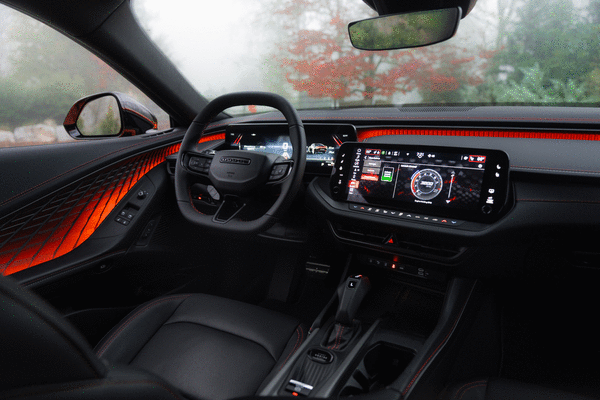
As the Charger goes about its business eating asphalt, the driver faces a 10.25 or 16-inch instrument cluster, depending on trim, alongside a 12.3-inch infotainment touchscreen, wireless smartphone charging, USB-C ports, wireless Apple Car Play and Android Auto. There’s even a pistol-grip shifter in a nod to its Woodstock-generation forbearers. Room is plentiful, and the overall design impressive. Yet most of the plastics used are abysmally cheap. And being a hatchback, cargo access is easy and expandable. That said, the cargo holds is long and wide but its depth is shallow
The 2026 Dodge Charger Sixpack doesn’t abandon the Charger’s identity; it weaponizes modern engineering. It’s still excessive, still loud, still confrontational. It’s just faster off the line and less interested in your nostalgia. But it won’t convert Hemi loyalists, although it doesn’t need to. It only needs to do what Chargers have always done: provoke arguments, shred tires, and make a strong case that progress doesn’t have to be polite.
And if that offends you, well, Dodge would consider that a feature, not a bug.
2026 Dodge Charger Scat Pack Plus
Base price: $54,995
Engine: Twin-turbocharged inline six-cylinder
Horsepower/Torque: 550/531 pound-feet
EPA rating: Not available
Fuel required: Premium unleaded
Length/Width/Height: 207/84/80 inches
Ground clearance: 5.5 inches
Payload: Not available
Cargo capacity: 23-37 cubic feet
Towing capacity: Not rated
©2026 Tribune Content Agency, LLC







Comments