Commentary: The US is still killing people at sea. It must explain why
Published in Op Eds
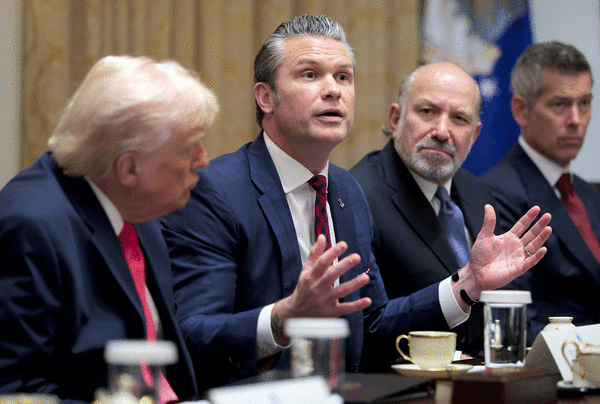
Over the weekend, the United States conducted two lethal strikes on small boats in the Eastern Pacific, part of an ongoing campaign that has now killed nearly 200 people. The public explanation from U.S. Southern Command has become routine: a designated terrorist organization, a known trafficking route, confirmed intelligence. But the government did not explain, and has never explained, the only question that matters: What legal rule made those people lawful targets for death?
That question is more urgent because just over a month ago, Southern Com commander Gen. Francis Donovan told Congress that boat strikes “aren’t the answer.” Since then, the U.S. has carried out at least nine more. Earlier in the campaign, President Donald Trump publicly touted the strikes and Defense Secretary Pete Hegseth emphasized that they were carried out on presidential authority. Now they are reported as being conducted at Donovan’s direction. No matter where the administration assigns the authorization, those responsible owe the country a plain-English explanation of what law permits this.
Let’s give the government the benefit of the doubt and suppose every claim it makes is true. Assume the boats are carrying drugs. Assume the people aboard are connected to cartel networks. Assume the intelligence is exactly what SOUTHCOM says it is. At most, that establishes suspicion of drug trafficking. Drug trafficking is a crime. It is not a death sentence. The U.S. does not kill people because it suspects them of committing crimes. Nothing in the Constitution permits the president to turn suspicion into execution.
Calling these traffickers “narco-terrorists” does not solve the problem. A terrorist designation can carry serious legal consequences, but it does not by itself create an armed conflict, authorize lethal force or make every suspected associate a lawful target. In 2001, Congress passed the Authorization for Use of Military Force, aimed at those responsible for the Sept. 11 attacks and the forces aligned with them. That authority has since been stretched to cover other groups, including Islamic State, but Congress has never authorized the use of military force against drug cartels. If Hegseth and Donovan believe otherwise, they should identify the source of that authority.
One reported part of the administration’s still-confidential legal theory is even more grotesque. According to Politico, administration lawyers have argued that the strikes target the alleged drugs or chemicals aboard the boat, reducing the people killed to an afterthought. But a police officer cannot fire a rocket at a car and claim he was targeting the cocaine in the back seat rather than the people inside. The government cannot make killing lawful by pretending human beings are just part of the cargo.
The administration does not need to reveal classified intelligence to answer this. It needs to explain the legal standard. If this is self-defense, say how two men in an open boat hundreds of miles from the United States posed an imminent threat that justified killing them. If this is armed conflict, assert who Congress has authorized the military to fight. If the claim is that the drugs themselves were the target and the people were just in the way, then defend that theory in public. What the government cannot do is keep killing people under a still-secret memo and insist we simply take its word that this is legally — much less morally — sound.
These concerns are not new. The strikes have continued despite months of public legal criticism. In fact, they have only become more frequent since Donovan was confirmed. If those ordering and carrying them out believe the law is on their side, they should lay out why.
The officers carrying out these orders have a responsibility to ask hard questions before taking lives. They are not absolved because a president supplies a label, the secretary repeats it or a lawyer writes a memo. Military officers are trained to understand the difference between combat and law enforcement, between lawful targeting and unlawful killing. If the legal theory cannot be explained, defended or squared with the Constitution, then it is not enough to salute and execute.
Congress has a responsibility here, too. Senators who remind service members that they need not obey unlawful orders are not wrong as far as that goes. But oversight does not stop with telling troops what courage requires after orders are issued. Donovan sat before Congress just over a month ago and said boat strikes “aren’t the answer.” Since then, he has directed them at a pace of nearly two per week. If members of the Armed Services Committee are serious about unlawful orders, they should bring him back under oath and insist he testify to what legal authority he believes permits these killings.
This is not a technical dispute over targeting language. It is the use of lethal force against human beings under a legal theory the government refuses to explain. If the United States believes these killings are lawful, it should say why. If it will not, the country should not treat their continuation as routine. Killing people without public legal justification is not normal, not constitutional and not something a free nation can simply get used to. And if no lawful justification exists, stopping the strikes is only the beginning. Accountability must follow.
____
Jon Duffy is a retired naval officer. He writes about leadership and democracy.
©2026 Los Angeles Times. Visit at latimes.com. Distributed by Tribune Content Agency, LLC.















































Comments