Commentary: Supreme Court's decision against Voting Rights Act will be devastating
Published in Op Eds
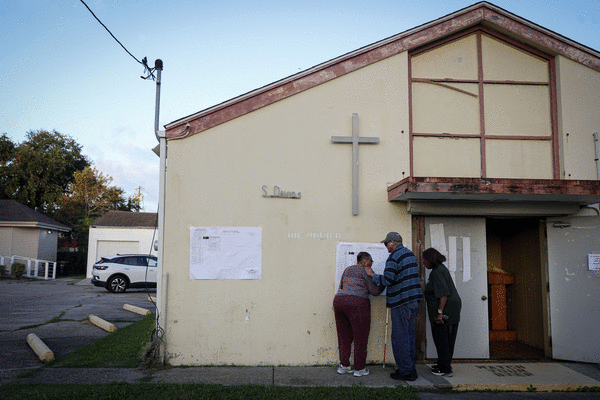
The Supreme Court has again dealt a devastating blow to voting equality in the United States.
On Wednesday, in Louisiana v. Callais, six justices effectively nullified a 1982 federal statute that prohibits states from running or establishing election systems, such as election districts, that have a discriminatory effect against voters of color. Simply put, unless it can be shown that a state or local government acted with the intent of racial discrimination — something very difficult to prove — it will be impossible to successfully challenge laws as having violated the Voting Rights Act of 1965 or the Constitution.
The Voting Rights Act is, simply put, one of the most important federal laws adopted during my lifetime. Although the 15th Amendment, adopted in 1870, prohibits denying someone the right to vote based on race, this was a hollow promise due to an array of practices used to keep Black individuals from voting. In Mississippi in 1964, for example, only 6.7% of eligible Black citizens were registered to vote. At the time it had the highest Black population of any state in the U.S.
Two key provisions in the Voting Rights Act were used to prevent racial discrimination in voting. Section 5 provided that jurisdictions with a history of race discrimination in voting needed to get preapproval from the U.S. attorney general for any significant change in their election systems. Hundreds of actions by state and local governments deemed discriminatory were blocked, and likely countless more discriminatory actions weren’t even attempted because of the understanding that preclearance would be denied. But in 2013, in Shelby County v. Holder, the Supreme Court nullified the preclearance requirement on the grounds that it unconstitutionally treated some states differently than others. No state has had to get preclearance since, and many state laws that were stopped for being discriminatory have since gone into effect.
In writing for the court in Shelby County, Chief Justice John Roberts offered reassurance that there was still another key provision of the Voting Rights Act: Section 2, which says that state and local governments cannot run election systems that discriminate against voters of color.
In 1980, in City of Mobile v. Bolden, the court held that proving race discrimination in voting requires proof that the government acted with the intent to disadvantage voters of color. But it is enormously difficult to prove discriminatory intent, and the reality is that legislators will rarely openly express a racist motive for their actions. In response to the court’s decision, Congress amended Section 2 of the Voting Rights Act in 1982 to provide that proof of a racially discriminatory effect would be sufficient to show a violation of the law.
Louisiana v. Callais was focused on Section 2, focusing on state congressional districts. After the 2020 census, Louisiana redrew its six congressional districts, creating one with a majority Black population. A federal district court found that Louisiana violated Section 2 because of the discriminatory effect against Black individuals — who comprise about 35% of Louisiana’s population — of having only one district with a majority Black population. Louisiana then redrew its maps to create two districts that were majority Black.
The Supreme Court, in a 6-3 decision on Wednesday with Justice Samuel Alito writing for the majority, said that based on prior decisions it is unconstitutional for the government to consider race in drawing election districts. The court added that avoiding a racially discriminatory effect, which would be a violation of Section 2, does not justify allowing consideration of race. Justice Elena Kagan in dissent said that the effect of this would be that those challenging state and local elections systems as discriminatory “will have to show, as well, race-based motive. Now, as then, that requirement will make success in their suits nearly impossible.”
Alito stressed that so long as the government can point to a non-racial reason for its action, there is no basis for challenging election districts. There is a strong correlation between race and political party affiliation, especially for Black voters who overwhelmingly support Democrats. Any time a state wants to discriminate, it can argue that its actions were based on partisanship and thus immune to a challenge. This is why Kagan said that the decision will “eviscerate” Section 2 of the Voting Rights Act, explaining that the court’s ruling “will effectively insulate any practice, including any districting scheme, said by a State to have any race-neutral justification… Assuming the State has left behind no smoking-gun evidence of a race-based motive (an almost fanciful prospect), Section 2 will play no role.”
Especially throughout the South, but also in parts across the country, states have established districts that had a majority of voters of color to avoid there being a discriminatory impact like that which led to the invalidation of the Louisiana districting. Now, unconstrained by Section 2, states can redraw these districts. The practical effect will be to greatly decrease the election of representatives of color and significantly harm the Democratic party. I expect many “red” states will sprint to do this as fast as possible, potentially in time for the 2026 elections.
It is hard to avoid seeing this as other than the six Republican appointed justices on the court helping the Republican party. It also is impossible to see this as other than the tragedy of one of the most important civil rights laws in history being gutted.
____
Erwin Chemerinsky is the dean of the UC Berkeley Law School.
©2026 Los Angeles Times. Visit at latimes.com. Distributed by Tribune Content Agency, LLC.













































Comments