Commentary: Politics has come to work, once an apolitical space
Published in Op Eds
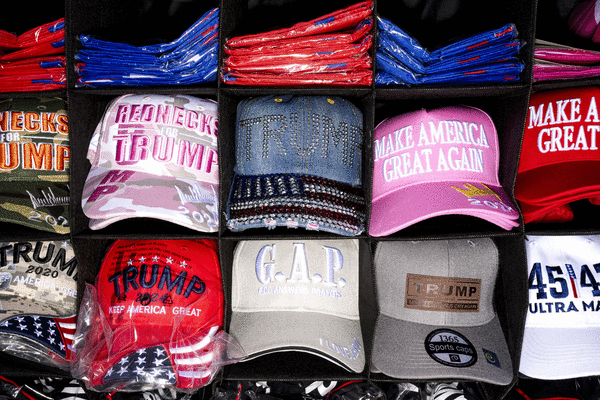
A colleague recently emailed me a picture of a seemingly political gesture that was roiling her office and asked me what I thought. The picture was of a 10-by-3-inch sticker, openly affixed to an employee’s desk, stating “Make America Blue Collar Again” in big red, white and blue block letters.
Her company is tucked away in a small, progressive community that went for Kamala Harris over Donald Trump in the 2024 presidential election by nearly 2 to 1. Several employees expressed their discomfort with the sticker to HR. Questions swirled, and gossiping ensued. What was the exact purpose of the sticker? Was it genuinely meant to bring attention to the plight of America’s diminished blue-collar workforce, as the employee who owned the sticker claimed? Or was it a Trojan horse carrying President Donald Trump’s political ethos?
Some torturous snowballing invariably took off from there. Did the employee with the sticker on their desk also want to covertly signal their support for ICE’s recent actions in places like Minnesota? Or perhaps the Trump administration’s attacks on LGBTQ+ rights?
In recent years, Americans have come to expect politics at virtually any time at virtually any place. That includes places of worship, their kids’ classrooms and in sports, movies, music and other forms of entertainment. The ubiquity of social media, and the meme subculture it has spawned, has made politics’ intrusion at work, one of the last mostly politics-free refuges, not only likely but inevitable.
A 2025 poll found that 47% of workplaces in America have no policy governing political discussions. Even when organizations have policies on the books to “manage” their employees’ political speech, the growing flirtation between politics, consumer culture and pop culture still has organizations asking when or how to go about intervening — and indeed has them wondering what exactly even constitutes political speech these days.
The Center for Cultural Humility, which I direct, regularly fields questions like these and tries to find answers. Some cases are easier to decipher than others. For example, the “Make America Great Again” hat, like Obama’s “hope” poster, serves as a pretty clear projection of one’s affinity for a particular politician and political ethos. But how about the seemingly innocuous “Live, Love, Laugh” placard — which perhaps gives liberal hippie— or its more expository cousin, the “ In This House, We Believe …” placard that is making its way into the workplace?
A 2025 poll conducted by the job search site Monster found that 60% of U.S. employees believe political discussions should be avoided entirely at work. A total of 14% of respondents say they’d rather get a cavity filled than talk politics at work. Yikes.
The trope that people in America don’t want to talk politics when in mixed company prevailed for ages. With the exception of universities like mine, where the opposite is encouraged (or at least is a vague aspiration ), avoidance of political discourse at the job was once considered a basic sign of decorum in America. And before the Digital Age, there was an implicit understanding that the discussion of politics in the workplace wasn’t just a social taboo to be avoided, but corrosive to employee relationship-building and productivity.
While some degree of socialization, on and off the clock, has usually been encouraged by workplace leaders to juice up employee bonding, researchers have observed the direct and subtle ways that political conversations can fritter away employees’ trust and respect for one another. These tensions can even foment employee turnover, particularly when the organization is seen as embracing (or being indifferent to) a particular political ideology. A 2024 poll found that 73% of American workers had witnessed concerning situations arising from political discussions at work, including arguments, bullying and retaliatory acts like exclusion from projects.
Dating back to the roughshod targeting of suspected communist-sympathizing employees in the 1920s by corporate employers and government agencies, organizations in America have struggled to thoughtfully discuss and hold space for their employees’ political beliefs, often to the ire of not just their employees, but their customers and partners. These days, no organization is immune to the frictions summoned by the political telegraphing of its employees. Exhibit A: the aftermath of the killing of conservative commentator Charlie Kirk back in September, when a slew of government agencies, small businesses, colleges and healthcare organizations got a direct taste of just how damaging their employees’ political views can be to their brands. After employees railed against Kirk’s deification by the right, his deifiers organized retribution against the employees and their employers.
Unions have long advocated for employees to have the ability to promote their causes at work and have predictably brushed up against opposition for doing so. For example, Section 7 of the National Labor Relations Act of 1935, signed by President Franklin D. Roosevelt, disallows employers from prohibiting “employees from talking about the union during working time” (if they’re permitted to talk about other non-work-related subjects) and also disallows prohibiting “employees from wearing union buttons, T-shirts, and other union insignia unless special circumstances warrant.” But neither unions nor employers are prepared for the complex, evolving ways that politics are showing up at the workplace.
The barriers to entry to workplace activism have gotten increasingly low, meaning the issue is likely to get worse before it gets better. We can fire off hot political takes, or seemingly apolitical takes, on social media in a matter of seconds, often oblivious that our employers and co-workers — or a stranger with an ax to grind — are studiously watching. Stationery, coffee mugs and clothing emblazoned with political, or quasi-political, messaging are also now abundantly available from third-party sellers on websites like Amazon and Walmart. Other websites, like Etsy, even offer customization options, meaning customers can find or create a bespoke iteration of political iconography, like the “Make America Blue Collar Again” sticker, and have it on display at work within days.
Workplace leaders’ existential dilemma on this topic is a two-part question: Should there be an expectation that employees bring their true identities — their political and cultural likes and dislikes — into the workplace? And what value, in terms of production and professional quality of life, does that bring the individual employee and their co-workers?
Ultimately, not all political discourse is created equal. Studies have found that workplace-based exposure to differing political views increases employees’ understanding of the various rationales for political perspectives and can actually foster political tolerance. Deciding which kinds of discussions foster this and which don’t is the tricky part, but it’s a worthy endeavor given the unrelenting nature of America’s current political divide.
____
Jerel Ezell is an assistant professor at the University of Chicago Medicine and director of the Berkeley Center for Cultural Humility.
©2026 Los Angeles Times. Visit at latimes.com. Distributed by Tribune Content Agency, LLC.








































Comments