Editorial: King Charles gets a W
Published in Op Eds
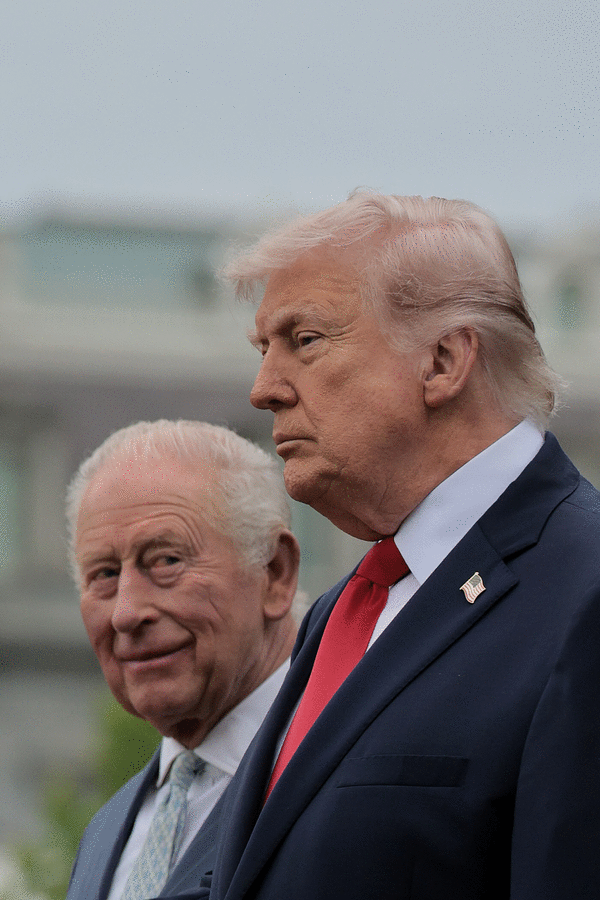
Most Americans think of the Bill of Rights as a bespoke 1789 creation for a nation that was, in the signature “Hamilton” lyric of Lin-Manuel Miranda, “young, scrappy and hungry.”
Not so fast, said the great-great-great-great-great grandson of King George III before the U.S. Congress on Tuesday.
King Charles III knew his audience. “The Founding Fathers were bold and imaginative rebels with a cause,” he began, softening it up. “By balancing contending forces and drawing strength in diversity, they united 13 disparate colonies to forge a nation on the revolutionary idea of ‘life, liberty and the pursuit of happiness.’”
Then he got to what he really wanted to say: “They carried with them, and carried forward, the great inheritance of the British Enlightenment — as well as the ideals which had an even deeper history in English common law and Magna Carta.”
Charles was, of course, historically correct, as he was when he went on to note that the Magna Carta is cited in at least 160 Supreme Court cases since 1789 and when he pointed out that England’s 1689 Declaration of Rights, the document that established the constitutional monarchy and thus prevented its eventual obliteration (for now), was, shall we say, heavily sourced in the Bill of Rights in 1791. Charles had a sly addition to that assertion, noting that the one was used by the other, “often verbatim.”
Was he daring to call James Madison a plagiarist? Charles came close, with a nod and a wink, but the septuagenarian’s real point was to recast for a new generation the United Kingdom as the motherlode of American democracy rather than a system to be vanquished or to be seen as a figure of fun, a role King George plays in “Hamilton.” At the same time, Charles was pushing a shared history of understanding the need for checks on the executive branch, a good message for the Republicans in Congress to hear, given the propensity of the president they support to rail against precisely that.
This might all sound trivial. But, in his quirky way, Charles was trying to leverage his reputation as an intellectual (by royal standards, anyway) to stand for a kind of traditionally centrist multi-nationalism in a world where much of the America First right wants to throw away such global thinking, and the left even has styled its anti-Trump protests as “No Kings” marches. Indeed, a coalition of activists were using his invitation to speak to Congress to launch a campaign for a federal minimum wage of at least $25. “Congress should be focused on the needs of working people struggling to get by,” the activists wrote, explaining their intentional timing, “not elevating one of the wealthiest families in the world.”
Charles, of course, sees his wealth as incidental to his main role, which is to wield soft political power. He’s been doing that for decades and has learned how to leverage his eloquence and wit: “The alliance that our two nations have built over the centuries, and for which we are profoundly grateful to the American people, is truly unique,” he said. “And that alliance is part of what Henry Kissinger described as Kennedy’s ‘soaring vision’ of an Atlantic partnership based on twin pillars: Europe and America. That partnership, I believe Mr. Speaker, is more important today than it has ever been.”
Hear, hear. But some on both sides of the aisle needed reminding.
___
©2026 Chicago Tribune. Visit at chicagotribune.com. Distributed by Tribune Content Agency, LLC.











































Comments