Editorial: Illinois changes the label on school absenteeism, not the reality
Published in Op Eds
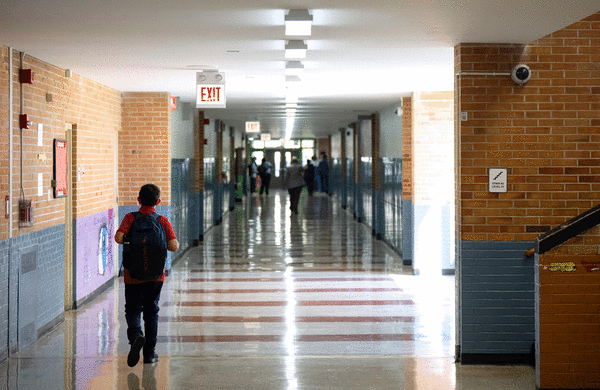
The Illinois State Board of Education has recommended swapping out “chronic absenteeism,” a metric that tracks how many students miss 10% of school days, for “consistent attendance,” the percent of students who have been present for 90% or more of the school year.
It’s the flip side of the same coin, but it’s a tad Orwellian and it’s also paired with a change that matters far more: how much attendance actually counts.
For those of us, including parents and watchdogs, who pay attention to the Illinois Report Card, one of the finest tracking tools in state government, in our view, this means you’ll be seeing a revised set of metrics. These are the tools we use to understand how our public schools — collectively and individually — are performing.
Words matter, and so we took note of this shift.
Accountability matters, too, and ISBE’s decision not to include attendance — excuse us, “consistent attendance” — as a core indicator in determining school designations, the state’s primary ratings of performance, strikes us as wrongheaded. Under the new system, strong attendance can boost a school’s ranking. But weak attendance will no longer count against it, a significant shift in how performance is judged.
Nationally, chronic absenteeism has become a standard part of school accountability systems, with most states including it in how they evaluate school performance. Illinois’ shift would move in a different direction, treating attendance as something that can help, but no longer hurt, a school’s standing.
Here’s the thing: A school can’t educate students who don’t show up, and to that end it is essential to weigh whether that’s happening when considering the performance of any given school. Research consistently shows that attendance is directly tied to grades and test scores.
We get it. Kids get sick, they go on trips, families deal with bereavement.
There are lots of legitimate reasons not to be at school for a few days a year, and we have no intention of playing hall cop on this issue.
Those everyday absences don’t come close to explaining the scale of the problem. In Chicago Public Schools, a chronically absent student misses about 18 days. And in that district, 40% of students fit that description, compared with an average of 25% statewide. That scale of absence isn’t a marginal issue, but one that is central to whether schools are functioning as intended.
One reason to critique these changes is a sincere appreciation for the data ISBE makes public. The Illinois Report Card is one of the best tools we have to understand school performance, hold leaders accountable and make informed decisions. Often, it reinforces the strength of many of our public schools.
We understand the argument that school leaders have less influence than families in terms of getting kids to the building. Attendance often is shaped by forces well beyond a school’s control, including transportation, health, housing stability and the daily logistics of family life.
But as we’ve argued before, treating attendance as something outside a school’s influence misses a critical part of the picture. Students are more likely to show up when school feels safe, when relationships with teachers and peers are strong, and when the classroom feels worth their time. The likelihood of real consequences for skipping out are a factor, too.
The latest research from the University of Chicago Consortium on School Research suggests that conclusion is too limited. Yes, material barriers matter, but so do relationships, and those are squarely within a school’s reach. Students are significantly more likely to attend when they feel known by adults in the building, when they trust their teachers and when school feels like a place where they belong. The consortium’s January 2026 report finds that connection and trust are not soft concepts; they are measurable drivers of attendance, even after accounting for outside challenges.
That doesn’t mean schools can solve poverty or eliminate every obstacle families face. But it does mean attendance isn’t simply a reflection of circumstances at home. It is also a reflection of whether students feel seen, supported and engaged once they arrive — and whether they believe it matters that they show up at all.
All of these things matter when assessing and understanding school performance, not as a way to shame the folks leading them but to evaluate what’s going on and to identify solutions, as well as being honest with stakeholders — parents, grandparents, taxpayers and the students themselves.
At the end of the day, what we call it — chronic absenteeism or consistent attendance — matters far less than whether the state is taking the problem seriously. This new system is not exactly a clear step in that direction.
_____
©2026 Chicago Tribune. Visit chicagotribune.com. Distributed by Tribune Content Agency, LLC.




















































Comments