Justin Fox: We'll miss gas taxes when they're gone
Published in Op Eds
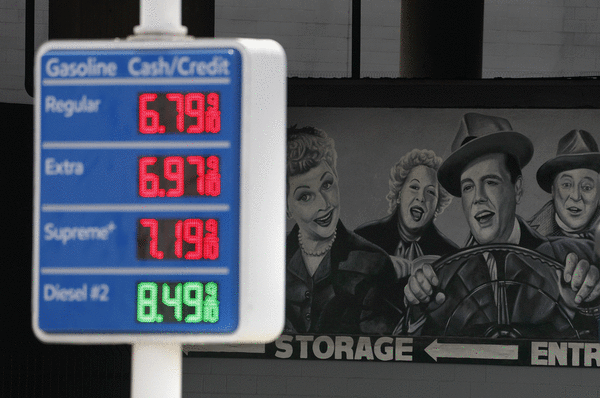
The sharp rise in gasoline prices caused by the Iran war has led to bipartisan calls, and in some cases action, to reduce U.S. gas taxes. At least three Republican-run states have declared gas-tax holidays, and three Democratic U.S. senators have introduced legislation to suspend the federal gas tax until October. Several European countries have reduced fuel taxes as well.
These moves, while understandable politically, reduce government revenue and actually worsen the global oil crisis by exacerbating the supply-demand imbalances that are causing the price increases in the first place. Many consumers seem to be turning to a more permanent solution, with the crisis already delivering a big boost to global electric-vehicle sales. And all of this — the temporary reductions in gasoline taxes and the permanent reductions in gasoline demand from EV sales — raises questions about what will replace what has long been the leading means of paying for transportation infrastructure in the U.S. and much of the world.
The only plausible answer, it has been clear for a while, is user fees. These already exist in the U.S. in the form of highway, bridge and tunnel tolls and, since early last year, New York City’s congestion charge. Expect more tolls and congestion charges in the future but also some sort of mileage fee to be charged to everyone with a car or truck and possibly monitored by Global Positioning System trackers. Fuel taxes have been a remarkably efficient way of collecting revenue and even promoting behavior friendly to the environment. Their replacements will be kludgier and more intrusive.
The U.S., it must be said, has not used fuel taxes to anywhere near their full potential. At the federal level, where since 1993 the excise tax on gasoline has been stuck at 18.8 cents a gallon and the diesel excise tax at 24.4 cents, fuel taxes and other vehicle-related fees no longer bring in nearly enough revenue to cover what Congress allocates to transportation.
Congress has been covering the gap with appropriations from general revenue, but given yawning federal deficits, that doesn’t seem sustainable. Another twist is that continued trust fund deficits will cause federal spending on highways and transit to lose its privileged “contract authority” and become annual appropriations that are much harder to plan around, as Jeff Davis and Rebecca Higgins of the Eno Center for Transportation in Washington explained in a recent report with the dire title “The Last Exit: Options for Fixing the Highway Trust Fund While Solvency is Still Solvable.”
The spending increases in recent years have been huge, partly because of COVID-19 stimulus efforts and partly because of inflation, and reining them in is certainly one option. A target popular in conservative circles is the 13% or so of Highway Trust Fund revenue that is set aside for public transportation. In crowded places like the Acela corridor of the Northeast, transit spending clearly complements road spending by easing traffic congestion, but that’s less true elsewhere, and I’m certainly not going to argue that the federal government’s transit priorities have been consistently sensible.
Another possibility would be raising gas taxes. State and local governments have been doing this in the absence of federal action, but the increases haven’t been enough to fully counteract the decline in federal revenue. Adjusted for inflation, overall U.S. gas tax revenue is lower than it was 30 years ago.
U.S. gasoline taxes at all levels remain quite low by international standards. (This table contains just a selection of the countries for which the Organization of Economic Cooperation and Development has 2023 data, but the U.S. is in a similar position in the full ranking: 65th out of 78.)
So, yes, gas taxes in the U.S. could stand to be higher. But raising them would speed the underlying trend that is undercutting motor-fuel tax revenue around the world. Even in the EV laggard that is the U.S., gasoline consumption is lower than it was 20 years ago and falling.
Fuel-efficiency improvements in internal-combustion-engine vehicles are a chief reason for this development. (A slowing in the growth of vehicle miles traveled is another.) As David Ditch of the conservative Economic Policy Innovation Center points out, the rollback in fuel-economy enforcement included in last year’s budget bill actually improved the Highway Trust Fund’s revenue outlook as the Congressional Budget Office reduced its estimates of future fuel-efficiency improvements. This move and the general anti-EV stance of the Trump administration and the Republican Congress feel more like lost-cause signaling than sustainable policy, though. As EVs keep improving they will eventually become so superior to the fossil-fueled competition that it’s hard to see how their rise can be stopped — and it shouldn’t be, of course.
Which brings us back to replacing gas taxes. All but 10 U.S. states have implemented EV-specific annual registration fees ranging from $260 in New Jersey to $50 in Hawaii and South Dakota. Several are offering mileage-based fees as an alternative, and Hawaii is planning to make these mandatory for EVs in 2028 and all vehicles in 2033.
This will be accomplished with annual odometer readings, which can work in a state surrounded by thousands of miles of oceans. Elsewhere, GPS-based systems seem necessary to align fees with states’ actual road use. Adjusting fees by vehicle weight also seems crucial because a large SUV wears down roads faster than a subcompact. And at some point the federal government needs to be integrated into the fee-collecting system if a Highway Trust Fund and significant federal transportation spending are going to continue.
It’s all a reminder of what an elegant solution motor-fuel taxes have been to the problem of how to fund transportation. They’re easy to administer, don’t involve tracking motorists’ movements and do quite a decent job of matching tax payments to road wear-and-tear (because heavier vehicles usually get fewer miles to the gallon).
The one innovation in user fees that offers clear advantages over gas taxes is congestion pricing because it incentivizes drivers to use roads more efficiently. The Trump administration — which has been trying, so far unsuccessfully, to halt New York City’s congestion pricing experiment — recently announced a Freedom to Drive initiative to address “the nation’s growing congestion problem.” I know just the policy to fix that.
_____
This column reflects the personal views of the author and does not necessarily reflect the opinion of the editorial board or Bloomberg LP and its owners.
Justin Fox is a Bloomberg Opinion columnist covering business, economics and other topics involving charts. A former editorial director of the Harvard Business Review, he is author of “The Myth of the Rational Market.”
_____
©2026 Bloomberg L.P. Visit bloomberg.com/opinion. Distributed by Tribune Content Agency, LLC.




















































Comments