Commentary: Defenders of the Jones Act have lost
Published in Op Eds
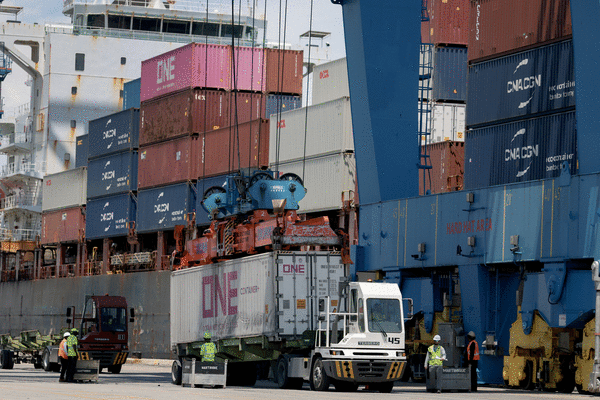
For more than a century, the Jones Act has survived on purported economic and security grounds. Its waiver by the Trump administration for Operation Epic Fury reveals serious flaws in both rationales.
Section 27 of the Merchant Marine Act of 1920, as it’s formally known, requires that goods shipped between U.S. ports travel on vessels that are U.S.-built, U.S.-flagged, U.S.-owned, and crewed predominantly by U.S. citizens. Because of this legally enforced domestic shipping monopoly, building and operating ships in America today costs far more than doing so abroad, and domestic coastwise shipping is effectively nonexistent outside the few places that have no choice, such as Alaska, Hawaii and Puerto Rico.
Rather than bolstering U.S. commercial shipping capacity and the merchant marine, the Jones Act has presided over the steady degradation of both.
Supporters of the law claim it’s essential for national security and has negligible economic costs. They’ve also vigorously opposed waivers of the law, which are permitted in the "interest of national defense," arguing that exemptions undermine economic and national security and are unnecessary due to sufficient domestic capacity. Their efforts to narrow the waiver conditions have, along with vigorous lobbying, successfully ensured they’re rarely met.
President Donald Trump’s most recent waiver of the law has substantially undermined the pro-Jones Act case. Issued for 60 days on March 17 – right after the Strait of Hormuz effectively closed – and subsequently extended for another 90, the waiver covers all U.S. territories and more than 659 product categories. That makes it the longest and broadest waiver since 1950. The law also requires that any operator using the waiver file a compliance report on their activities. Here's what the data thru May 6 show – and what they don't.
First, the waiver exposes flaws in the law’s national security rationale. The Jones Act ostensibly exists to ensure the U.S. isn't dependent on adversaries to move critical supplies in times of crisis. Yet, even leaving aside that this “national security” law keeps getting waived when a genuine security emergency arrives, the waiver data tell a benign story. None of the foreign vessels moving millions of barrels of gasoline, diesel, crude oil, and fertilizer between American ports have been owned or operated by Chinese firms or have flown the flag of China. Russia is similarly absent.
The White House has called these vessels’ availability “incredibly effective” for stabilizing U.S. energy markets. Thus, when a real crisis hit, allies and neutral registrants, not adversaries, filled the gap – a gap created by a withering Jones Act fleet of just 93 oceangoing vessels (only 55 tankers) and a moribund commercial shipbuilding industry that recently got bailed out by the South Koreans.
So much for “national security.”
Second, the waiver reveals some of the domestic shipping demand that the Jones Act has suppressed, thus hinting at the law’s substantial economic costs. As industry publication TradeWinds reports, foreign vessels utilizing the waiver have supplemented a fully-booked Jones Act fleet instead of displacing it. This implies the existence of latent demand for coastwise shipping that the law has thwarted – additional transactions between U.S. companies and U.S. ports that would occur daily but for the Jones Act’s costs. In non-waiver times, this activity goes to foreign suppliers, along overland U.S. routes, or via ridiculous workarounds such as sending Gulf Coast fuel to the Bahamas for blending before delivering it to California. For the next few months, it doesn’t.
The waiver data also show the potential for both U.S. long- and short-haul shipping markets – sometimes between a single American company’s U.S. facilities. Distant voyages include diesel from Louisiana to Puerto Rico (due to “non-Availability of U.S. flag vessels”); crude oil from Texas to Pennsylvania; gasoline from Houston to Long Beach; and renewable diesel from New Orleans to Portland. Jones Act critics have long claimed that the law forces supply-constrained U.S. areas to use imports instead of preferable American-made goods; under the waiver, Phillips 66 is shipping domestic oil from Texas to an East Coast refiner, instead of the foreign crude it usually sends.
The short-haul voyages are just as noteworthy. They include gasoline and diesel from Washington to California and Oregon; same-state shipments of fertilizer, ethanol, and refined products in Louisiana, Texas, and California. These are natural trade lanes that have been blocked for decades, all but ensuring more traffic on U.S. interstates and rail lines instead of goods traveling more efficiently on the water.
A robust coastwise shipping sector could exist in the United States, but the Jones Act simply prevents it. That’s “demand destruction” in action, and the waiver lets us see it.
That visibility is another benefit: Unlike a tariff, which raises costs but still allows trade during high-stress periods, the Jones Act's prohibition on foreign coastwise shipping created a century-long dearth of the information needed to model a more competitive shipping environment. Now, the law’s unseen effects are no longer theoretical; they’re real – and documented in federal records. Economic analyses and public discourse should be better for it.
That said, the waiver won’t show everything Jones Act critics might want. Although 150 days is a relatively long period, it’s still fundamentally different from permanent reform, which would give market actors the consistency and predictability they need to make large, long-term investments. As the administration's 90-day extension acknowledges, it takes time for shippers to commit to routes, reorganize freight networks, establish new supply chains, and otherwise reveal the potential of unrestricted American maritime trade.
Twenty-three movements are useful datapoints, but they’re not permanent policy change. The waiver will reveal some of what’s possible without the Jones Act, but surely not all, or even most, of it – especially the new companies, services, and even entire markets that might eventually emerge in the absence of the law’s restrictions and distortions.
The waiver also won’t show a major change in fuel, fertilizer, or other prices — something Jones Act defenders have unfairly seized upon. Even a peacetime repeal of the law would likely reduce the price of a gallon of gas by 10 cents at most. A temporary waiver will provide smaller benefits – ones swamped by the seismic forces of a generational energy crisis. The Jones Act is a small, chronic tax on the American economy, not a deathblow. Temporarily lifting that tax will help at the margins; it won’t fundamentally transform the economy.
Nevertheless, the Jones Act waiver has given us something the law's defenders have spent a century trying to prevent: evidence of what we've been missing. Dozens of ships. Millions of barrels. Natural trade lanes. It's a good start.
____
This column reflects the personal views of the author and does not necessarily reflect the opinion of the editorial board or Bloomberg LP and its owners.
Scott Lincicome is an economist with the Cato Institute. He specializes in domestic policy and international trade.
©2026 Bloomberg L.P. Visit bloomberg.com/opinion. Distributed by Tribune Content Agency, LLC.




















































Comments