Commentary: The Ted Turner I knew bet on what others missed
Published in Op Eds
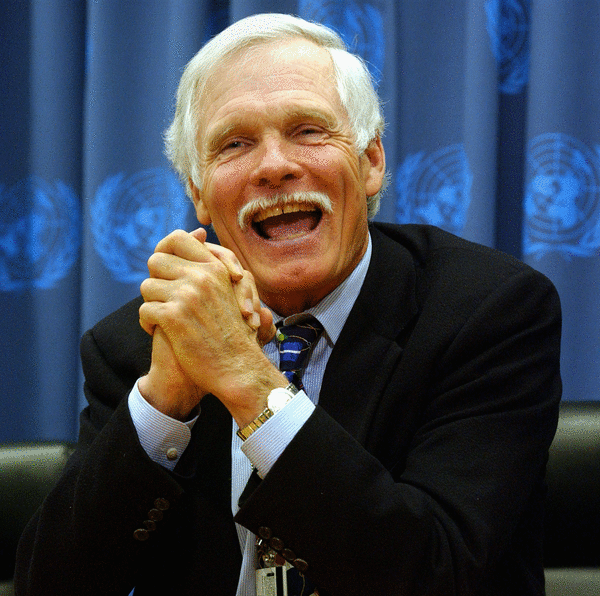
Ted Turner died Wednesday at 87, and the world feels a little less interesting, a little less imaginative and a little less fun without him in it — but also a lot better off because he was here.After hearing the news of his passing, one moment came to mind that embodied how he moved through the world: a very drunk Turner giving an interview after winning the America’s Cup in 1977. The yachting world was aghast. How did this uncouth, mouthy Southerner find his way into their patrician club … and win?
He had a way of wandering into spaces he wasn’t invited into and then changing them forever.
I had the pleasure of working for him at Turner Broadcasting System Inc. in the late 1990s. With some frequency, everyone would arrive at work and find a book on their desks — about American history, Native Americans, conservation or the environment — accompanied by a short note from Turner encouraging us to read it.
That was a telling habit. He was brash — in ways that came off as insensitive and earned him the moniker “The Mouth of the South” — but also restless, curious and utterly original. He inherited his father’s billboard company and transformed it into something almost nobody at the time fully understood: a modern media empire built around the emerging power of cable television. Against the advice of many financial experts, Turner made an enormous bet that cable would reshape entertainment, sports and news.
Being a risk-taker wasn’t the only thing that made him exceptional, though.
It was that each bet connected to a much larger strategic vision. Turner understood earlier than most executives just how powerful the relationship between content and distribution could be. WTBS became the “Superstation,” allowing Atlanta Braves games to reach fans far beyond Georgia. He bought the MGM film library to strengthen his cable networks. He acquired the Hanna-Barbera catalog to power Cartoon Network. Long before “synergy” became an overused corporate buzzword, Turner instinctively understood how media ecosystems worked.
All of it pointed to something else he never lost sight of, and that many modern executives often de-emphasize: the most important decisions do not always make immediate financial sense.
I remember being in a meeting where Turner joked that the best thing about controlling 50% of the company was that he could make decisions Wall Street might hate in the short term. That mindset allowed him to think differently — and longer-term — than many of his competitors.
The then-head of research at TBS once told me how Turner had commissioned consumer research on the appeal of a 24-hour news network. The findings were grim. People were perfectly happy getting their news in the morning and in the evening. The conclusion was unambiguous. No one wanted a 24-hour news channel.
Turner smiled, ignored the research and relied on his gut, launching the Cable News Network nobody asked for.
At the time, CNN was widely mocked. Critics called it the “Chicken Noodle Network.” The very idea of around-the-clock news seemed absurd. Today, CNN feels like one of those innovations so embedded into modern life that it is hard to imagine the world before it existed.
That was often the pattern with Turner. He saw around corners before others even realized there was a turn.
But his interests were never confined to business alone. Turner loved history, particularly the Civil War. In the 2003 film "Gods and Generals," which he helped finance, he briefly appeared as a Confederate officer — sword and all. He never seemed content merely to own, sponsor or observe things from afar. He wanted to wander directly into the middle of them. His character’s sword became an oft-used prop in his office for years to come.
That was part of his charm, as was his willingness to expand the boundaries of modern philanthropy. Upon seeing his name on the Forbes 400 list of the richest Americans, Turner didn’t envision moving up the ladder. Instead, he seemed more interested in a different kind of ranking — one measured by how much people gave away, and so he pledged $1 billion to the United Nations.
I mentioned Turner’s name recently to an undergraduate student and could tell they’d never really heard of him. Time moves fast, and even the boldest names of one era gradually recede into the background. But when I explained what Turner had built — the brands, ideas and products — the student simply said, almost reverently, “Wow.”
That’s precisely the right word for a life like his.
____
This column reflects the personal views of the author and does not necessarily reflect the opinion of the editorial board or Bloomberg LP and its owners.
Paul Hardart is director of the entertainment, media & technology program at NYU's Stern School of Business and founding director of the Graduate Program in Media Management at The New School. He was previously an executive at Universal and Warner Brothers.
©2026 Bloomberg L.P. Visit bloomberg.com/opinion. Distributed by Tribune Content Agency, LLC.



































Comments