Commentary: How the American Revolution created a great trading nation
Published in Op Eds
We think of wars as conflicts between militaries, decided by force. However, as the German military theorist Carl von Clausewitz famously said, “War is … an act of force to compel our enemy to do our will.”
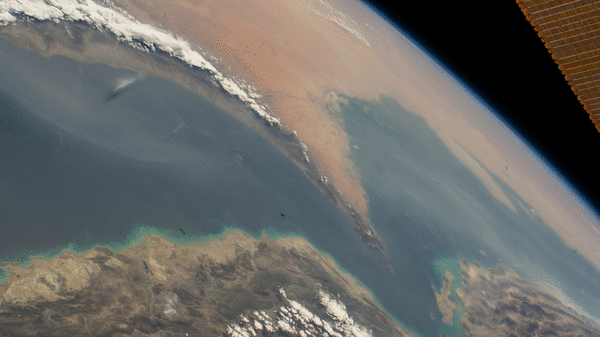
We see this in the current conflict with Iran. The United States has destroyed much of Iran’s military infrastructure and killed several levels of its leadership, but at least as of this writing, it has not forced Iran to do its will.
Recognizing Clausewitz’s insights and having exhausted most of its target lists, the United States has instead turned to economic means: blockading Iran’s ports, shutting off its commerce, and even boarding its ships, swashbuckler-style!
This is not a new strategy. Two hundred fifty years ago, as the American Continental Army was recovering from its failed invasion of Canada, and British forces were regrouping after their forced evacuation of Boston, both sides turned to economic measures to impose their will on the other.
The freedom to trade is a fundamental American principle, but the practice of using trade as a weapon is a tradition even older than the country.
In 1774, at the Continental Congress, the colonies created the Continental Association to enforce a boycott on buying, consuming or selling British goods. Its purpose was to inflict economic pain on Britain and thereby force Parliament to change its policies.
In December 1775, the British retaliated by passing the Prohibitory Act, which imposed a total blockade on the colonies. The message: If you won’t trade with us, we’ll stop you from trading with anyone! The goal was to stop the flow of goods and soldiers among the colonies — at least by sea. It was also intended to thwart any efforts by foreign powers to arm the colonists. The blockade went into effect on March 1, 1776.
The colonists responded by shifting trade policy in the opposite direction, declaring themselves open to commerce with everyone except Britain. What had started as a near total cessation of trade in 1774 turned into a movement for free trade in 1776.
Commerce with France, the Netherlands, and their Caribbean colonies skyrocketed. The benefit was not merely commercial. In his “Notes on the Continental Congress,” John Adams recalls arguing that “Your Trade will become of so much Consequence, that Foreigners will protect you.” He believed that American trade could be used to entice European powers into supporting the American rebellion, and he was not alone.
In late April 1776, the Rev. Samuel Cooper, pastor of the Brattle Street Church in Boston, wrote to Adams that foreign governments would have “a clearer ground for protecting the Trade.” Trade would incentivize foreign powers to support the Revolution once they tasted American tobacco, rice and indigo.
And what about those swashbucklers? Today, the U.S. Navy has traded swinging from the yardarms ship-to-ship for fast-roping from helicopters, but the idea is similar: the government authorizing armed men to board enemy vessels to enforce a blockade.
In April 1776, the Congress approved the provision of letters of marque, or papers allowing private colonial ships to stop, board and seize British ships. Those carrying letters of marque were called privateers — to distinguish them from pirates, who engaged in much the same behavior but weren’t legally sanctioned by any government.
The response was overwhelming. During the war, ships operated by privateers outnumbered those of the Continental Navy by as much as 30 to 1. They captured or destroyed as many as 1,600 British ships, enriching themselves, helping the war effort, and seriously disrupting British trade.
In the end, Britain lost its will to fight after a few decisive battles. Battles, however, in which the French joined, in no small part, as John Adams had predicted, out of a desire to protect their new commercial partners.
The effect was lasting. Trade with Britain accounted for 50 percent of American trade before the Revolution. After the war, less than 30%.
The colonies entered the war dependent on the British and came out engaged with the world.
____
ABOUT THE WRITER
Frederic J. Fransen is the president of Amerion College in Huntington (W.Va.) and CEO of Certell Inc. He wrote this for InsideSources.com.
_____
©2026 Tribune Content Agency, LLC.














































Comments