Commentary: May we never grow inured to homelessness
Published in Op Eds
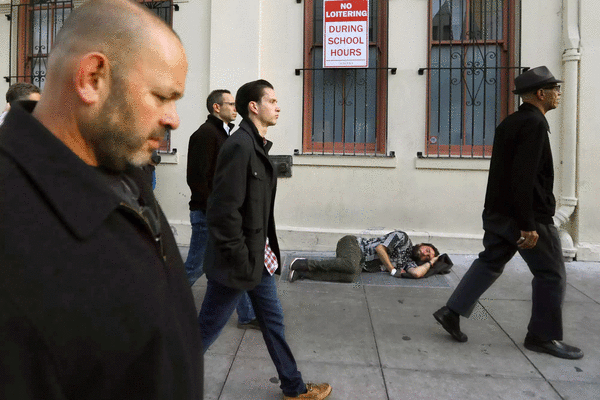
Most Saturday mornings, I stroll half a mile downhill from my tiny apartment in a bosky part of San Francisco to a farmers market. My usual reverie of anticipation (about carrots with their tops attached, about the price of berries) was interrupted recently by the sight of three bodies.
That is, I thought of them as bodies; it was not evident whether they were alive or dead. All lay splayed on the sidewalk, one a couple blocks from my home, the other two, blocks apart, closer to the market, itself located in a neighborhood where need is evident. (Food stamps are often the tender for buying produce.) The bodies belonged to shabbily but fully dressed men — except one man, who was missing a shoe. Maybe the men are sleeping, I thought, or unconscious from drink or drugs. Or maybe they are dead. Nobody walking by — including me — slowed down to pay attention to them, beyond a glance.
For decades, encountering such a scene, I used to stop, then wait to see a leg twitch, a chest rise. I rarely do even that anymore. In high school, I had read with shock that poor people in India, people with no home, slept on the sidewalk, while others just walked by. How awful of those others, I remember thinking. How could they live with themselves? The reproach has come home. We’ve gotten used to homelessness — the homelessness of others.
I guessed the three men on that recent Saturday had no homes, but from many years interviewing a formerly homeless man who is now a civic leader in San Francisco, I learned not to rush to conclusions. Del Seymour, today known locally as the mayor of the Tenderloin, taught me that a man lying with his eyes closed on a sidewalk may have a home, but perhaps was interrupted by temptation or a medical situation on his way there. I also learned from Del, to my initial shock, that some homeless people work full-time jobs. I’ve learned a lot about homelessness, mostly from him, but also from my daily Google alert for the word in the news.
Because those alerts are so rarely encouraging, one seeming spark of good news recently stood out. In Los Angeles County, according to newly released statistics about 2024, the number of deaths among the homeless population decreased from 2023. Yay! I thought. The myriad programs are working! Whether naloxone intervention or tiny houses or new shelters or other efforts (free job training like Del initiated in San Francisco?) are to praise, I felt a surge of hope. Then I read more closely.
Deaths among unhoused individuals in L.A. County had fallen in 2024 not to 100 or so, as I naively hoped, but to 2,208. A trend in the right direction, yes. A cause for celebration, no.
Far too many people know firsthand the emotional and physical grind of homelessness. Virtually all other Californians know it secondhand and have probably asked themselves the same question: What is a (presumably well-meaning) housed person to do in response to the sight of an unhoused person, not to mention many unhoused people? I know of a nurse in San Francisco who screeches her car to a stop when she spots a person in bodily distress and administers CPR if appropriate. I admire her action, but doubt I could replicate it.
Granted, my own main and stubborn response, to spend nearly a decade writing a book about the subject in the hope it will have a helpful impact, is not a route available or attractive to many. And shorter term efforts, such as volunteering at local nonprofits, certainly have more immediate results. One common impulse, in which I take part, if insufficiently and awkwardly, is to give someone food or money, or call 911 when someone clearly needs help.
Yet any pedestrian, especially any female pedestrian, will attest that the impulse to help someone on the sidewalk becomes more challenging if that someone is awake, and male. Will an offering lead to a spit, a scream, a chase? Should we avoid eye contact and walk on? Not necessarily.
What I’ve learned from Del is to offer something that may mean more than a dollar or a sandwich: Say hello.
Acknowledge the person whose face is several feet below your own. This individual is part of a family, “somebody’s son, somebody’s auntie,” Del’s litany goes, and remains a human being. Remind yourself of that. More importantly, remind them. Del adds: Don’t stop if the person seems “nuts,” his enjoyed foray into politically incorrect phrasing. Otherwise, slow down for a few seconds, maybe longer. At some point, over time, and the same route, you might recognize one another and actually have a conversation. Meanwhile, keep it basic, but say something.
I obey. Often, just “Hi.”
Almost always comes an incalculably generous reward: a smile and a greeting returned. Humbled, I move on, again resolved not to let our unhoused neighbors feel invisible, nor to forget that homelessness is, among other adjectives, abnormal.
____
Alison Owings is the author of “Mayor of the Tenderloin: Del Seymour’s Journey From Living on the Streets to Fighting Homelessness in San Francisco.”
_____
©2026 Los Angeles Times. Visit at latimes.com. Distributed by Tribune Content Agency, LLC.


































Comments