Editorial: Ruling on redistricting leaves Virginia at a disadvantage
Published in Op Eds
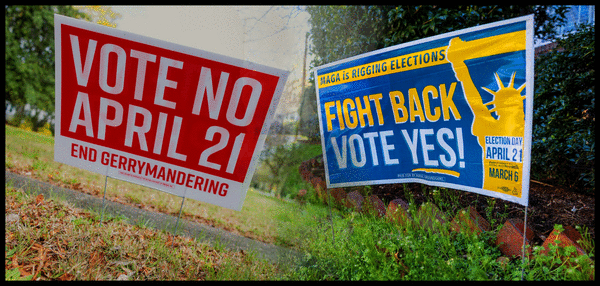
An amendment to the Virginia Constitution that would temporarily change how the commonwealth draws congressional districts twice passed the General Assembly, with an intervening election separating those votes.
The measure was put before the voters, 1.6 million of whom cast ballots in favor, compared to 1.5 million against. It earned nearly as many votes as Glenn Youngkin received in 2021 and, for all the talk of a narrow victory, enjoyed a more decisive win than Virginia’s former governor.
Yet, on Friday, all of that was undone by the Virginia Supreme Court in a 4-3 ruling that struck down the amendment for violating the state constitution. While it is in the court’s power to do so, nullifying the public’s will means Virginians will participate in a November election unfairly tilted by actions outside the commonwealth’s control.
Last year, as President Donald Trump ordered Republican-led states to redraw congressional districts to maximize the likelihood of protecting a GOP majority in the U.S. House, Virginia Democrats moved in response. On Oct. 29 and again on Jan. 14, the General Assembly approved a referendum to suspend the commonwealth’s redistricting commission for four years in order to create new maps.
In between, on Nov. 4, a statewide election saw voters expand the Democratic majority in the state House. An intervening election is required between legislative votes on proposed amendments, so while the timeline was tight, that should have satisfied the legal requirement for changing the state constitution.
Not so, said the state Supreme Court on Friday. In a 30-page opinion, the majority ruled that because early voting began prior to the amendment’s legislative approval on Oct. 29, the measure violated Article XII, Section 1 of the state constitution and should be nullified.
In a dissent, three justices took issue with the majority’s definition of “election,” contending that the inclusion of the early-voting period contradicts the state and federal constitutions as well as volumes of legal precedent that an “election” is defined only as Election Day.
The opinion notes that broadening what constitutes an “election” could have sweeping implications for the judicial system, due to limits on what voters can be compelled to do “during an election,” and the qualifications for state senators and delegates, since the Virginia Constitution includes age requirements of legislative eligibility “at the time of the election.”
Virginia waded into the fetid waters of mid-decade redistricting reluctantly. The commonwealth, as every proud resident will remind you, is not like other states and, in 2020, voters here embraced the nobility of a bipartisan redistricting commission in the hope of bringing transparency and fairness to that opaque and often crooked process.
Flawed though that commission may be, its approach remains a superior way to draw maps for representation, allowing everyone to have a seat at the table. Looking at the national landscape, however, one cannot help but think that Virginia has tied its hands amid a larger fight about how a 435-member House of Representatives can best reflect the popular will of 350 million Americans.
The redistricting wars — in Virginia, California, Texas, North Carolina and other states — have been supercharged by the recent U.S. Supreme Court decision in Louisiana v. Callais. That ruling effectively cleared the way for Republican-led legislatures to wipe away majority-minority districts and approve maps that lock in a durable Republican advantage throughout the South.
The same voices who decried the Virginia process, which put the question to the people, are now cheering these unilateral and undemocratic choices by GOP legislatures elsewhere. There may be no better argument for overarching national parameters for redistricting, though it’s no certainty that the U.S. Supreme Court would allow those to stand.
Virginia should be focused on what’s best for the commonwealth, but cannot ignore what’s happening across the nation. That’s what drew 3 million people to the polls for last month’s special election and what should animate voters when, come the fall, they make decisions that the state Supreme Court cannot quash.
©2026 The Virginian-Pilot. Visit at pilotonline.com. Distributed by Tribune Content Agency, LLC.


















































Comments