Martin Schram: Strait-talk 2 – the Trump-Xi summit
Published in Op Eds
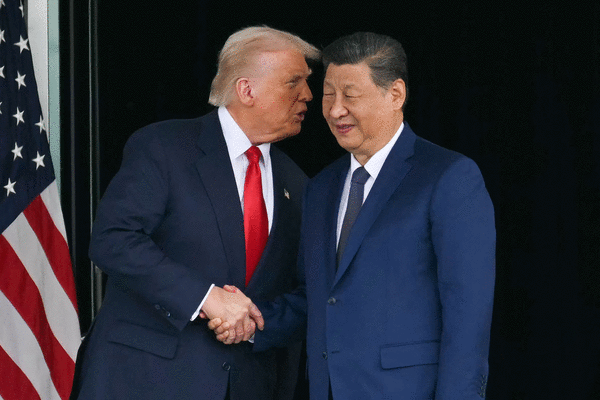
Before peace comes to President Donald Trump’s unwon Iran war and the world’s unopened Strait of Hormuz, global media’s big eye will be focusing this week on another of Asia’s militarily dire straits – the forever-tense Taiwan Strait.
On Thursday and Friday, Presidents Donald Trump and Xi Jinping plan to finally meet in Beijing’s Great Hall of the People. Their summit was originally planned for late March. That was back when Trump expected the Iran war that he and Israel started by bombing Iran’s leaders on Feb. 28 would be quickly won and done. Trump expected he’d be striding into Xi’s Great Hall as the triumphant winner of the war – with bombings that prevented Iran from becoming a nuclear nation and also made an Iranian regime change happen.
But neither happened. However, that didn’t prevent Trump from quickly declaring his Iran war was won just days after he started it – and demanding an “unconditional surrender.” Instead, Iran closed the Strait of Hormuz – which Trump had assured his generals wouldn’t happen after they warned him it would.
Now America’s commander-in-chief will be walking – quite un-triumphantly – into Xi’s Great Hall. He may not yet realize that his best hope for a global re-do of his self-shattered image may be to give peace a chance. And that brings us to the dire straits of the Taiwan Strait. Xi has been recasting himself as a Trumpian-style bully, using military exercises to menace the 110-mile-wide strait that separates China from the island of Taiwan. He has held similar militarily assertive exercises in the South and East China Seas. So this is not Trump’s finest hour; it’s not Xi’s either.
Consider what Xi really wants. He wants the world to see him as the leader of the global economy. That title long belonged to America’s president – until Trump bizarrely abdicated that role by taunting Canada as America’s 51st state, scolding and insulting his NATO and European Union allies, threatening to militarily conquer Greenland.
Xi, of course, is wiser and wilier than Trump – and more cunning than his self-destructive autocrat pal, Russia’s Vladimir Putin. But Xi also loves to conquer – it’s the fatal flaw he has yet to conquer.
Rewind and recall: In December 2021, as Russia was massing troops near Ukraine's borders, I wrote a column cautioning Xi that Putin was about to forever doom his global reputation. It began: “In his quest to make his country the undisputed leader of the global economy, China’s President Xi Jinping can learn a lot from his next-door neighbor, Russia’s President Vladimir Putin. Not about what to do, but about what not to do.”
In 2021, Putin ordered his generals to give each soldier invading Ukraine a book he wrote that ended with Putin’s four words of inspiration: “We are one people.” Then he sent his troops in to slaughter those “one people” who lived in Ukraine. But then and ever since, Xi has refused to promise that he won’t invade and slaughter his ancestral Chinese “one people” who live in Taiwan.
Since then I have written that “the Putinization of Xi” is precisely what Xi cannot do or even threaten if he wants the world to hail him as the leader of the global economy. I have urged Xi to coexist with his Chinese neighbors in Taiwan, promoting trade, cultural exchanges and visits while just self-governing differently.
Now this: Last month, a remarkable confluence of events occurred on both sides of the Taiwan Strait. In the Great Hall of the People, Xi warmly greeted a next-door neighbor – Taiwan’s Cheng Li-wun, who chairs the Kuomintang Party that controls Taiwan’s legislature. (Taiwan’s President Lai Ching-te heads the Democratic Progressive Party that is less conciliatory toward China.) It was an exchange of political party leaders, not governments. But Xi gave Cheng a friendly proposal of 10 items of mutual exchanges – trade and tourism arrangements among the Chinese people on both sides of Taiwan Strait.
It was all so promising. But wait! As Xi was cordially conferring with Taiwan’s Cheng, Xi’s navy warships were sailing menacingly through the Taiwan Strait, yet again. And Xi’s warplanes were flying menacingly across the strait – just another exercise, of course.
But that simply cannot continue if Xi wants to be the leader of the global economy. And that’s the opening for Trump’s best hope for remaking his shattered global reputation. Trump can help his adversary, Xi, forge a new peacemaking path with Taiwan.
It is time for Trump and Xi to collude by creating a proposal that is consistent with the late Chairman Mao’s One China vision – by issuing the one assurance Xi has refused to voice: Xi can propose that the leaders of China and Taiwan will unite behind a pledge that each side will not use hostile military force against the other; they will coexist through extensive trade and cultural exchanges.
Globally, Xi’s gesture can be seen as leadership befitting a global economy. And Trump’s efforts at securing this historic declaration of peacemaking across the Taiwan Strait may finally be applauded as an achievement that is not only noble – but even Nobel, in a more normal world.
EPILOGUE: As Trump was preparing for his week of strait-talk summitry, news broke all around him in Washington that made it clear how important this new China-Taiwan peacemaking can be for his reputation, which has been so shattered by his warmaking failures. Trump’s CIA analysts just told him the real truth he never heard from his Pentagon: For at least three or four months, Iran can survive the U.S. blockade of the Strait of Hormuz that is devastating economies in China, Europe and also even America. And Iran still has ample missiles and drones – so those assurances Trump told the world were flat-out false. Then, after days of stalling, Iran finally sent its response to Trump’s latest war-ending proposal – a response Trump could only call “totally unacceptable.” No surprise.
Let the Beijing summit begin. Xi and especially Trump need it, now more than ever.
___
©2026 Tribune Content Agency, LLC.










































Comments