Trump dismisses 'little war' with Iran as Mideast clashes resume
Published in News & Features
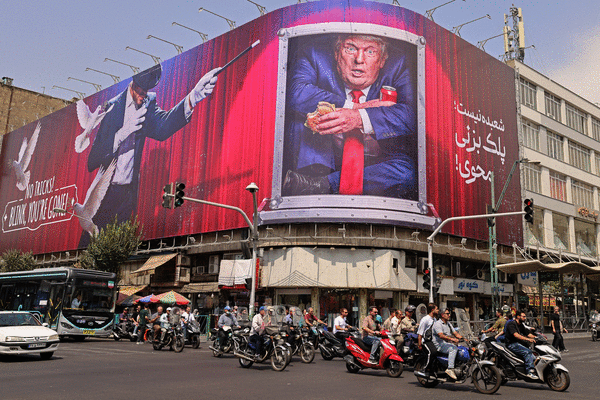
WASHINGTON — President Donald Trump dismissed concerns that the conflict in Iran was draining American firepower as clashes resumed in the on-again off-again hostilities that have stretched more than six months, with neither side willing to restart negotiations to end the war.
“This is a relatively little war for us,” Trump told reporters on Monday. “This is not a big war.”
The president brushed aside criticism of U.S. munitions shortages after months of airstrikes and long-range missile attacks on Iran, saying the U.S. has “tremendous amounts, unlimited amounts of mid-grade and older” munitions and that “we’re only talking about what we call the elite, the elite stuff — and even that we’re in very good shape, but we can always take from other sources.”
The president’s comments came as the U.S. and Iran exchanged strikes for the first time in about a month. American forces hit an island in the Strait of Hormuz and the Islamic Republic responded by launching attacks on the United Arab Emirates and Jordan. Earlier on Monday, Trump told Fox News on Monday that the U.S. would respond to Iran’s attacks on U.S. forces.
The incidents underline the high tensions between Washington and Tehran, with the countries still at odds over the status of the Strait of Hormuz. Trump’s comments regarding further U.S. attacks indicate they may be back in a cycle of military escalation that could bring further volatility to energy and stock markets.
Earlier, Iranian media said the country’s authorities seized a bulk carrier near the port of Bandar Abbas in the strait and claimed an oil supertanker trying to go through the waterway was hit by mines early on Monday. U.S. Central Command said in a social media post on Monday that no ships had hit mines in Hormuz.
Central Command, which oversees military operations in the Middle East, said Sunday it fired on Islamic Revolutionary Guard Corps forces in a “limited, precise action” after spotting them preparing to deploy mines into the Strait of Hormuz.
The IRGC retaliated with a missile-and-drone attack on U.S. air bases in Jordan early Monday. Jordan’s military intercepted eight missiles, destroying them before they caused any damage, the Jordan News Agency reported. The UAE’s military also dealt with a drone coming from Iran over the country’s territorial waters and said its forces remain on high alert.
Crude oil prices rose with tensions in the Middle East, with Brent ending the session above $90 a barrel. European natural gas prices increased too.
Several current and former U.S. and Iranian officials have said they expect the conflict to drag on for months, with the sides essentially deadlocked and bouts of fighting puncturing weeks-long lulls in hostilities.
“The state of neither war nor peace cannot be a sustainable solution,” Anwar Gargash, a senior foreign-policy adviser to the UAE’s leadership, said on X soon after the country fended off a drone attack. “What is needed today are realistic and sustainable political solutions that address the political and economic dimensions of the crisis, beginning with overcoming the escalation and returning navigation in the Strait of Hormuz to its normal state.”
The U.S. attack was the first against Iran since late July, as Trump has shifted toward an economic pressure campaign aimed at winning concessions from Tehran. U.S. Treasury Secretary Scott Bessent promised an “economic onslaught” against Iran and its trading partners. That includes China, which buys 90% of Iran’s oil.
Yet the economic squeeze hasn’t been powerful enough yet to convince Supreme Leader Mojtaba Khamenei and hard-liners within the government to accept American demands and allow ships free passage through the Strait of Hormuz.
Countries with ties to Tehran have also so far shrugged off sanctions threats, while Iran analysts and sanctions experts have largely been underwhelmed by early U.S. actions.
Any sustained return to hostilities risks driving up energy costs and stoking inflation, which would unnerve global investors and complicate Republicans’ efforts to retain control of the U.S. Congress in November’s midterm elections. Polls show growing frustration among American voters with the war and Trump’s inability to bring it to an end.
Foreign Minister Abbas Araghchi has said Iran remains open to resuming diplomacy with the U.S., but argued that progress depends on Washington abandoning its pressure campaign.
Iran, in particular, wants the U.S. to lift a blockade of Iranian ports. That operation is preventing Iran from getting its oil onto international markets and importing many vital goods, causing inflation to rise.
Following what he described as “creative discussions” last week with Qatar, a mediator in the conflict, Araghchi said progress “hinges on U.S. understanding of one simple fact: Pressure doesn’t work.”
Bessent said the White House would discuss with allies their plans to stop buying Iranian products, but so far there have been no agreements to do so.
Meanwhile, the Treasury secretary indicated plans to ratchet up economic pressure, telling the Associated Press ahead of the Group of 20 finance ministers meeting in North Carolina that the U.S. would penalize a second bank that does business with Iran this week.
“This is going to be financial violence if we have to,” Bessent said.
_____
(With assistance from Devika Krishna Kumar, Patrick Sykes, Jon Herskovitz, Paul Abelsky, Anand Krishnamoorthy, Akriti Sharma, Onur Ant and Wendy Benjaminson.)
______
©2026 Bloomberg L.P. Visit bloomberg.com. Distributed by Tribune Content Agency, LLC.




Comments