Prominent Cuban American group urges U.S. and Cuba to ease restrictions on aid delivery
Published in News & Features
A prominent Cuban-American group is calling on the Trump administration to carve out broad humanitarian exemptions from U.S. sanctions on Cuba — including for fuel donated by third countries— while pressing the Cuban government to dismantle restrictions that keep aid from reaching Cubans who need it.
In a policy statement released Monday, the Washington-based Cuba Study Group said the island’s humanitarian emergency has reached “an alarming stage,” with chronic blackouts and shortages of fuel, food and medicine straining Cuban families and hobbling the churches, humanitarian organizations and private businesses trying to respond.
Cuba’s government, the group says, bears great responsibility for the structural economic and political failures that left the country so exposed to outside pressure. But it argues the United States bears responsibility for a de facto fuel blockade and other new sanctions policies intended to force political change that have yet to show results while compounding ordinary Cubans’ suffering.
“Humanitarian assistance should never be treated as a bargaining chip,” the statement says. “We urge both governments to act immediately so that sanctions and bureaucratic obstacles no longer impede urgently needed relief for the Cuban people.”
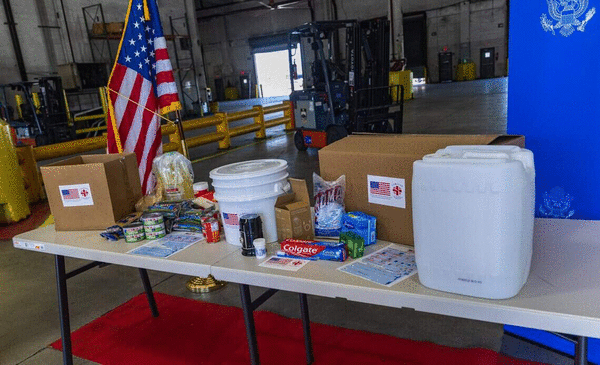
The Trump administration has committed $100 million in humanitarian aid for Cubans on the island, which is being delivered by the Catholic Church, but that remains “woefully insufficient relative to the scale of the island’s needs,” the group said.
The statement stresses that facilitating the flow of humanitarian aid to Cuba is more urgent in light of comments by Secretary of State Marco Rubio suggesting that both military escalation and “a brokered grand bargain” in Cuba are likely off the table for the time being — leaving humanitarian policy as one of the few levers still in play.
The group cautions that the proposed measures would not resolve the underlying causes of Cuba’s crisis, nor substitute for the political and economic reforms needed for lasting recovery. Still, they would help create “more reliable channels for delivering aid.”
Changes in Washington
The group made several recommendations to the U.S. government, all of which it says can be accomplished through executive actions and changes to the regulations implementing the U.S. embargo, without new legislation. They include:
—Allowing fuel donations from third countries “with safeguards against diversion.”
The U.S. government currently allows sales of U.S. oil to Cuba’s private sector, but has discouraged other countries from selling fuel to the Cuban government, threatening tariffs. In March, the administration allowed a Russian tanker to deliver roughly 700,000 barrels of crude that the Cuban government said was a donation from Russia.
The Cuba Study Group said the U.S. government should exempt “bona fide” donations of fuels from third countries and other international actors from U.S. sanctions and secondary economic measures.
“Energy is essential to virtually every humanitarian activity on the island,” the document says. “Hospitals need electricity; water must be pumped; medicines and food require refrigeration; and churches, humanitarian organizations, farmers, private businesses, and transportation providers need fuel to deliver assistance and essential goods.”
To guard against abuse, Ric Herrero, the Cuba Study Group’s executive director, said the U.S could impose secondary sanctions on foreign buyers in case Cuba resells the donated fuel.
“If the concern is that the Cuban government takes the fuel shipments and instead of distributing them to the people who need them on the ground in Cuba, they are reselling them to get their hands on hard currency, the United States could allow the shipments, but then impose secondary sanctions on buyers of any resold fuel,” he said.
The document does not explain how U.S. government controls could prevent the Cuban government from diverting donated humanitarian fuel for other activities inside the country.
—A general license for medical donations.
U.S. sales of medicines and medical equipment to Cuba are currently authorized, as are donations. But the group says the Department of Commerce’s Bureau of Industry and Security currently also requires donors to obtain a specific license for donated medicines, devices, diagnostic equipment and replacement parts. The document said that should be replaced with a broad license exception covering not just the goods but the payments, shipping, insurance, logistics, installation and maintenance required to deliver them.
—U.S. humanitarian aid and fuel reaching Cuban hospitals.
The group calls for expanding U.S.-funded humanitarian assistance to include medicines, medical devices, diagnostic equipment, and other medical supplies. “Such assistance should be permitted to reach Cuban hospitals, clinics, pharmacies, laboratories, and other public health institutions when those institutions are the legitimate end users of the assistance,” the document says.
It also calls for “establishing a narrowly tailored humanitarian exception allowing eligible private-sector importers and distributors to sell light fuel products to state-run hospitals, clinics, and other medical facilities for power generation and other essential needs.”
Given that Cuba’s health-care system is state-run, excluding public health institutions from these authorizations can prevent U.S. humanitarian aid or U.S. fuel bought by private companies legally from reaching the facilities where most Cubans actually receive care.
“Appropriate documentation, end-use verification, and anti-diversion safeguards should remain in place,” to ensure that medicines and fuel supplied under these exceptions are used genuinely for civilian medical purposes.
—A working financial corridor.
The Biden administration authorized Cuban entrepreneurs to open accounts in U.S. banks. Still, a flurry of sanctions, executive orders and Cuba’s listing as a state sponsor of terrorism have deterred U.S. banks from implementing the policy. Given the Cuban private sector’s major role as a food importer, the group wants the Treasury Department to issue clear guidance and safe harbor protections for banks, enabling them to serve authorized Cuban entrepreneurs and other authorized Cuban entities, such as churches and aid groups.
“The objective should be a functioning formal cross-border channel through which humanitarian organizations and independent Cuban businesses can lawfully receive funds, purchase goods and services, and conduct authorized trade,” the document says.
The Cuba Study Group also suggests that the administration appoint a Special Representative for Cuba or another senior official to coordinate implementation of the proposed changes across government agencies. In addition, it urges Washington to publicly recognize the private sector’s role in providing food, transportation and logistics on the island, and to loosen current visa restrictions for independent Cuban actors.
Changes in Havana
The group wants Cuba to allow churches, non-governmental groups and private businesses that support the delivery of assistance to receive, hold, and spend humanitarian funds in dollars or other freely convertible currencies, without being forced to convert them into pesos at an unfavorable exchange rate. They also want the Cuban government to expedite the authorization of independent private-sector financial institutions capable of handling such funds.
The idea is to create a “transparent, protected, and verifiable channel for humanitarian funds through emerging private-sector financial institutions,” according to the document.
The Cuba Study Group also asks Havana to allow churches, private distributors, and other qualified groups handling donations to import goods directly, without routing shipments through state import companies. It also calls on the government to allow them to import, store, and distribute fuel for humanitarian operations without contracting through CUPET, the state oil company —currently under U.S. sanctions — as an intermediary.
The group also asks for simplified customs paperwork, expedited handling for perishables and medicines, and credible safeguards against diversion, favoritism, and political discrimination. And it urges Cuba to allow private businesses to fully deduct documented expenses related to humanitarian work and to create a legal framework for nonprofit or social-purpose private enterprises.
It is unclear whether the recommendations will find receptive ears in Washington and Havana, despite the deplorable situation the population faces. Negotiations between the two countries are at a standstill. Rubio has said the Trump administration will continue imposing sanctions on Cuban government and military entities for the near future, and the Cuban-handpicked president Miguel Díaz-Canel has vowed to resist.
©2026 Miami Herald. Visit at miamiherald.com. Distributed by Tribune Content Agency, LLC.






Comments