Editorial: Israel's victories aren't bringing it closer to peace
Published in Op Eds
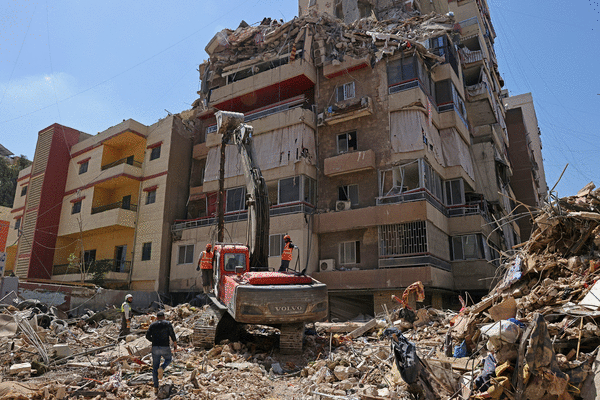
Since the brutal Oct. 7 Hamas attacks in 2023, Israel has won a series of remarkable tactical victories against its enemies. If it continues to foreclose any pathway to peace with the Palestinians, though, it’s going to find itself without friends.
Israeli forces adopted an aggressive new posture after Oct. 7, aiming to eliminate threats they had previously sought to contain. Their assaults wiped out the top leadership of Hamas, Hezbollah and Iran, and contributed to the fall of Syrian dictator Bashar al-Assad. In waves of strikes last June and this spring, the U.S. and Israel buried Iranian nuclear facilities in rubble; destroyed hundreds of ballistic missiles and launchers; sunk most of the regular Iranian navy; and gravely damaged key industrial assets. Israel has seized swaths of Gaza, Syria and southern Lebanon as buffer zones against future attacks.
Proponents claim this strategy has left Israel stronger than ever. The Jewish state has shown the U.S. how capable an ally it is, sharing intelligence and fighting alongside the world’s most powerful military. Persian Gulf nations should now see that they’re better off partnering with the U.S. and Israel than trying to placate the Islamic Republic. Even some Iranian civilians might appreciate that their erstwhile enemy took on regime forces that only weeks earlier had slaughtered thousands of peaceful protesters.
Yet all these “wins” risk adding up to strategic defeat. Hamas remains entrenched in Gaza. An extended occupation in Lebanon isn’t likely to turn out better than previous quagmires. Decapitation strikes appear to have brought a more hard-line regime to power in Tehran, still in possession of most of its missile arsenal and almost 1,000 pounds of near-weapons-grade uranium.
Most important, Israeli leaders haven’t translated tactical victories into diplomatic agreements that would preserve the country’s long-term security. To the contrary, far-right ministers have infuriated Arab governments with their dismissive attitude — at best — to Palestinian civilian deaths and suffering in Gaza. And they’ve accelerated efforts to expand control over territory that Palestinians envision as the heart of a future state.
Prime Minister Benjamin Netanyahu’s government has approved new housing units in the West Bank at a furious pace and fast-tracked development of a particularly controversial corridor that would divide Palestinian-controlled areas in two. Since last May, the government has withheld customs and tax revenue owed to the Palestinian Authority, crimping its ability to pay salaries and maintain public services. Meanwhile, Israeli security forces have done little to restrain Jewish extremists who have assaulted Palestinians, more than 1,000 of whom have been killed since 2023.
Rising impunity has deeply angered European leaders, who recently debated suspending their association agreement with Israel, and upended hopes of normalization with Saudi Arabia. Shockingly, as many Americans now sympathize with the Palestinians as they do Israel — a divide that yawns even wider among Democrats and younger voters.
Losing American support would be devastating to Israeli security, far outweighing any temporary gains. Although Netanyahu’s government is unlikely to shift course before elections due this fall, the U.S. should make clear that its creeping annexation of the West Bank is both shortsighted and unacceptable. Whichever government comes to power next ought to enforce the law equally, detaining and prosecuting settlers and soldiers suspected of attacks against Palestinians (including Palestinian Americans). It should also begin to restore the flow of funds to the Palestinian Authority, halt the expansion of settlements and seizures of Palestinian land, and strive for more durable rapprochements with Lebanon and Syria.
If Israel wants to remain both Jewish and democratic, it can’t continue along this path. Endless war is taking a dangerous toll on its military and economy, while its approach to the Palestinians erodes its moral and diplomatic standing. It’s time the country’s leaders put more thought into making peace.
____
The Editorial Board publishes the views of the editors across a range of national and global affairs.
©2026 Bloomberg L.P. Visit bloomberg.com/opinion. Distributed by Tribune Content Agency, LLC.





















































Comments