The 10-Foot World: How Animals Experience Space Differently
Published in Cats & Dogs News
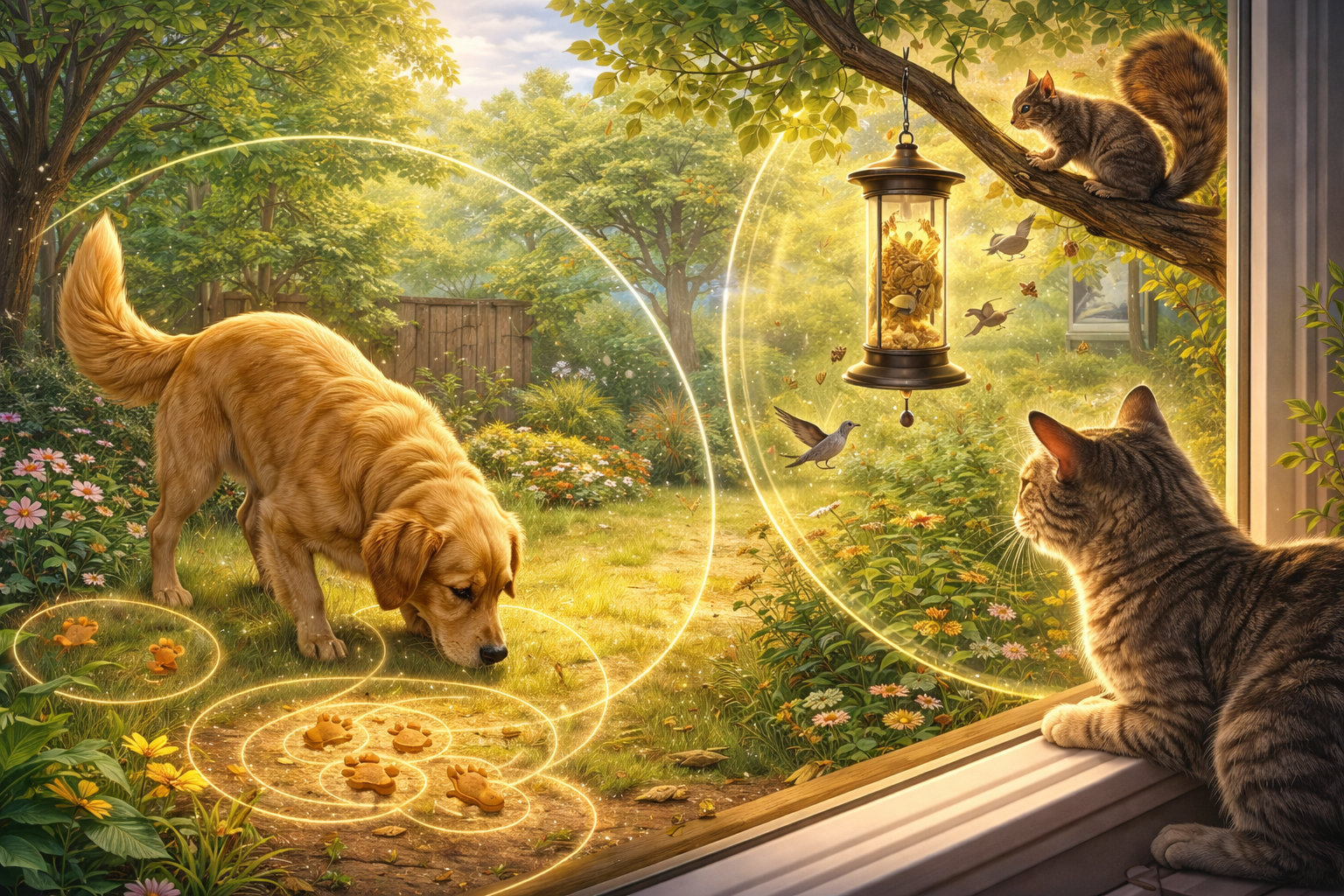
In a suburban backyard, a dog pauses halfway down the walkway, nose hovering just above the grass. To a human, it’s a brief hesitation—nothing more than a distraction before continuing the walk. But to the dog, that patch of ground is dense with information: who passed by, how long ago, whether they were anxious, confident, or in a hurry. It is, in a meaningful sense, a conversation already underway.
We tend to think of animals as living in the same spaces we do—yards, rooms, sidewalks—just with different priorities. But many animals, especially our companion pets, experience the world at a radically different scale. Their reality is not defined by neighborhoods or even rooms, but by a shifting, detailed bubble roughly ten feet in every direction. Within that radius, the world is vivid, layered, and alive with signals humans barely register.
The Radius of Attention
For humans, attention often stretches outward. We look across rooms, down streets, toward horizons. Our visual system privileges distance, organizing space in broad, navigable chunks. Animals, particularly dogs and cats, operate differently. Their focus is intensely local, anchored to what is immediately around them.
A dog on a walk is not primarily concerned with the destination. Instead, each step reveals a new cluster of scents, textures, and micro-changes in terrain. The “ten-foot world” is not a fixed boundary, but a moving sphere of relevance. As the dog advances, the sphere advances with it, constantly refreshing with new information.
Cats, especially indoor ones, exhibit a similar pattern. From a windowsill, a cat may watch a bird feeder with unwavering intensity—not because the entire yard matters, but because a very specific zone within view is active. A rustle in a bush five feet away can command total attention, while a passing car across the street barely registers.
This localized attention is not a limitation. It is a specialization. Within that small radius, animals perceive far more detail than humans do.
A World Written in Scent
For dogs, the ten-foot world is not primarily visual at all. It is olfactory—a constantly updating map composed of scent layers that overlap in time and space. What appears to us as a uniform stretch of grass is, to a dog, a dense archive of recent activity.
A single patch of ground may contain:
* The path of another dog from an hour ago * The lingering trace of a human who paused briefly * The faint, older scent of a nocturnal animal passing through at dawn
Each of these layers carries information about identity, mood, and movement. Dogs do not simply detect these scents; they interpret them. The ground becomes a narrative surface, and the dog, nose down, is reading it fluently.
This is why a dog may stop abruptly at a seemingly unremarkable spot. To the human, nothing has changed. To the dog, the story has shifted dramatically.
Vertical Space and the Cat’s Domain
While dogs map the horizontal plane in detail, cats expand their ten-foot world vertically. Shelves, countertops, and window ledges are not separate spaces but extensions of a single, continuous environment.
A cat perched on the back of a couch is not merely resting. It is occupying a vantage point within its immediate sphere, monitoring movement below and around it. The vertical dimension allows cats to layer their attention, keeping track of multiple zones at once within that same ten-foot radius.
This vertical awareness also explains behaviors that can puzzle owners. A cat may ignore a toy on the floor but become instantly engaged if the same object is lifted or dangled. Movement within the vertical plane activates a different kind of attention, tapping into instincts tied to both hunting and safety.
In the cat’s world, height is not optional—it is integral.
Time, Movement, and Micro-Change
Within the ten-foot world, time is experienced differently as well. Animals are highly attuned to micro-changes: a leaf shifting position, a new scent appearing, a subtle alteration in sound.
These changes, often imperceptible to humans, are significant events within the animal’s immediate environment. A dog may return to the same spot multiple times during a walk, not out of confusion, but because the information there has updated. Something new has occurred, and it must be checked again.
Similarly, a cat may stare intently at an area where nothing appears to be happening. In reality, the cat is tracking minute movements or sounds—perhaps an insect behind a wall or the faint rustle of something outside.
The ten-foot world is not static. It is dynamic, constantly rewriting itself in small but meaningful ways.
Why Rain Changes Everything
Weather, particularly rain, dramatically reshapes this localized experience. For dogs, rain can blur or erase scent trails, flattening the rich olfactory landscape into something less readable. A yard that was full of information the day before may suddenly feel empty or confusing.
This helps explain why some dogs are reluctant to walk in the rain. It is not simply discomfort with getting wet. The world itself has changed, and not for the better. The stories they rely on to navigate their environment have been washed away.
Conversely, after a light rain followed by clearing skies, the scent world can become newly vivid. Moisture can intensify certain smells, briefly enriching the dog’s immediate surroundings.
Cats, too, respond to these shifts, though often from the safety of indoors. Rain alters sound patterns, dampens movement, and changes the behavior of birds and small animals. The familiar ten-foot zones a cat monitors from a window may suddenly behave in unfamiliar ways.
Living Alongside a Different World
Understanding the ten-foot world invites a shift in how we interpret animal behavior. What might seem like stubbornness, distraction, or even laziness often reflects a deeper engagement with an environment we do not fully perceive.
A dog lingering at a mailbox is not delaying the walk; it is gathering information. A cat fixated on a corner of the room is not bored; it is tracking something subtle and significant. These behaviors make sense once we recognize that animals are not experiencing the broader space we see, but a richly detailed slice of it.
For pet owners, this perspective can change daily routines. Walks become less about distance and more about exploration. Indoor spaces can be enriched by adding vertical options for cats or varied textures and scents for dogs. Even simply allowing an animal the time to investigate its surroundings acknowledges the importance of its sensory world.
Ultimately, the ten-foot world is a reminder that perception shapes reality. Animals are not living in a diminished version of our environment. They are inhabiting a different one—closer, denser, and far more immediate.
And within that small, shifting radius, there is more happening than we will ever fully see.
========
Larkin Hale is a contributing features writer focusing on human-animal relationships and everyday behavioral insights. They explore how small observations can reshape how we understand the lives of pets. This article was written, in part, utilizing AI tools.








Comments