The Silent Contract: How Cats Train Us Without Saying a Word
Published in Cats & Dogs News
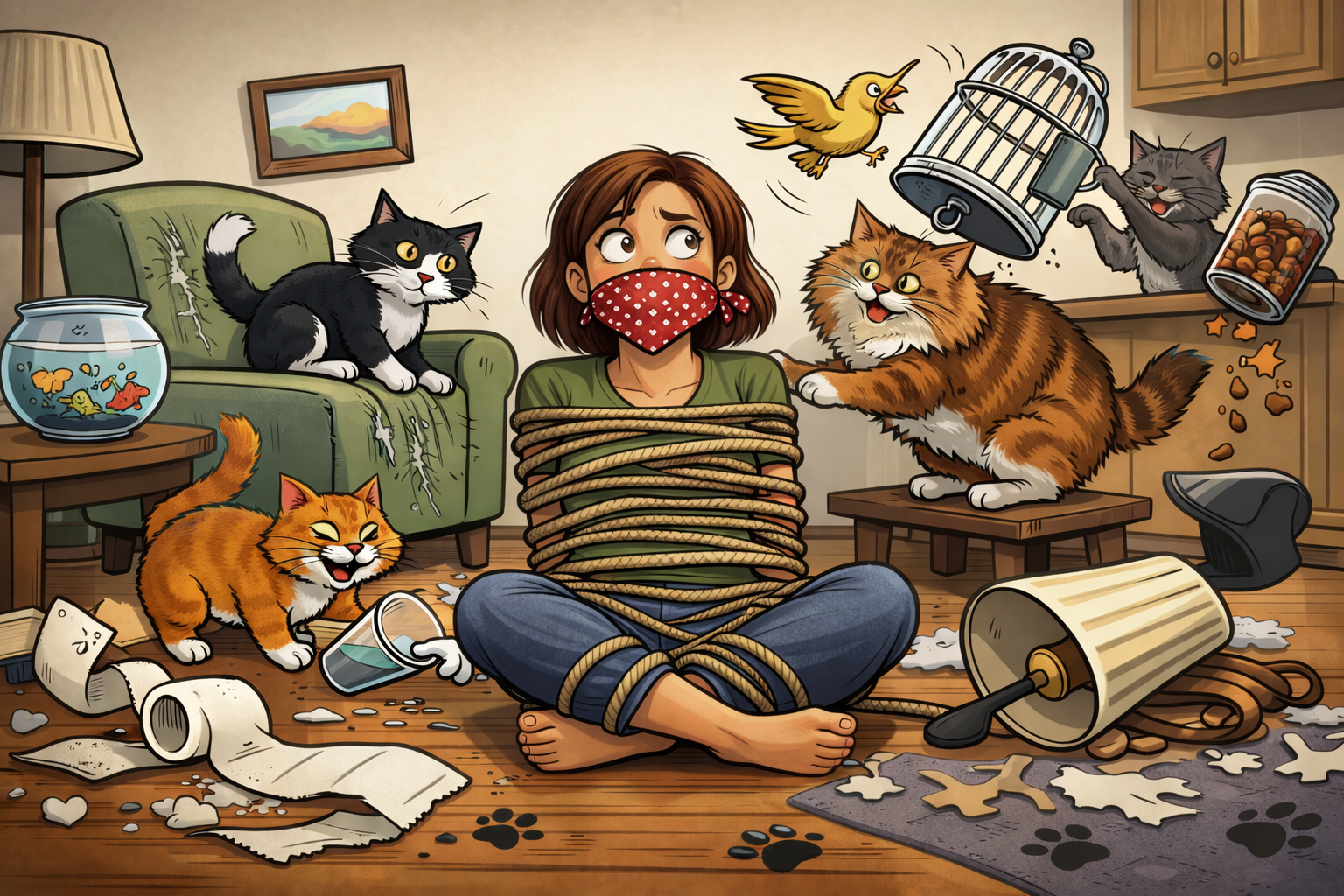
Cats do not announce their intentions. They do not call meetings, issue commands, or negotiate terms. And yet, within days of arriving in a home, they establish a quiet system of expectations so consistent and so effective that most people eventually find themselves living by it.
No one remembers the exact moment it begins. Perhaps it’s the first time you shift slightly so as not to disturb a sleeping cat. Or the first time you adjust your schedule—just a little—to accommodate feeding, or a preferred resting place. What feels like kindness, or flexibility, or even coincidence, slowly accumulates into something more structured.
Over time, it becomes clear: there is an agreement in place. Unspoken, unwritten—and entirely binding.
The Chair Is Not Yours
It often starts with furniture. A chair, a cushion, a particular corner of the couch. A cat selects a spot, returns to it repeatedly, and in doing so, transforms it. The object is no longer neutral. It has been claimed.
The human response is almost always subtle. You hesitate before sitting. You check first. If the cat is already there, you choose another place. If not, you may still feel a faint sense that you are borrowing the space rather than owning it.
In households with multiple cats, this becomes a layered system of territories. One favors the back of the couch, another the sunlit rug, another a chair that was never especially comfortable until it became unavailable. These claims are rarely contested outright. Instead, they are reinforced through repetition and quiet acceptance.
The remarkable part is how quickly humans adapt. There is no resistance, no formal acknowledgment—only a gradual recalibration of what belongs to whom.
Time Is a Suggestion (Except Feeding Time)
Cats exist outside of human timekeeping, except when they don’t. For most of the day, they appear indifferent to schedules. They sleep, wander, observe, and disappear into routines that seem self-contained.
But introduce a consistent feeding time—even once—and a shift occurs.
What began as convenience becomes expectation. A meal served at six in the evening is not interpreted as a one-time event. It is recorded, internalized, and enforced. The cat appears at 5:58 the next day. Then 5:55. Then earlier still, just to ensure nothing has been forgotten.
The enforcement mechanisms are varied: quiet staring, strategic positioning, a soft but persistent vocalization. None of it is aggressive. All of it is effective.
Humans, for their part, begin to plan around it. “We should be back by six,” becomes a real constraint. Not because anyone insisted on it—but because the alternative feels like a breach of something understood.
Affection on Their Terms
Cats are often described as aloof, but this misses the point. They are not withholding affection; they are defining its conditions.
A cat will approach when it chooses, settle where it prefers, and leave without explanation. The human role is not to initiate but to respond. Attempts to reverse this dynamic—unsolicited handling, prolonged attention—are typically met with gentle correction.
A shift of the body. A flick of the tail. A departure.
Over time, humans learn the cues. They begin to wait for the invitation. They become attentive to mood, posture, and timing. When affection is offered, it feels earned—not because it was difficult, but because it was not guaranteed.
This asymmetry creates a curious effect. The very lack of control increases the perceived value of the interaction. A cat choosing to sit beside you carries more weight than one that could be summoned at will.
The Night Shift
If daytime interactions are governed by quiet negotiation, nighttime introduces a different layer of the contract. Cats, particularly in multi-cat households, maintain an awareness of the home that extends beyond human sleep cycles.
A soft step across the bed. A brief pause near the head. A moment of observation. Sometimes a gentle nudge—just enough to confirm presence.
Respond once—speak, move, acknowledge—and the interaction may repeat the following night. Not as a demand, exactly, but as a possibility that has been established.
Humans often describe this as disruption. But just as often, they adjust. A repositioned pillow, a slightly lighter sleep, an acceptance that the night is shared space as well.
There is, again, no formal agreement. Only a pattern, and the willingness to accommodate it.
Why We Agree Anyway
From a purely rational perspective, the arrangement is uneven. Cats dictate terms they never articulate, enforce expectations without escalation, and reshape environments without permission.
And yet, most people do not resist. In fact, they lean into it.
Part of the answer lies in the nature of the exchange. Cats do not offer obedience, but they offer presence. They are there—not constantly, not predictably—but in a way that feels chosen rather than obligated.
That choice matters.
When a cat settles into a room, observes quietly, or decides to rest nearby, it creates a sense of shared space that is not transactional. There is no performance, no requirement to engage. Just coexistence.
In homes with multiple cats, this becomes a kind of layered companionship. Each animal operates independently, yet contributes to a broader sense of life within the space. One may be affectionate, another distant, another curious. Together, they form a dynamic that is both structured and fluid.
Humans, in turn, find themselves participating in that structure. Not as managers, but as members.
The contract, if it can be called that, is not enforced through dominance or submission. It is maintained through consistency, repetition, and a quiet mutual understanding. Cats establish the terms, but humans uphold them willingly.
Not because they have to.
Because, at some point, they decided it was worth it.
========
Leland P. Crowther is a Virginia-based writer focusing on domestic life, animal behavior, and the quiet negotiations that shape everyday routines. His work explores the intersection of humor and observation in modern households. This article was written, in part, utilizing AI tools.







Comments