The Dinner Clock: How Your Pets Always Know It’s Time (And Why They’re Never Wrong)
Published in Cats & Dogs News
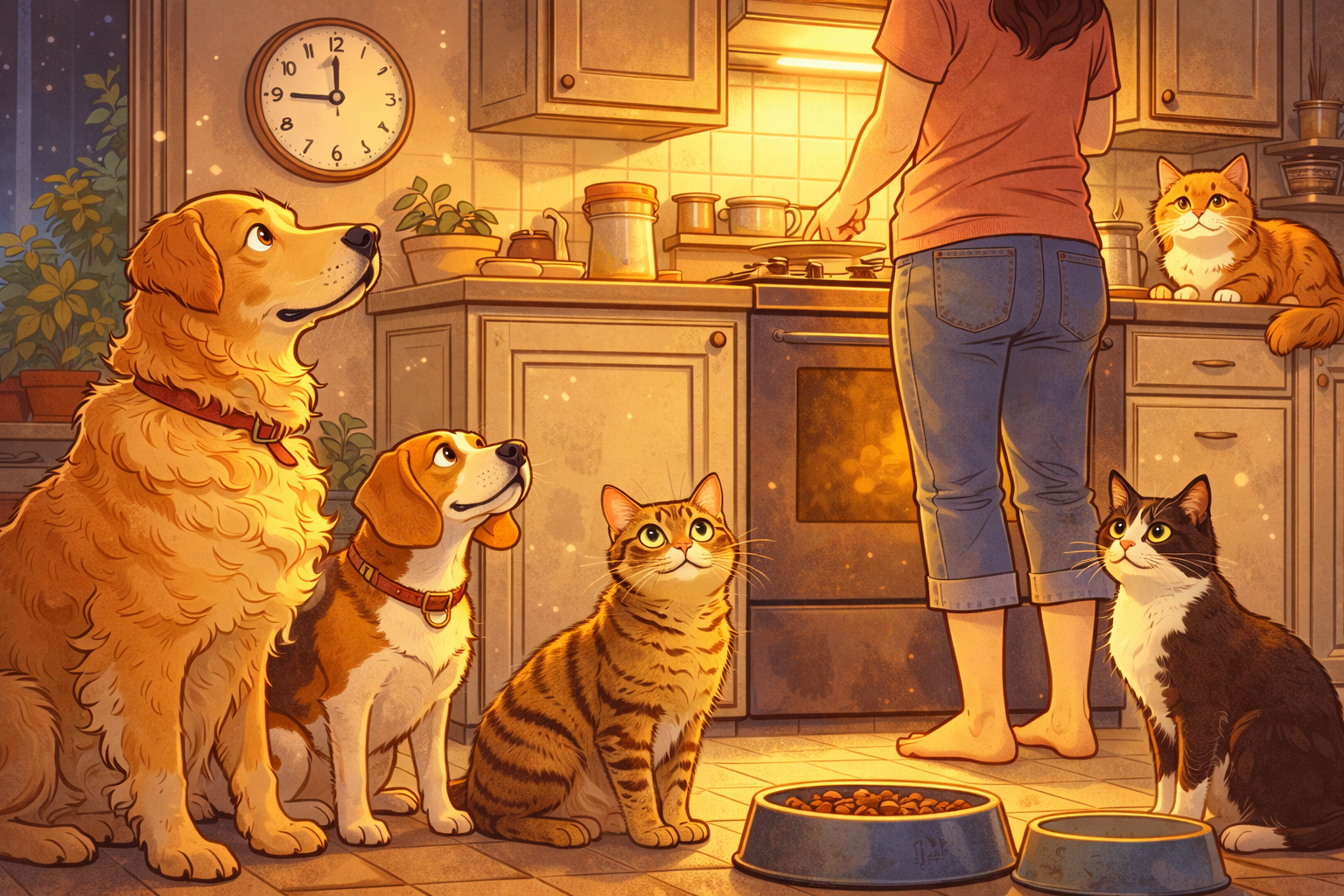
The first sign is rarely dramatic. A dog lifts its head from a nap a few minutes earlier than usual. A cat relocates from a sunbeam to a spot with a better line of sight to the kitchen. Nothing urgent, nothing loud—just a quiet adjustment, as if an internal switch has flipped. Then, slowly, the atmosphere shifts. A presence gathers. Eyes follow. Footsteps begin to shadow your own. And somewhere between “it can’t be that time already” and “fine, I’ll check the clock,” you realize the truth: your pets know exactly when it’s dinner.
They know it with a confidence that borders on defiance. It doesn’t matter if you’ve been busy, distracted, or convinced you still have another half hour. They have already arrived at the appointed moment, and they expect you to catch up. This uncanny timing, often dismissed as routine or coincidence, is something closer to a finely tuned biological and behavioral system—one that blends instinct, memory, and a remarkable sensitivity to human patterns.
Built-In Timekeepers
At the core of the “dinner clock” is a biological reality. Like humans, dogs and cats operate on circadian rhythms—internal cycles that regulate sleep, wakefulness, and metabolic processes over a roughly 24-hour period. Feeding becomes one of the strongest anchors in that cycle. When meals are served at consistent times, the body begins to anticipate them, triggering hunger signals and behavioral readiness even before food appears.
This anticipation is not vague. Studies of animal behavior have shown that regular feeding schedules can entrain physiological responses, including hormone release and digestive preparation. In simpler terms, your pet’s body is literally preparing for dinner before you’ve even reached for the bowl. The result is a creature that doesn’t just want food—it expects it, right on schedule.
The Power of Routine
But biology alone doesn’t explain the precision. That’s where routine comes in. Pets are extraordinarily good at recognizing patterns, especially when those patterns lead to something rewarding. Over time, they build a detailed map of your daily habits: when you get up, when you sit down, when you move toward the kitchen, when the light changes in the room.
To a human, these details blur into the background. To a dog or cat, they are signals—clear, repeatable, and meaningful. The clink of a coffee mug, the shutting of a laptop, the shift in your posture as you stand: all of these can become markers along the path to dinner. Your pet isn’t reading the clock. It’s reading you.
And, crucially, it’s reading you better than you read yourself. Where you see a flexible schedule, your pet sees a sequence. Where you think, “I’ll feed them in a bit,” your pet thinks, “You are three steps behind.”
Accidental Training
If pets are so good at knowing dinner time, it’s partly because we’ve taught them—often without realizing it. Every time you give in a little early, every time you respond to a hopeful stare or a well-timed nudge, you reinforce the idea that persistence works. What begins as a fixed feeding time can slowly creep earlier, not through rebellion, but through negotiation.
Dogs, in particular, excel at this. They escalate gradually: a glance becomes a sit, a sit becomes a nudge, a nudge becomes a quiet whine. Each step is calibrated, each response noted. Cats take a different approach. They begin with silent judgment, then transition—sometimes abruptly—into direct action: a paw on your arm, a sudden sprint across the room, the unmistakable sound of something being knocked off a surface.
In both cases, the message is the same: dinner is not just expected, it is overdue. And if you respond—if you feed them even five minutes early—you’ve shifted the baseline. Tomorrow, that earlier time becomes the new “correct” one.
Different Species, Same Certainty
While both dogs and cats possess this remarkable sense of timing, they express it in distinct ways. Dogs tend to externalize their anticipation. They hover, they follow, they position themselves strategically between you and the food source. Their behavior is collaborative, almost hopeful: a shared understanding that dinner is a joint project you’ve momentarily forgotten.
Cats, by contrast, operate with an air of inevitability. They do not ask so much as inform. Their presence becomes increasingly deliberate, their gaze more fixed. If ignored, they escalate—not out of anxiety, but out of certainty. Dinner is happening. The only question is how long you intend to delay the obvious.
Yet beneath these differences lies the same mechanism: a blend of biological rhythm and learned pattern, sharpened by daily repetition.
Why They’re (Almost) Never Wrong
Perhaps the most striking aspect of the dinner clock is how often it aligns with reality. Even when it feels early, your pet is usually responding to a subtle shift you haven’t consciously registered. The light outside has changed. Your activity level has slowed. The household has entered a phase that, in their experience, precedes food.
In this sense, your pet’s timing is not guesswork—it’s inference. A conclusion drawn from hundreds of previous evenings, each one reinforcing the connection between certain cues and the arrival of dinner. When they act, they’re not hoping. They’re predicting.
And more often than not, they’re right.
The Human Adjustment
Living with a pet means, in part, adjusting to this alternate sense of time. You begin to notice the cues they notice. You anticipate the moment before they act. Or you find yourself negotiating, trying to hold the line against a creature that has no doubt it is on schedule and you are not.
Over time, a kind of détente emerges. You feed them within a window, they accept a small delay, and both sides maintain the illusion of control. But beneath it all is a quiet understanding: the dinner clock belongs to them.
They set it. They monitor it. And when it’s time, they will remind you.
There is something grounding in that certainty. In a world of shifting schedules and flexible plans, your pet offers a fixed point—a daily ritual that arrives with unwavering precision. You may think you’re the one keeping time, but as any attentive owner learns, the truth runs in the other direction.
Dinner happens when they say it does.
========
Marlowe Finch is a staff writer covering animal behavior and the quiet rituals of domestic life. Their work explores the intersection of science, habit, and the everyday bonds between people and pets.
This article was written, in part, utilizing AI tools.








Comments